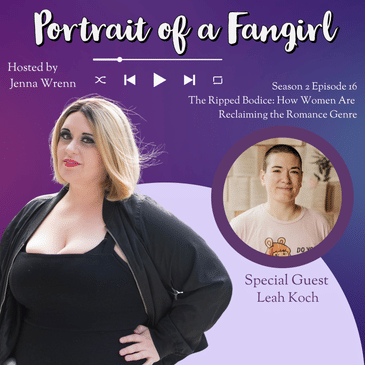
Leah Koch and her sister Bea, fueled by their passion for romance novels and fandom, brought their dream to life with The Ripped Bodice.
The post The Ripped Bodice: How Women are Reclaiming the Romance Genre appeared first on TEMPLE OF GEEK.
[00:00:02] The Ripped Bodice, Podcast Archives, and TEMPLE OF GEEK
[00:00:05] The Girl is a web series and podcast created by Temple of GEEK. At the core of the project
[00:00:15] is the importance of telling the stories of women who have found inspiration, growth,
[00:00:19] and power through fandom. My name is Jenna Ren and I'm the host of the Portrait of a
[00:00:23] Fan Girl podcast. Today I have the pleasure of talking to the owner of the romance
[00:00:28] bookstore, The Ripped Bodice, Leah Koch. Hi Leah, how are you?
[00:00:32] Hello, thank you for having me. I'm very good. Thank you for being here. Oh, I'm doing
[00:00:37] wonderful. Very excited to talk to you. So can you please just introduce yourself to
[00:00:43] our audience and tell them a little bit about who you are? Sure, my name is Leah
[00:00:48] and I am one of the owners of The Ripped Bodice bookstore. We are a romance
[00:00:55] only bookstore. We were the first one in the country when we opened a little
[00:00:59] over eight years ago and we now have two locations. Our original location is in
[00:01:04] Los Angeles and we opened in Brooklyn, New York in August of this year. So we are
[00:01:10] now by coastal. The other owner is my sister I should mention and we
[00:01:15] specialize in the celebration of romance novels. So we sell every single
[00:01:21] romance novel type that you could possibly think of. We probably have it
[00:01:25] and
[00:01:28] that is what we love to do and we love meeting readers and writers from all
[00:01:36] over the country.
[00:01:37] Wonderful, very it's such an interesting concept, the all romance bookstore
[00:01:41] and that's really what caught my attention. It's unique. It's a unique
[00:01:45] thing. You don't see it.
[00:01:47] So when we opened, we were the first one in the United States. Actually
[00:01:51] the Northern Hemisphere. There was one in Australia.
[00:01:54] At the time that we opened and then we were alone for a while and then it
[00:02:00] was it was there were there was maybe one or two other ones for again, a
[00:02:04] while pretty much up to the pandemic. But since the pandemic, there's been
[00:02:07] like eight open in the past year or something crazy like that. So that's
[00:02:13] really spreading across the country.
[00:02:18] But we were we were the first ones crazy enough to do that.
[00:02:23] Take that step. Well, I know I will get I will get distracted because I
[00:02:26] want to talk all about your bookstore, but we're going to save it for a
[00:02:28] little bit later.
[00:02:30] So I just want to ask you first that something we always ask our
[00:02:34] guests is how they view the term fangirl and what being a fangirl
[00:02:38] means to them. So for you, how do you view the term fangirl?
[00:02:42] Okay, well, I'm like a very literal linguistic person. So let's let's
[00:02:46] think about definitions here. Let's go with person who enjoys
[00:02:50] something. Girl, gender expansive definition. So let's go with
[00:02:58] gender expansive women who enjoy things as my personal
[00:03:02] definition.
[00:03:03] Yeah, I notice it's become quite a what sort of looking for
[00:03:08] like a non gendered term to because anyone can fangirl anyone
[00:03:13] can be a fangirl of something.
[00:03:15] Well, because then fangirl is like a verb too, you know, it's
[00:03:18] like an action to to sort of like a moat over something. And I
[00:03:23] just think language in general is getting less gendered, which
[00:03:25] is great. Yeah, I think what was the second part of the
[00:03:28] question? Like what what does it mean to you or
[00:03:31] Yeah, has that term changed over time since you've grown?
[00:03:36] Yes, definitely. I think it's interesting. I I have no idea
[00:03:41] how old you are, but I feel like the trajectory of my sort of
[00:03:47] solid middle millennials, which is what I am. Yeah, me too.
[00:03:52] Is has is very much like a public consciousness of liking
[00:04:01] things, which is not to say obviously that older people
[00:04:05] don't like things. I just feel like during my lifetime, there
[00:04:10] has been like a much more probably the internet obviously is
[00:04:14] what it is. But I just feel like it's been it becomes like a
[00:04:19] much larger part of your personal life for your leisure
[00:04:25] time. Like, okay, yes, as I'm saying this out loud, like,
[00:04:30] duh, it's the internet. So like, you know, I got Facebook when
[00:04:34] I was in like, I want to say middle school. And then I think
[00:04:38] I got a cell phone. I don't know. It's probably like 16
[00:04:41] maybe I don't know. I grew up in the big city. But it just
[00:04:45] like reinforce this idea that like, whatever you are into
[00:04:50] there are people all over the world who are probably into
[00:04:52] that too. And now you can talk to them. Right. And I
[00:04:56] think as I have grown up, there've been a lot of discussions
[00:05:01] about, especially things that women like. And this is like
[00:05:06] kind of my whole job. I sell a traditionally denigrated thing.
[00:05:11] Yeah. And we can talk more about that. But you know, whether
[00:05:15] it's music or movies or, you know, it was like one
[00:05:18] direction became really popular when I was like, I don't
[00:05:22] know, 1415 somebody fact check me. I was like a little it was
[00:05:27] like, it wasn't really my thing. But it it became this thing. And
[00:05:31] then there was all these articles about like, you know, people
[00:05:35] don't like it because their fans are young girls. And that
[00:05:40] cycle like repeats itself all the time. Like we went through
[00:05:43] that same cycle with 50 shades of gray except it was
[00:05:45] older women like, sorry, I'm rambling. But no, it's true.
[00:05:50] There's like it's almost slightly stigmatized the things that
[00:05:54] women really get hyped over. Oh, not slightly.
[00:05:58] Slightly. Yeah, very much. Like I think of a Twilight Twilight
[00:06:02] series and that became huge. Yeah.
[00:06:04] Exactly. Right. You like compare. Yes. 100%. I have always
[00:06:09] prided myself on liking things with enthusiasm. And you
[00:06:16] know, I feel like when I was in high school, there was like
[00:06:18] you know, it's cool to care kind of movement because like, you
[00:06:22] know, teenagers were like, I don't care about anything. What was
[00:06:27] the first moment you really found yourself fangirling over
[00:06:30] something?
[00:06:31] Gosh, I'm trying to cast my mind back. You know, it's I'm
[00:06:38] sure you hear this all the time and we don't have to dwell on
[00:06:41] it very long. But you know, it was Harry Potter and
[00:06:43] that's disappointing now as a member of the queer community.
[00:06:47] It's like fairly devastating. But but you know, I don't want to
[00:06:52] lose the you know, nice memories and you know, especially
[00:06:56] those memories were going to bookstores for midnight releases.
[00:07:00] Right. And now I own a bookstore and we have midnight
[00:07:03] releases for adults. So that's fun. After that, gosh, oh,
[00:07:10] actually, it was the Chicago Cubs. Really? Yeah, I am from
[00:07:17] Chicago. And brief baseball history lesson. The Chicago Cubs
[00:07:22] are generally really, really, really bad. And we're really,
[00:07:26] really bad for like a century kind of famously. And then a while
[00:07:33] ago now, we had a couple year we finally got good. And then we
[00:07:38] finally made it to the World Series and we finally won.
[00:07:41] And it was like, I like sports, but I it was like genuinely we
[00:07:49] were like running down our street with Chicago flags. Like
[00:07:52] it was very exciting.
[00:07:55] So much fun. Yeah. And I think that was also like, you know,
[00:07:59] the cool thing about sports is like, you know, you get
[00:08:02] invested for a season. This was actually, I think it was like
[00:08:05] one of the first two years that the store was open. And so I
[00:08:09] didn't have any employees. And I literally would like put on the
[00:08:14] Cubs game almost every day, because they play like freaking
[00:08:16] every day for four hours. While I was like, you know, shelving
[00:08:20] books or whatever. Yeah, I think that's that's a that's a good
[00:08:25] fandom run.
[00:08:26] Yeah, it's interesting, because that has come up in a few
[00:08:29] interviews I've done that sports is a fandom as well. And
[00:08:32] it's a really, I guess you don't necessarily think of it
[00:08:34] right away. At least for me, because I think, you know,
[00:08:37] fandom, I think of like nerdy things. But sports is
[00:08:40] legitimately a fan of fandom too.
[00:08:43] Yeah. And it's been it's been something like so I think I I
[00:08:47] felt very like not included. I was like, there is no place for
[00:08:52] me to watch football baseball like men's sports. And then
[00:08:58] like, you know, when I became more immersed in the queer
[00:09:02] community, I was like, Oh my god, women's sports, this is
[00:09:05] great.
[00:09:07] So I'm like a huge women's soccer fan. And I just watched the
[00:09:12] women's March Madness this weekend. And I love the
[00:09:17] Olympics, the Olympics are like my most favorite time of
[00:09:21] year. I like watch everything. And I like love all the
[00:09:26] human interest stories.
[00:09:27] It's every every time it comes along, it's I forget how
[00:09:30] much I love it. And then the Olympics start and I'm
[00:09:32] like, Oh boy, right back to the beginning again.
[00:09:35] It's all right. I like literally block out of my
[00:09:38] calendar. I'm like, do not I just want to sit for the TV for
[00:09:41] six hours and watch Javelin and forgetting like, I like the
[00:09:46] obscure sports like canoeing. And it's trampoline. I love
[00:09:51] trampoline. Oh, it's so I loved. Oh my gosh, why am I
[00:09:55] blanking?
[00:09:56] Curling curling was so good.
[00:09:59] I mean, it's like you're an expert in 15 minutes. I
[00:10:03] think about curling.
[00:10:04] Yeah, nothing.
[00:10:06] After it. So there's Summer Olympics this summer and then
[00:10:09] the next Summer Olympics are in Los Angeles where I have
[00:10:12] sore. So I'm really excited about that.
[00:10:16] That's gonna be a lot of fun. You know, I look forward
[00:10:18] to seeing if you do anything like themed for it. That
[00:10:20] would be fun. Yeah. I mean, yes, you can also look on
[00:10:24] our Instagram the last Summer Olympics 20. Well, it was
[00:10:28] supposed to be 2020 but then it was 2021. I did a whole
[00:10:31] Olympics themed window display. And I was very proud of it.
[00:10:36] Love that. That's so much fun because you can embrace your
[00:10:39] fandom at your store. That's really fun to do.
[00:10:42] I can do whatever I want. So it was only women and it was
[00:10:45] like all my favorite female athletes. And I had all these
[00:10:49] like big cutouts. I think they were like, we had a lot
[00:10:52] was like 1215 or something and I did not have room to
[00:10:55] store those. So then I gave them to the local middle
[00:10:57] school for them to display or do whatever they want.
[00:11:03] That's a lot of fun. Oh my God, the kids probably love that.
[00:11:05] That's a cool thing. So I want to get into talking about
[00:11:08] your bookstore. You have as you mentioned two bookstores
[00:11:11] one in California and one New York both called the
[00:11:14] ripped bodice. And I came across your shop on social
[00:11:17] media and it caught my attention immediately. Like
[00:11:20] I had mentioned there's really not many other stores
[00:11:24] out there like yours. So the idea of an all romance
[00:11:27] bookstore where people can be completely open and
[00:11:31] fangirl over a specific genre is really welcoming.
[00:11:35] So can you tell me a bit about the history of the shop
[00:11:37] and how you and your sister took it from an idea
[00:11:41] into reality? So her name is B and way back
[00:11:46] in 2015 we were both finishing educational
[00:11:52] experiences. So I was finishing my undergraduate
[00:11:55] in college and she was finishing her graduate
[00:11:58] degree and we had both done a very classic
[00:12:02] decide that the career path that we were interested
[00:12:05] in was actually not what we wanted to do.
[00:12:08] It happens. Yeah, it happens.
[00:12:11] And and we were both like facing this moment of like
[00:12:14] well OK now what?
[00:12:17] And we were really like we were really just talking
[00:12:20] one day, you know, sort of like is there a is
[00:12:24] there a dream job that we can design for ourselves?
[00:12:28] You know, it was really important to me.
[00:12:30] I wanted to work for myself like I don't like
[00:12:34] having a boss. I want to be able to do whatever I
[00:12:36] wanted. And the we and we actually like each
[00:12:42] other. So we were like it would be fun to go
[00:12:46] into business together. She was living on the
[00:12:48] East Coast and I was on the West Coast at that
[00:12:50] point. We hadn't lived in the same city for a while.
[00:12:52] The initial idea that we had was like just shop
[00:12:55] like and and that was like we should be shopkeepers
[00:12:59] because it'll be like we're on Gilmar Girls and
[00:13:02] so cute. And let me tell you something.
[00:13:05] It is really not. But it was the notion
[00:13:09] seems like very romantic to us, which I think
[00:13:12] it is for a lot of people once again.
[00:13:13] It is not. And so I really the
[00:13:18] conversation truly went like this.
[00:13:20] OK, what the shop is sells like things we like.
[00:13:23] So it's like kind of a gifty boutique thing.
[00:13:26] Well, we like books.
[00:13:27] So the shop should sell books.
[00:13:29] The books that we like are romance novels.
[00:13:31] So we should sell romance novels.
[00:13:33] What if we only sold romance novels?
[00:13:35] At that point, we were like, oh, tons of other
[00:13:38] people are doing this, which a quick Google
[00:13:41] search told us they were not.
[00:13:44] And in the classic fashion of being at the time
[00:13:48] twenty two and twenty four years old, we were instead
[00:13:51] of the fact that no one was doing it, scaring us off.
[00:13:54] We were like, well, clearly there's a huge hole in the market
[00:13:58] and we are the ones to fill this.
[00:14:00] And particularly I'm like more of the numbers
[00:14:03] financial person and I was like these people
[00:14:06] have so much money to spend and no one is taking their money.
[00:14:10] Like I would let's take their money in addition to, you know,
[00:14:15] providing an awesome space.
[00:14:17] But because we are a woman known business
[00:14:20] because we do romance novels like people sort of forget
[00:14:23] about the financial aspect.
[00:14:24] Right. But I was like, this is a really good business idea.
[00:14:28] And once again, due to the naivete of youth,
[00:14:33] we were like, great.
[00:14:34] The fact that we have absolutely no money
[00:14:36] is a bit of a problem.
[00:14:40] Also, the fact of our age and lack of business experience means
[00:14:44] no bank is going to give us money.
[00:14:47] So we decided to crowdfund on Kickstarter.
[00:14:52] Oh, it was very nerve wracking.
[00:14:54] But we were ultimately successful at raising $90,000.
[00:14:59] Oh, wow. Mainly from complete strangers
[00:15:02] who didn't live in California, but were really excited
[00:15:07] by the idea of a space for romance readers,
[00:15:12] like a brick and mortar space and, you know,
[00:15:15] giving it legitimacy in independent bookstore world
[00:15:19] and publishing worlds.
[00:15:21] And I mean, all this time later, I still can't believe
[00:15:24] like strangers just like gave us money.
[00:15:27] I still meet people all that we meet people all the time
[00:15:30] who are, you know, our original Kickstarter backers
[00:15:33] and they have like a tote bag that we don't produce anymore
[00:15:35] because it was just for that.
[00:15:36] Right.
[00:15:38] We started looking for a space
[00:15:40] while the Kickstarter was going on.
[00:15:42] We we we took very seriously the notion
[00:15:45] that people were going to give us money
[00:15:47] and we knew Kickstarter's have a tendency
[00:15:49] to, you know, sometimes take a long time.
[00:15:52] And also we didn't we I we were finishing school
[00:15:55] and we were like, OK, we got to do this.
[00:15:57] So we finished the Kickstarter in October of 2015.
[00:16:01] And then we opened on March 4th, 2016.
[00:16:04] Oh, wow.
[00:16:05] And a quick turnaround.
[00:16:06] Yeah, because we weren't doing anything else.
[00:16:09] We were like working night and day on this.
[00:16:12] When we opened, we had zero employees.
[00:16:15] It was me and B.
[00:16:17] So if the store was open, one of us was there
[00:16:20] and we didn't have any employees until
[00:16:23] it was towards the end of our second year.
[00:16:26] We just had our eighth birthday for LA in March.
[00:16:29] And now between our two locations, we have 20 employees.
[00:16:33] OK, so yeah, you've grown a lot in that time.
[00:16:36] Yes. So something I also really love is the name.
[00:16:40] I think the name completely captures
[00:16:41] the essence of what you're doing, what you're selling.
[00:16:45] How did you come up with that name?
[00:16:46] What inspired it?
[00:16:48] All credit for the name goes to B.
[00:16:51] So a little backstory.
[00:16:54] Romance novels in mainly the 70s and early 80s
[00:16:59] were almost all historical, like picture,
[00:17:01] like super stereotypical, like girl in a big dress on the front,
[00:17:04] shirtless guy, maybe.
[00:17:06] And they were referred to as bodice rippers
[00:17:09] because they often featured a literal scene
[00:17:12] of somebody ripping a bodice, which I always point out,
[00:17:15] by the way, is extremely hard to do.
[00:17:17] There's a lot of lances and boning and blah, blah, blah.
[00:17:21] And it was used as a derogatory term.
[00:17:24] It was like, oh, those silly bodice rippers
[00:17:27] on the rack at the grocery store.
[00:17:29] So fast forward a lot of years.
[00:17:32] B is doing her graduate thesis at NYU in fashion history
[00:17:38] and her thesis is about the clothes
[00:17:41] and historical romance novels.
[00:17:42] And she came up with the name Mending the Ripped Bodice.
[00:17:47] So then when we're doing the store, we were like,
[00:17:50] oh, like rip bodice is so good.
[00:17:52] Like I wish we could use that.
[00:17:54] And then my friend Laura was like,
[00:17:56] you are plagiarizing yourself.
[00:17:58] You came up with it.
[00:18:00] I think we tried to come up with something else,
[00:18:03] but we just felt like it was so emblematic
[00:18:06] of what we wanted to do in terms of reclaiming language,
[00:18:13] eliminating stigma, having fun with it,
[00:18:16] you know, being tongue-in-cheek.
[00:18:18] When we launched our Kickstarter,
[00:18:20] there was a very large portion of the romance community
[00:18:22] who hated the name vehemently
[00:18:27] and sent us very mean emails,
[00:18:29] but I've never forgotten.
[00:18:31] Oh, but it's interesting.
[00:18:33] It's just, it's, you know, and it was it was exclusively
[00:18:36] women over 50, probably even 60.
[00:18:39] You know, they just they felt like it was a derogatory term,
[00:18:43] which it was, but that's the whole point of language.
[00:18:47] You change it, you reclaim it
[00:18:49] and you do what you want with it.
[00:18:50] But I still think it's the perfect name.
[00:18:52] It's such a great name.
[00:18:53] And that was actually one of the first things
[00:18:56] that I noticed was the name.
[00:18:59] It's such a great name.
[00:19:00] It is a it stands out.
[00:19:01] It's awesome.
[00:19:02] And it kind of reminds me really of what the goal
[00:19:05] was here with this podcast.
[00:19:06] And it was reclaiming the name Fangirl
[00:19:08] because a lot of times Fangirl is viewed
[00:19:10] in a very derogatory term.
[00:19:12] It's kind of like, I guess you could say simplified.
[00:19:15] People are like, oh, it's a little girl thing, you know,
[00:19:17] but it's not.
[00:19:17] It's it's such a huge thing.
[00:19:18] And I think that that's something
[00:19:19] the rip bodice is showing as well for sure.
[00:19:23] As you mentioned earlier,
[00:19:24] you have one shop in Southern California
[00:19:25] and you have one shop in Brooklyn.
[00:19:27] Did you ever plan or expect to expand to two coasts?
[00:19:31] Yes.
[00:19:32] You did.
[00:19:33] Yes.
[00:19:35] Our initial brainstorming,
[00:19:39] like when we were working on our business plan
[00:19:40] before we did the Kickstarter,
[00:19:41] before we did anything,
[00:19:43] there were like 17 different parts of the business
[00:19:47] there were, and it was a global empire.
[00:19:50] Obviously we then had to scale it back
[00:19:54] and start with one thing,
[00:19:57] but we have always both been ambitious,
[00:20:03] been candid about the word ambition.
[00:20:07] My least favorite question,
[00:20:08] not that you're gonna ask this,
[00:20:09] but I get asked it all the time is like,
[00:20:11] did you think you were gonna be this successful?
[00:20:14] And I'm like, can you imagine if the answer was no?
[00:20:17] Right.
[00:20:17] What business would I have taking other people's money
[00:20:20] and pouring all this work into this?
[00:20:22] Of course I thought I was gonna be successful.
[00:20:25] You have to believe in your idea
[00:20:26] in order for it to be something.
[00:20:29] And in fact, we know ourselves so well
[00:20:32] that when we opened the first store,
[00:20:34] we were like you cannot do anything else for three years.
[00:20:37] Right.
[00:20:38] Like you have to grow the roots
[00:20:41] and build a really solid foundation.
[00:20:44] We actually ended up making it about four years
[00:20:46] before we started talking about expansion
[00:20:47] which funnily enough was January of 2020.
[00:20:51] Of course.
[00:20:52] And so then obviously that got put on hold for a while.
[00:20:56] Right.
[00:20:57] But yes, so I don't know that we knew where
[00:21:02] the next ones would be,
[00:21:04] but expansion was definitely always part of the plan.
[00:21:08] See that was gonna be my next question
[00:21:09] was did you plan New York?
[00:21:10] Was New York over something in your mind?
[00:21:13] That is harder to answer.
[00:21:15] No, not really.
[00:21:16] Like it was more,
[00:21:18] it was just like the amorphous idea of another location
[00:21:23] cause at that point we didn't have
[00:21:27] the rest of our family there which we do now
[00:21:29] which is ultimately why we ended up there
[00:21:32] in addition to it being New York
[00:21:34] and making a very good financial sense.
[00:21:37] Our brother and his wife and their two boys live there
[00:21:40] and our dad and our stepmom live there.
[00:21:42] Okay.
[00:21:43] So it's convenient for you guys.
[00:21:45] Exactly.
[00:21:46] And something I really learned from the first store
[00:21:51] to the second because by the time we opened the second store
[00:21:53] Bees married, she's staying in California.
[00:21:57] And I was basically deciding between a location
[00:22:00] where I knew not one single person
[00:22:03] and a location with a lot of my family
[00:22:06] and they probably both would have been good business
[00:22:10] decisions but you have to think about,
[00:22:14] I was there for a year building the store and working
[00:22:18] and to have an actual support system makes a huge difference.
[00:22:22] Right, it would have been a lot harder
[00:22:23] if you were completely an island unto yourself.
[00:22:26] Yes.
[00:22:27] But I feel like Brooklyn is such a great place
[00:22:29] because if you know the culture of Brooklyn
[00:22:31] and how niche it is, I feel like the store
[00:22:34] just when I saw you were in Brooklyn
[00:22:35] I'm like that's perfect, that's so perfect.
[00:22:37] And we could not fit in better, it's so great.
[00:22:41] It's like- It's so perfect.
[00:22:41] And you're taking a gamble when you're picking your spot
[00:22:49] and we looked at a lot of different store fronts
[00:22:51] and streets and I'm so happy with where we ended up
[00:22:57] because it's just like our neighbors are great
[00:22:59] and the people are great and we fit in well in Brooklyn.
[00:23:03] So what kind of atmosphere can visitors expect
[00:23:06] when they walk into one of your stores?
[00:23:09] It's something that's really important to me.
[00:23:12] I mean, it obviously varies depending on
[00:23:15] what kind of knowledge of romance you're coming in with
[00:23:18] but regardless of that we want it to be fun
[00:23:22] and welcoming and I think unapologetic
[00:23:29] about what we're doing.
[00:23:31] There's a lot of pink.
[00:23:33] Pink is not for everybody.
[00:23:34] I love that.
[00:23:35] It's not for everybody, you don't have to like pink
[00:23:37] but like this is what we're doing.
[00:23:38] It's a romance story, you gotta lean into it.
[00:23:41] A romance bookstore.
[00:23:43] Aside from what, let's pretend that the person coming in
[00:23:46] like has some decent amount of romance knowledge.
[00:23:50] You know, we want you to feel like
[00:23:52] this is a space that is for you
[00:23:55] and celebrates the thing that you like
[00:23:57] and that carries across everything
[00:24:00] from like any staff member you talk to
[00:24:02] is gonna like know about what you're talking about
[00:24:07] people that you bump into in the aisles
[00:24:10] like might have recommendations
[00:24:11] cause like they're into the same thing too.
[00:24:14] We try to be a just a really fun place to visit
[00:24:19] because it's brick and mortar.
[00:24:21] You know, we understand like
[00:24:23] you have made the trek to get here
[00:24:25] whether you live around the corner
[00:24:27] or you live in Germany.
[00:24:28] Like we wanna make it worth it
[00:24:29] that you have come to this physical space
[00:24:32] so we want it to be an experience.
[00:24:35] There's a reason like I spend so much time on decorating
[00:24:38] and hanging books from the ceiling
[00:24:40] and there's things to read on the walls.
[00:24:43] Like, you know, we wanna make it worth your while.
[00:24:47] And I love that.
[00:24:48] I really wanna go into Brooklyn.
[00:24:50] I live about a two-hour drive, you know, from Brooklyn
[00:24:52] and I'm like, I need to go in there.
[00:24:54] I need to go check this out.
[00:24:55] Well, it's a bit of a trek
[00:24:56] but listen, we get people from Australia and you know.
[00:25:01] Well, that's just New York traffic.
[00:25:02] I'm always gonna hit some sort of traffic.
[00:25:05] On this podcast, as I mentioned earlier,
[00:25:08] we often touch on the term fan girl
[00:25:10] and how it's been stigmatized over the years
[00:25:13] and how there is a lot of times
[00:25:14] a negative connotation along with it.
[00:25:16] And in a similar vein,
[00:25:17] the romance genre has suffered from that exact treatment.
[00:25:21] So for so long, many people have associated romance
[00:25:24] with the Fabio covers, the Nicholas Sparks-esque plots.
[00:25:29] How do you respond to people who have this static view
[00:25:32] of an entire subplot of fiction?
[00:25:34] Well, it really depends on my mood.
[00:25:38] Because you know, I get asked to do it
[00:25:40] about 12 times a day.
[00:25:43] And it really depends on the person
[00:25:46] and you know, I think there's a difference
[00:25:50] between someone who is interested
[00:25:53] in having a conversation with you
[00:25:54] and someone who just wants to, you know, be belligerent.
[00:25:58] Right.
[00:25:58] So for the purposes of this, let's pretend
[00:26:01] that it's a person who's actually, you know,
[00:26:05] interested in engaging.
[00:26:07] What's really actually interesting to me
[00:26:08] about just the way that you phrase the question
[00:26:11] is that the two people that you mentioned are both men.
[00:26:13] Up front I wanna say romance novels are read
[00:26:16] and written by people of all genders.
[00:26:18] However, it is impossible to talk about this
[00:26:23] without talking about institutional misogyny,
[00:26:27] internal misogyny, blatant misogyny,
[00:26:30] all kinds of misogyny.
[00:26:32] I don't wanna reduce it just to men and women
[00:26:34] because it's more complicated than that.
[00:26:36] But the answer to the question
[00:26:39] if we're literally answering the question is misogyny.
[00:26:43] Period.
[00:26:45] Sub colon, racism, homophobia,
[00:26:49] other hatred of various groups of people.
[00:26:52] You would stop there because that really is the answer.
[00:26:55] People don't love it when I stop there
[00:26:57] because they're like, can you expand?
[00:26:59] This goes back to exactly what we were saying
[00:27:01] at the beginning.
[00:27:02] For a very long time,
[00:27:04] the majority of romance novels were consumed by women.
[00:27:08] The majority of them were produced by women
[00:27:10] in a publishing industry that was almost exclusively men,
[00:27:14] the only people who were working not only
[00:27:16] but a lot of the women who were working in publishing
[00:27:20] were working on a romance imprint.
[00:27:22] I'm sure I don't have to tell anyone who's watching this
[00:27:24] that American society doesn't do great with that scenario.
[00:27:30] Nope.
[00:27:31] Then you add in the sex factor
[00:27:36] that a lot of these books, not all,
[00:27:39] even to this day, not all,
[00:27:41] contain sex on levels ranging from
[00:27:45] and then they kissed in the book ends to very graphic.
[00:27:50] And oh, by the way, we're not married.
[00:27:52] And by the way, we're both men
[00:27:54] or one of us is a sea creature.
[00:27:56] When we get into America's morality problem,
[00:28:03] books that contain sex that women are reading
[00:28:06] and enjoying equals bad.
[00:28:09] And all of that just conspires
[00:28:11] and layers over each other in time.
[00:28:13] You add in homophobia, you add in racism.
[00:28:17] You're keeping out non-white authors
[00:28:19] from being traditionally published
[00:28:21] and you end up with a toxic soup
[00:28:24] of a lot of people I meet
[00:28:30] that think there's something wrong with romance novels
[00:28:35] but can't actually pinpoint why they think that.
[00:28:40] It's interesting to talk to people
[00:28:42] because I try, I'm like conducting
[00:28:44] human experiments on people.
[00:28:47] You go into the rip bodice
[00:28:49] and you get a human experimented on.
[00:28:51] Exactly.
[00:28:52] Because I'm interviewing people
[00:28:53] because I'm trying, especially older women,
[00:28:56] it's all different kinds of people
[00:28:58] but you say, okay, so,
[00:29:01] first of all, have you ever read a romance novel?
[00:29:04] Like a lot of times the answer is no
[00:29:07] but did anyone in your life read them?
[00:29:10] Mom, grandma, aunt, did somebody make comments
[00:29:15] about the silly trash that that person was reading?
[00:29:18] Yes, dad, grandpa, uncle.
[00:29:21] And it's not that that person thinks that,
[00:29:24] it's just you hear that and you start internalizing it
[00:29:27] and then you grow up and you're like,
[00:29:30] oh, maybe actually everything I've been told
[00:29:33] about this is wrong.
[00:29:36] Young people are so much better at recognizing that
[00:29:40] and hopefully will only continue to get better.
[00:29:43] I meet young people all the time,
[00:29:46] readers from 16 to 25 and they don't understand
[00:29:50] why they would care what someone else thought
[00:29:53] about what they're reading.
[00:29:54] And I'm like, yes, absolutely, never care.
[00:29:57] That's how it should be, but it's a different,
[00:29:59] it's a generational thing, I believe.
[00:30:00] Absolutely.
[00:30:01] And then I talked to my friends' moms in there just,
[00:30:04] and again, they can't,
[00:30:06] they don't wanna be hurtful or anything,
[00:30:12] but I just prefer serious literature.
[00:30:16] It takes a lot more unlearning
[00:30:19] and again, there's layers on layers to this.
[00:30:22] I think especially for older generations,
[00:30:25] this goes back to like America's ideas about leisure
[00:30:28] and fun and like doing something for no reason.
[00:30:34] Like I think a lot of older people feel that
[00:30:38] reading must have a purpose,
[00:30:43] whether it's academic or you're supposed to
[00:30:48] broaden your mind and learn things and whatever.
[00:30:52] For some reason, you can't do that
[00:30:55] if it's a romance novel because of again,
[00:31:01] a variety of reasons.
[00:31:02] So as you can see, I can go on the subject
[00:31:04] for a very long time, but it's getting better.
[00:31:07] I think the younger generations, they're doing it right.
[00:31:10] They're really doing it right.
[00:31:12] Yes.
[00:31:13] What would you say to romance fan girls
[00:31:16] who are hesitant to let their love
[00:31:18] for the genre really show?
[00:31:20] If that's the way you wanna be, that's fine.
[00:31:22] You wanna just enjoy your books at the library
[00:31:26] or in your house and that's totally fine.
[00:31:30] However, if you feel like you want to connect
[00:31:35] with other romance readers
[00:31:37] and you feel like something's holding you back,
[00:31:39] there are so many more spaces these days to do that
[00:31:44] where you're just not gonna encounter
[00:31:48] the fricking Jonathan friends and fanboys.
[00:31:51] Again, going back to sort of like the internet
[00:31:53] and like the niche corners of things,
[00:31:55] you have to wade through so much less bullshit.
[00:32:00] Can I swear on this?
[00:32:01] And there's also, there's just so much specificity.
[00:32:04] If you only wanna talk to somebody about monster romance,
[00:32:10] orcs and gargoyles and stuff,
[00:32:13] there are dozens of TikTok groups
[00:32:16] and Twitter book clubs
[00:32:18] and there's just so many more places for that.
[00:32:23] And I also think kind of the nice thing about the internet
[00:32:26] is you can be as engaged as you want.
[00:32:30] Like if you just wanna lurk in a chat room
[00:32:32] and see, take comfort in what people are talking about
[00:32:35] and get book recommendations,
[00:32:37] Reddit by the way has amazing romance book recommendations.
[00:32:40] Like you don't ever have to say anything
[00:32:43] going back to what we were talking about a second ago.
[00:32:45] Like, do a little soul searching
[00:32:47] on why you're feeling nervous or embarrassed.
[00:32:52] And obviously there's a huge variety of reasons.
[00:32:54] Like if you have social anxiety,
[00:32:56] like that's different than like,
[00:32:59] feeling like there's something inherently wrong
[00:33:01] with the books that you're reading.
[00:33:03] And people come from so many different experiences.
[00:33:06] I talk to people who've grown up
[00:33:09] in very religious environments a lot
[00:33:12] and when they find romance novels
[00:33:14] and if they've grown up in purity culture,
[00:33:17] it can be really empowering and freeing
[00:33:21] and it can be a little jarring
[00:33:24] if you're obviously not used to that.
[00:33:27] But there's just,
[00:33:29] there are so many experiences that people bring.
[00:33:33] And if you ultimately come to the conclusion
[00:33:37] that you're just happy reading your books,
[00:33:40] go on with your bad self.
[00:33:42] Just go read your books, enjoy them.
[00:33:44] I've read it's what they're for.
[00:33:45] Part of reading is like,
[00:33:47] it can be a solitary activity
[00:33:50] or it can be something super social.
[00:33:52] Like that's what a book club is.
[00:33:54] And then there's like kind of something in the middle
[00:33:56] if you just wanna like,
[00:33:57] make some TikToks or watch other people's TikToks.
[00:34:00] I think that's why book talk is so great
[00:34:03] because again, like you were saying
[00:34:05] you can interact as much as you want or not
[00:34:07] but there's so many recommendations
[00:34:08] and now I see it being brought onto
[00:34:12] like Amazon, they have a whole section
[00:34:13] that's like best of book talk.
[00:34:15] Like my goodness, that's amazing how it's expanded.
[00:34:19] Yeah.
[00:34:19] Yeah, I mean the best part of something like book talk
[00:34:22] or really any of these things is it's also just like
[00:34:25] to a certain extent, which I'll get to in a second
[00:34:28] democratizing things a bit.
[00:34:30] It's not reviewers deciding like what's good and cool.
[00:34:34] Like it's some 15 year old girl in her bedroom in Ohio.
[00:34:37] Yeah.
[00:34:39] So it can, you know, and it can be really fun
[00:34:41] to see what other people your age are reading
[00:34:46] or maybe someone who's in like a totally different
[00:34:49] place in their life.
[00:34:51] I do wanna mention there is an issue with
[00:34:55] TikTok social media in general obviously
[00:34:57] but TikTok algorithm is racist.
[00:35:00] So it is always gonna raise white authors work
[00:35:05] to the top.
[00:35:06] So I do wanna encourage people to be intentional
[00:35:08] about seeking out TikTokers of color
[00:35:13] who are promoting authors of color
[00:35:15] because otherwise if you just rely on the algorithm
[00:35:18] you're only gonna end up with white stuff
[00:35:19] and there's so much better stuff out there.
[00:35:21] Right.
[00:35:22] So the Rip Bottice hosts many events
[00:35:25] that are specifically focused on the queer community
[00:35:27] and I find that fantastic, especially as a member
[00:35:30] of the queer community myself
[00:35:31] and you know that not being something
[00:35:33] I saw growing up.
[00:35:35] For instance, you have events like a Queer Lit Book Club
[00:35:37] and the Queer Romance Book Club.
[00:35:39] Have you noticed a rise in queer romance fiction?
[00:35:45] Yes, definitely.
[00:35:47] Quite starkly in just the time that I've been doing this.
[00:35:51] So when we opened again, this was about eight years ago
[00:35:55] in our LGBTQ plus section, this is a little insidery
[00:36:00] but when you look at the spines of all the books
[00:36:03] they were all coming from like two to three
[00:36:06] really niche independent publishers.
[00:36:09] There's nothing on there that's coming from
[00:36:11] Penguin Random House, Harper Collins, these big publishers.
[00:36:16] The mainstreaming of things improves access.
[00:36:20] Now if you look at that same section
[00:36:22] you're gonna see books from 20 different publishers
[00:36:28] just a lot more variety,
[00:36:31] a lot more traditionally published queer romances.
[00:36:37] Now let's not give anyone too many cookies
[00:36:40] out of like all the books they're publishing that year
[00:36:44] like a tiny fraction of them are queer
[00:36:46] like you know, let's not give anyone awards for quite yet
[00:36:50] but it is, it's a quite significant improvement
[00:36:53] and it's quite fast.
[00:36:55] Frankly, a lot faster than improvement
[00:36:58] in publishing more authors of color.
[00:37:01] The interesting thing is there, there's still,
[00:37:04] I mean, you know, we're still,
[00:37:06] gay people just started like 15 years ago.
[00:37:09] So early and you know, they just appeared out of nowhere.
[00:37:15] So, you know, you're still primarily gonna have
[00:37:18] like contemporary romances, like it's always gonna be harder
[00:37:21] to have like a queer fantasy or a queer historical
[00:37:24] because like you're already weird
[00:37:26] so you can't like add another weird thing
[00:37:28] and same goes, it's always gonna be easier
[00:37:31] for a queer white author to get published
[00:37:32] than a queer author of color.
[00:37:35] But you know, we're really starting to see books
[00:37:37] with asexual representation, polyamory,
[00:37:42] trans heroes and heroines, non-binary characters.
[00:37:46] Like it's just, we're definitely just continuing
[00:37:50] to expand which is great.
[00:37:53] There's some really great stuff coming out this year.
[00:37:56] Obviously it all comes out in May and June
[00:37:58] because queer books can't come out the rest of the year.
[00:38:00] Right.
[00:38:01] So make sure you stop up then.
[00:38:03] There's really good stuff going out.
[00:38:06] I'm just kidding, they, I mean,
[00:38:10] I should actually run the numbers on that.
[00:38:13] I'm sure like-
[00:38:13] Oh sure, it's probably like a ridiculous percentage
[00:38:16] increase right?
[00:38:17] It comes out in May and June.
[00:38:19] What is the general response that you get
[00:38:21] from attendees of these events?
[00:38:24] Oh, it's so great.
[00:38:26] It's just, I mean, queer people are the best obviously.
[00:38:30] You know, our first like queer book club in Brooklyn,
[00:38:35] there were like 50 people there.
[00:38:38] I'm not surprised.
[00:38:39] I mean, oh, it's just so great.
[00:38:41] And you know, different ages and yeah, it's Brooklyn.
[00:38:44] So they have probably more opportunities
[00:38:46] than you know, some of the rest of the country.
[00:38:48] But the gays get stereotyped like everything else.
[00:38:51] Like, you know, maybe they don't wanna play kickball
[00:38:53] or you know, go clubbing.
[00:38:56] Like gays like reading too.
[00:38:59] What do you think is one of your most popular events?
[00:39:03] Actually our most popular event in Los Angeles
[00:39:05] is our standup comedy show.
[00:39:08] We do a free standup show on the third Thursday
[00:39:11] of every month.
[00:39:11] We've been doing it since the beginning of the store.
[00:39:13] It's called Romantic Comedy.
[00:39:15] It's really, people like really love it in our community
[00:39:18] and especially because it's free,
[00:39:20] there aren't always like a ton of free things to do in LA.
[00:39:22] Again, back to our ethos of everything.
[00:39:25] You're very unlikely to find many straight white male comics
[00:39:30] on the lineup.
[00:39:32] They do appear and let me tell you,
[00:39:35] it can be a very humbling experience for them.
[00:39:38] I have seen people bomb.
[00:39:42] It's funny.
[00:39:43] It's one of those know your audience type of thing, right?
[00:39:46] Yeah, and then people like really embrace where they are.
[00:39:50] Like people just love them.
[00:39:51] I love when I've seen the show a bazillion times.
[00:39:55] I don't do the booking by the way.
[00:39:56] It's two local, wonderful comics who organize everything.
[00:40:00] When people like really embrace where they are,
[00:40:04] it's great.
[00:40:06] And we do do that show in New York as well,
[00:40:08] but we just started so it's not quite as long running.
[00:40:12] Yeah, I think otherwise it kind of depends on
[00:40:15] who the author is.
[00:40:16] We have been doing, I mentioned before,
[00:40:19] we've done a couple of midnight release parties this year
[00:40:21] for the first time for some really big fantasy books
[00:40:24] that people were excited about.
[00:40:26] And let me tell you, it was just like,
[00:40:29] I felt like I was gonna cry.
[00:40:30] It was so fun.
[00:40:32] Like just seeing all these adults, it was at midnight.
[00:40:37] Excited enough about a book to show up at midnight
[00:40:40] on a weekday.
[00:40:42] We had games and cocktails and it was really, really fun.
[00:40:48] That's a lot of fun.
[00:40:49] And I think that for people around my age,
[00:40:52] like the older millennials, it's a lot,
[00:40:54] it's a nostalgia too for a time where that was so popular.
[00:40:59] So bringing that back is just fantastic.
[00:41:01] Absolutely, it's just, I was like the last time
[00:41:05] I've been to a midnight,
[00:41:06] Rooker Lease would have been for the fourth Twilight.
[00:41:09] I think I was like 17 or 18.
[00:41:12] I remember going to the Barnes & Noble in Chicago.
[00:41:15] Yeah, I think that was the last time
[00:41:17] I would have gone to a midnight release party.
[00:41:20] Yeah, that was, I think that, I mean,
[00:41:23] I'm not as immersed as I was when I was in my early 20s
[00:41:26] in the book culture like I used to be,
[00:41:29] but Twilight was just a phenomenon unto itself.
[00:41:33] There's not many things that reached that level.
[00:41:36] So true.
[00:41:37] What advice would you give to someone out there
[00:41:40] who wants to make a business out of their fandom?
[00:41:43] Ooh, that's an interesting question
[00:41:45] and I promise I'm gonna give it,
[00:41:47] but I wanna say first, really consider
[00:41:51] if you wanna do that.
[00:41:53] I grew up in a very, if you do what you love
[00:41:58] you'll never work a day through life kind of vibe
[00:42:02] and like anytime I expressed like an interest in something,
[00:42:07] my dad who's amazing and I love was like,
[00:42:09] how can we monetize this?
[00:42:12] Now, as an adult, I have realized
[00:42:17] that there is a lot of benefit and joy
[00:42:19] in keeping something free of labor, monetization, whatever.
[00:42:26] One of my other hobbies is I make quilts
[00:42:29] as it was my fashion.
[00:42:31] I was like, I'm gonna sell these
[00:42:33] and then I was like, wow,
[00:42:34] I really don't like doing this anymore,
[00:42:37] which is not to say I don't like books anymore.
[00:42:39] I obviously love them,
[00:42:40] but it changes your relationship to the thing.
[00:42:42] It really does.
[00:42:44] So I'm not discouraging you,
[00:42:47] but I don't think I thought enough about it
[00:42:49] when I was doing it.
[00:42:51] Just spend some time thinking about it,
[00:42:54] think about and think about how you're gonna feel
[00:42:59] when other people's opinions become a big part
[00:43:03] of your life and your interaction with this thing.
[00:43:07] Now, that being said,
[00:43:10] let's say you decide to do it,
[00:43:13] which I am encouraging of.
[00:43:15] The biggest advice I have as it relates to business,
[00:43:20] particularly small business is be authentic.
[00:43:23] I think that is a big part of the reason
[00:43:25] we're so successful from the Kickstarter on,
[00:43:28] we were sharing with the people who gave us money,
[00:43:31] like, oh, here's what we're doing,
[00:43:32] like here's the furniture we're buying,
[00:43:33] like it's so exciting, blah, blah, blah.
[00:43:34] I think people really responded to that
[00:43:37] and felt like they were a part of it.
[00:43:39] Many years on, we're sort of constantly reminding people,
[00:43:44] we don't have corporate overlords,
[00:43:46] we just do what we want,
[00:43:48] because we think it's fun.
[00:43:49] And I think that will only continue
[00:43:51] to set you apart as our world grows increasingly
[00:43:59] conglomerated and dominated by everything sold
[00:44:02] by five companies kind of vibes.
[00:44:05] Right, my other advice,
[00:44:08] especially if you are more of a creative person
[00:44:12] which I would consider myself,
[00:44:15] like obviously I have to do money stuff for my job,
[00:44:18] is identify the things you are not good at
[00:44:23] and pay people for them.
[00:44:25] Even when you think you have no money,
[00:44:29] for example, we had no money.
[00:44:32] And so I did our bookkeeping for two years
[00:44:35] and I was very, very terrible at it.
[00:44:38] So when I could afford to hire someone to do it,
[00:44:42] I had to pay so much money for them to fix
[00:44:46] everything that I had messed up
[00:44:48] that it would have been cheaper
[00:44:49] to just hire them from the beginning.
[00:44:52] Wow.
[00:44:55] That might be something different for every person,
[00:44:57] like, you know, I mean, for me it's like taxes and accounting
[00:45:02] but you know, maybe you suck at graphic design
[00:45:05] or you suck at, I can't think of other things
[00:45:09] but there is a real benefit and value
[00:45:13] to like evaluating your own skill set
[00:45:16] and recognizing when it would be beneficial
[00:45:19] to you to let somebody else do it.
[00:45:22] That's very good advice.
[00:45:24] And I think that on that note,
[00:45:26] where can we find the Ripped Bodice on social media
[00:45:30] and in person?
[00:45:33] So many places.
[00:45:35] We are the Ripped Bodice on pretty much all social media
[00:45:37] and our website is therippodice.com.
[00:45:40] We ship all over the world.
[00:45:42] So even if you can't come in person,
[00:45:44] we'd be delighted to send you things.
[00:45:46] You can get sign books, you can get t-shirts,
[00:45:48] you can get all kinds of stuff.
[00:45:50] And then if you do happen to either live close to
[00:45:52] or be traveling to either Los Angeles or New York,
[00:45:57] in Los Angeles we're located in a neighborhood
[00:45:59] called Culver City, which is pretty close to the airport
[00:46:02] if you have a layover.
[00:46:04] And in New York we're in the Park Slope neighborhood
[00:46:07] of Brooklyn and we have directions
[00:46:10] and all those things on our website.
[00:46:12] And we'd love to have you.
[00:46:14] Well, thank you so much, Leah.
[00:46:16] This has been such a great conversation.
[00:46:17] Very interesting to learn about your journey here.
[00:46:20] Oh, thank you for having me.
[00:46:21] I appreciate it.