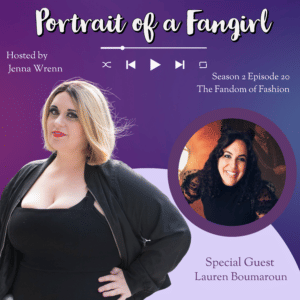
On the latest episode of Portrait of a Fangirl podcast, host Jenna Wrenn spoke with designer, Dr. Lauren Boumaroun, about her experience blending fashion and fandom.
The post The Fandom of Fashion appeared first on TEMPLE OF GEEK.
[00:00:05] Portrait of a Fangirl is a web series and podcast created by Temple of Geek. At the core of the project is the importance of telling the stories of women who have found inspiration, growth, and power through fandom. My name is Jenna Wren and I'm the host of the Portrait of a Fangirl podcast. Today I have the pleasure of talking with Dr. Lauren Boomerun. Hi Lauren, how are you?
[00:00:26] I'm doing well, how are you?
[00:00:28] I'm great. Very excited to talk to you and hear your story today.
[00:00:32] Thanks, me too. I'm excited to be here. Thanks for having me.
[00:00:34] Of course. So can you just start off by introducing yourself and telling our audience a little bit about who you are and what you do?
[00:00:43] So my name is Lauren Boomerun. I am a PhD. That's where the doctor comes from. So if you're sick on an airplane, don't call for me. If you need help choosing a movie on the airplane, call for me.
[00:00:59] So my PhD is in cinema and media studies. I have a master's in visual culture costume studies, which is basically like a fashion and textile history degree. I did that at NYU.
[00:01:12] And undergrad, I also studied film and television. I was in the screen arts and cultures program at University of Michigan.
[00:01:19] Oh, and my PhD is from UCLA.
[00:01:21] So then...
[00:01:22] All around the country.
[00:01:24] Post ghosts, Midwest, all over the place, studying film, television, costume, fashion in various ways.
[00:01:31] I'm also a costume designer. So that's part of what gets me excited about studying costume and costume designers from an academic perspective.
[00:01:41] And is a big reason why my focus on fandom tends to be on sort of geek fashion, bounding, cosplay, things like that.
[00:01:52] Anything that's sort of crossover between media and clothing is like what I'm really into.
[00:02:00] So were you a fashion designer before you got into this field or did it come along with doing these studies and finding an interest in costuming?
[00:02:09] I think my first time doing costume design was actually once I was already in my master's program.
[00:02:18] When I was studying film in undergrad, I was thinking more like I would be a critic or something.
[00:02:25] I'm not sure I was really thinking practically about it at the time.
[00:02:29] I just was like, you know, study what you want in school.
[00:02:33] And, you know, the pros and cons of doing that are a whole other conversation.
[00:02:38] But I was always interested in clothing.
[00:02:41] You know, especially I grew up in the suburbs of Detroit.
[00:02:44] So especially back in like the early 2000s, there was an Urban Outfitters about half hour away.
[00:02:53] And like that was pretty much it in terms of like cool clothing back then.
[00:02:59] But I always had a way of putting stuff together that made people notice.
[00:03:05] My brother's friends would call me Hollywood in like an insulting way.
[00:03:10] But I kind of took it as a compliment.
[00:03:11] Like, yeah, I know how to put an outfit together.
[00:03:14] I know how to like be creative with my style.
[00:03:16] You know, that's nothing to be ashamed of.
[00:03:18] So I'd say I've always been interested in it.
[00:03:22] And then, you know, as I was starting to study these things academically and look more into it,
[00:03:31] I realized there was a way that I could combine these interests.
[00:03:34] So that's when I started looking into actually doing costume design and not just studying it from like an academic perspective.
[00:03:44] Right. Very interesting.
[00:03:46] You know, I actually did my master's in history and I had a peer who was doing her master's in history as well.
[00:03:56] But it was in historical fashion.
[00:03:58] And it was such like a big thing at the time because nobody did that.
[00:04:02] And in a room full of historians, it was like, really, really?
[00:04:06] But it's so interesting.
[00:04:08] Fashion has so much more to it than just, you know, surface level.
[00:04:14] Mm hmm.
[00:04:14] Yeah.
[00:04:15] It's funny that it's seen as sort of like frivolous and kind of shallow.
[00:04:19] But I mean, people wear clothing every single day.
[00:04:22] Even if you don't engage with fashion in the way that you think of, you know, like high fashion designer, stuff like that.
[00:04:30] Everyone's still wearing clothes every day.
[00:04:31] So it's like a huge part of our lives.
[00:04:33] And I've always been really interested in the relationship between dress and identity, which is where costume design and fandom and stuff come in, because it's all about creating people through clothing or recognizing people through clothing.
[00:04:49] Right.
[00:04:49] Really interesting.
[00:04:50] So something we always like to ask our guests is how they view the term fangirl and how that's changed as they've grown.
[00:04:58] So to you, what does being a fangirl mean?
[00:05:05] I don't know.
[00:05:06] I don't know.
[00:05:06] It's so hard.
[00:05:06] I've been thinking about this because I knew you like from the past podcast that you asked other people this question.
[00:05:11] And I was like, I have a great, succinct answer.
[00:05:13] And I still don't have one.
[00:05:14] I think because it's such a, like amorphous term that's been evolving.
[00:05:20] I mean, when I use it casually, I just mean like somebody who is a woman and is into fandom.
[00:05:28] But I think if, you know, the academic side of me wants to like delve deeper into it and think about how it really kind of, I think at this point represents a type of fandom.
[00:05:40] Like I think even people that are men or non-binary might call themselves a fangirl about certain stuff.
[00:05:47] Just a way of engaging with fandom that I think is very open and like emotional connection based and like excited and sort of uninhibited.
[00:06:00] And I think that used to have a negative connotation and now it has more of a positive connotation.
[00:06:05] So it's cool because I feel like fangirl is one of those things that was a little bit derogatory back in the day.
[00:06:12] And now people are like very proudly calling themselves fangirls.
[00:06:16] So I think that's really cool.
[00:06:18] It's true.
[00:06:19] I love seeing the way it's changed over time.
[00:06:23] Like you said, I remember being growing up when I was younger and it was like, oh my gosh, you're a fangirl of the like boy bands or teeny boppers kind of thing, you know?
[00:06:31] So it's very interesting to see how that's changed as time has gone on.
[00:06:36] Yeah.
[00:06:37] How did you get into fandom first?
[00:06:40] I'm curious.
[00:06:42] Or was it a long time thing?
[00:06:44] It has.
[00:06:45] It's been my whole life.
[00:06:47] Oh my goodness.
[00:06:48] So this is going to be a little bit of a different episode.
[00:06:50] I should have prefaced myself.
[00:06:51] We're going to kind of do a little bit of a back and forth interview here.
[00:06:55] So this is a unique episode.
[00:06:57] I have probably always been somewhat immersed in some sort of fandom.
[00:07:04] Growing up, definitely.
[00:07:06] I mean, I'm 35.
[00:07:07] So I'm like the perfect age for Harry Potter.
[00:07:10] I grew up with the first book came out when I was probably 11 or so.
[00:07:14] And, you know, I grew up with each book coming out.
[00:07:17] So that was something of my childhood.
[00:07:20] And I would say that and probably Star Wars.
[00:07:24] I was really big into Star Wars also.
[00:07:29] Like my grandfather took me to see the anniversary of A New Hope when it came out in the 90s.
[00:07:36] So like that was one of my first memories is going to see that on the big screen.
[00:07:40] So yeah, I've always been a big fangirl my whole life.
[00:07:43] That's so cool.
[00:07:44] I love having those nice memories with like family or friends when you're younger too.
[00:07:49] I didn't really get into fandom until later in life.
[00:07:52] Like I didn't see Star Wars, I think, until I was 23 maybe.
[00:07:57] But I am.
[00:07:58] I'm 36.
[00:07:59] So I'm also very much of the age for Harry Potter.
[00:08:03] So I guess at the time I never really considered it fandom because I didn't engage with it the ways that other people who called themselves fans did, you know, back in like the early 2000s.
[00:08:15] But yeah, I mean, I would always my mom would preorder the books for me.
[00:08:19] So they'd arrive the day they came out and I'd like try to read it all in one day and always dress up and go to the midnight screenings of the movies.
[00:08:27] And then if we couldn't make the midnight screening, my cousin and I would just get in costume and go like two weeks later on a random noon screening.
[00:08:37] That's so cute.
[00:08:40] I can remember when each book, I remember when I got it, like where I got it.
[00:08:46] It's one of those things that I don't think will happen.
[00:08:49] It might happen again, but it was such a phenomenon at the time that I can't think of another time where, you know, you can go up to somebody like maybe who is like Gen Z and say, hey, like, did you ever experience this?
[00:09:02] It's not the same.
[00:09:04] Yeah, it definitely.
[00:09:05] I mean, you know, Harry Potter fandom, I think for a lot of people has been tainted because of J.K.
[00:09:11] Rowling and her real life persona.
[00:09:13] And, you know, as we get older and start to look at media a little bit more critically, people have seen problems with the books themselves.
[00:09:21] But we were kids, you know, we didn't we didn't look at things that way.
[00:09:25] We didn't know better and we definitely did not know what was going on outside of it.
[00:09:29] So I think, you know, for us, it was easy to like just get immersed in it and enjoy it and love it.
[00:09:36] But now, you know, the Internet has made fandom so much more accessible, but I also feel like it's made it a little bit more complicated, too.
[00:09:44] And I just I wonder if it's even possible yet to have something that is like so key and so exciting for so many young people, even people who weren't into other, you know, like nerdy or geeky stuff when they were younger.
[00:10:01] It definitely was like a pioneer in that way.
[00:10:04] Yeah. And because of the technological advances, like I I don't think you'll have that necessarily that like excitement because I mean, it will happen.
[00:10:14] But I remember like waiting and waiting and waiting to hear when the new title was going to be released.
[00:10:18] And now it's like, you know, with between a 24 hour news cycle where you have leaks of things or people, you know, who are like, you know, getting information before someone else does.
[00:10:28] Like there's not that sense of suspense anymore. It's everything's so accessible.
[00:10:32] But I remember like waiting and watching. Oh, we know if we watch the news at this time, they're going to announce this.
[00:10:37] And that doesn't happen anymore.
[00:10:40] Yeah, definitely not.
[00:10:41] Yeah, I think. And that stuff feels a lot more controlled now to the marketing and the release of information and all of that.
[00:10:49] Yeah, I feel like it was a little bit more organic back then, maybe.
[00:10:53] Or just, you know, or we weren't as aware of, you know, the whole marketing scheme behind everything.
[00:10:58] But yeah, it just felt like something that everyone was excited about.
[00:11:01] And, you know, I mean, you're everyone's like into magic when you're I mean, a lot of us were into Matilda, too,
[00:11:08] because it was just like the idea that you could be like a normal kid and somehow have magical powers or like be trained in that,
[00:11:17] I think was just so exciting to those of us who love to live in our heads and have really active imaginations.
[00:11:23] So I think that's one reason why I still, to a certain extent, engage with Harry Potter as a fandom,
[00:11:29] because just the concept of like anyone could have this inside of them and unlocked and like go and be trained in the arts of magic.
[00:11:38] It just, you know, it's cool.
[00:11:40] It's like every nerd's dream to find out that you're secretly magical.
[00:11:44] Right. And it's about finding your place somewhere.
[00:11:47] You know, there's a lot of themes that, you know, resonate with people who maybe don't feel like they fit in.
[00:11:53] Or, you know, a lot of times if you were like an avid, like a real avid reader or nerd, maybe you were a little like introverted.
[00:12:02] So you didn't know where you fit in.
[00:12:04] And I mean, I've always been an extrovert.
[00:12:05] So I don't know from experience.
[00:12:07] But, you know, we had a lot of that.
[00:12:10] Like you mentioned, Matilda.
[00:12:11] I thought of Sabrina the Teenage Witch.
[00:12:13] Like, I wonder if there is like some sort of phenomenon, you know, about that.
[00:12:19] Like at that time, it was such a big thing now that I'm thinking about it.
[00:12:24] Yeah.
[00:12:25] I'm sure there are at least one to ten academic journal articles out there somewhere by media studies people that have like gone through the trend of the 90s and 2000s with magical things.
[00:12:37] I'd be curious to look into that, too, and see.
[00:12:40] Very interesting.
[00:12:41] Yeah.
[00:12:42] It's funny when you mentioned like being into fandom or like being immersed in fandom.
[00:12:47] I only recently realized that I kind of was cosplaying before I knew what cosplaying was.
[00:12:53] Like growing up, my best friend and I would we were really, really, really big into Lord of the Rings.
[00:13:01] And we would like reenact the movies and dress up.
[00:13:03] We had like a whole closet filled with costumes and wigs and props, all these things that we gathered from like multiple Halloweens and, you know, on sale after Halloween, all these things.
[00:13:14] And we would just like raid the closet and we would make our own movies.
[00:13:17] So I always like think it was almost like if TikTok had been a thing and like cosplaying, like we were doing it as kids.
[00:13:24] And it makes sense as to like why I am kind of the way I am now, because I always had that that love and that interest.
[00:13:33] Right.
[00:13:33] It's funny.
[00:13:34] Yeah, I was big into dress up as a kid.
[00:13:37] Not necessarily specific characters, but just dress up, costume, all of that.
[00:13:41] My cousin and I would like we like to reenact music videos, too.
[00:13:45] So we did like Heartbreaker, Mariah Carey music video and tried to recreate that.
[00:13:51] And we did The Boy Is Mine, Brandy and Monica music video and recreated that.
[00:13:56] So, yeah, I think they're like I always say I didn't get into fandom until I was older.
[00:14:01] But then you're right.
[00:14:02] Yeah, I look back on certain things and I'm like, yeah, like these are fan-ish things to do, like recreating videos and engaging with it in that way.
[00:14:09] So I think it was maybe dormant until I was older and, you know, started looking into what I liked for myself and not just basing on what my friends liked or what my older brothers or my parents liked.
[00:14:24] I didn't even think I liked science fiction until the last semester of college.
[00:14:29] I took a class on sci-fi because my favorite teacher was teaching it.
[00:14:33] And I was like, I just really want to take Mark's class one more time before I graduate.
[00:14:37] And it was on sci-fi.
[00:14:38] And I was like, all right, whatever.
[00:14:40] Turns out I love sci-fi.
[00:14:42] Surprised me at like 21.
[00:14:45] But it's actually one of my favorite genres.
[00:14:48] So that was nice.
[00:14:50] Yeah.
[00:14:50] And then after that, I think it opened me up to exploring a lot of things that I had ignored growing up.
[00:14:57] So slowly throughout my 20s, watched Star Wars, Lord of the Rings.
[00:15:02] You know, started looking into that world a bit more.
[00:15:07] Yeah, it's funny because I think a lot of times maybe we have a preconceived notion of what a genre is or what certain things are like or how accessible they are.
[00:15:17] So maybe we like stay away from them because, oh, this is like dominated by this sort of person.
[00:15:22] And, you know, as you get older, you realize, oh, I can I can like what I like.
[00:15:27] I can be into what I'm in and it doesn't matter.
[00:15:29] And I think that that's an important thing for younger people to younger people are doing it better.
[00:15:36] Like the Gen Zs are doing it a lot better than we did.
[00:15:39] They don't really seem to seem to care about, you know, preconceived notions of like, you know, who's into what or gatekeeping or anything.
[00:15:48] So I think that that is was a big thing for us.
[00:15:51] Like, oh, like like the boys can't be into boy bands.
[00:15:55] That's a girl thing, you know, and it's different now.
[00:15:59] Yeah. And now boys are like super into K-pop groups of all guys.
[00:16:02] And like they have their favorites still, too.
[00:16:04] And gay, straight doesn't matter.
[00:16:06] Like people are just I think, yeah, with I mean, the MCU probably has a lot to do with fandom going mainstream.
[00:16:12] But I mean, there's so many different things that we could point to for that.
[00:16:17] But it's been so nice because I think it has helped break down those barriers, let more people in, let more people feel comfortable getting into it.
[00:16:25] And also just like being more accessible.
[00:16:27] You know, I mean, even if you wanted to get into anime back in like the 90s, you kind of had to know someone else who knew it because you didn't even know.
[00:16:36] Like you couldn't just go on Netflix and search for it.
[00:16:38] You know, like you had to know at least a title to go look for and things like that.
[00:16:42] So I think it's cool now that like geek culture is so much more accessible.
[00:16:48] And I think fandom is now around things that aren't just geek culture.
[00:16:55] Like I'd say a lot of my fandoms are things that aren't necessarily at Comic-Con, like Succession.
[00:17:02] It's like a weird thing to be like, I'm a huge Succession fan.
[00:17:06] Like I've rewatched it multiple times.
[00:17:08] I run a meme group for it.
[00:17:09] Like I'm like that.
[00:17:11] I think you should leave with Tim Robinson.
[00:17:13] It's a sketch on Netflix.
[00:17:14] Also like huge fan of that.
[00:17:18] So I think it's cool too how seeing how everything has evolved and being able to actually dedicate time to studying that and talking to people about it.
[00:17:31] Which is something we both get to do.
[00:17:33] Yeah.
[00:17:34] What was it like for you?
[00:17:35] I'm really interested in the fact that you didn't watch Star Wars until your 20s.
[00:17:38] Like I feel like, what was that like?
[00:17:40] What was that experience like being, you know, obviously you would have known about Star Wars.
[00:17:45] It's a pop culture, significantly pop culture, you know, franchise.
[00:17:49] But what was it like watching it for the first time in your adulthood?
[00:17:54] You know, I remember watching it on like a very small TV in my bedroom.
[00:18:01] I shared an apartment in New York with a couple other roommates.
[00:18:04] And my roommate was probably watching Real Housewives or some sort of reality TV in the living room.
[00:18:12] But I just remember like, yeah, just being like, oh, I get it.
[00:18:16] You know, like I've never really gotten, I tend to be interested in a lot of things rather than go really, really deep into a few things.
[00:18:24] So I've never gotten like super into Star Wars in the way that some other people have.
[00:18:29] But I'm like, I get it.
[00:18:30] Like this is a fun world.
[00:18:31] These are fun characters.
[00:18:32] I remember being surprised by the humor.
[00:18:35] And I think in general, a lot of sci-fi has a lot of humor in it.
[00:18:39] And I'm like big on comedy.
[00:18:41] I'll watch things that are like straight dramas.
[00:18:44] But for the most part, it needs to have a few laughs in it for me to like want to turn it on.
[00:18:50] So that was something that I really thought was cool about Star Wars.
[00:18:53] It was absolutely hilarious.
[00:18:54] And I wasn't prepared for that.
[00:18:56] I remember thinking the Ewoks were super cute.
[00:18:58] And then I wanted a little baby one.
[00:19:00] That was, I think, the main thing that stuck out to me.
[00:19:02] I remember this was like when Instagram first started.
[00:19:05] So I just like took a picture of the TV screen of like the baby Ewok.
[00:19:09] And I was like watching Star Wars for the first time.
[00:19:11] I get why people like it.
[00:19:13] These are so cute.
[00:19:15] That's adorable.
[00:19:17] Yeah.
[00:19:18] And then I think the first con I ever went to was Star Wars Celebration.
[00:19:22] So Star Wars has been kind of my entry into fandom in many ways.
[00:19:29] Yeah.
[00:19:30] I would say it was similar for me.
[00:19:32] Like I said, what would the 25th anniversary would have been like, what was the 20th?
[00:19:36] Yeah, 25th.
[00:19:36] So that probably would have been like the late 90s.
[00:19:39] When was it?
[00:19:40] Late 90s.
[00:19:40] Right?
[00:19:41] So that I was young.
[00:19:42] I was 10 maybe.
[00:19:44] And then right around there is when the prequels started coming out.
[00:19:47] So the prequels, they were like just the biggest thing in the world.
[00:19:51] And they started when I was maybe like 11.
[00:19:54] And then they finished when I was in high school.
[00:19:56] So it was like the perfect age to get immersed in something.
[00:20:00] And it's just so funny because I was such a huge Ewan McGregor and Hayden Christensen fan.
[00:20:08] And everybody, like so many people, just really were so negative about the prequels and the way that they played them.
[00:20:17] But now, you know, 20 years later, people are having this renaissance for them.
[00:20:23] And I'm like, I love them the whole time.
[00:20:25] I love them the whole time.
[00:20:27] OG prequel fan.
[00:20:28] Yeah, I have one friend that's like a legitimate fan of the prequels, like loves them.
[00:20:33] Not in.
[00:20:34] So like I think I, well, actually I did see one of them in the theaters because I think I was like, I want to like, oh, there's new Star Wars movies.
[00:20:44] That's a big thing everyone's into.
[00:20:45] And I think I made my dad take me to see the first one.
[00:20:50] But I obviously didn't really like super grab me because I didn't follow up on any of the other ones.
[00:20:56] So I finally watched the prequels a year or two ago, I think.
[00:21:00] Like really, even though I have engaged with all other Star Wars stuff, partially because of like the bad rep they have.
[00:21:08] Right.
[00:21:09] But I loved them.
[00:21:11] I mean, I enjoyed them, I guess, maybe in a little bit of a campy way, which helps to approach some sci-fi that way.
[00:21:20] But yeah, I think they're great.
[00:21:22] And now I appreciate them.
[00:21:24] But yeah, they it is kind of sad.
[00:21:26] They got really made fun of back in the day and for years.
[00:21:30] And they're so memeable, too.
[00:21:32] Like, I feel like those are like that's where you see all the Star Wars memes are usually prequel stuff.
[00:21:37] I know I will hold true that Revenge of the Sith is probably my favorite Star Wars movie.
[00:21:44] Might be a little bit of a controversial opinion.
[00:21:46] Almost everybody always says Empire Strikes Back, but I love Revenge of the Sith.
[00:21:51] But it's it's just such a great fandom to be in sometimes.
[00:21:56] Yeah, yeah.
[00:21:58] I mean, I think that's the case for all fandoms is there are certain parts that are welcoming and other parts that are still very exclusive and, you know, towards women or just anyone who doesn't, you know, do fandom right.
[00:22:15] I guess I got it.
[00:22:17] Yeah.
[00:22:17] So I guess I was more into music fandom growing up.
[00:22:20] Um, so it was definitely one of those things where, like, I got called a poser, you know, for not being into, like, the real punk bands, just like pop punk and emo bands, you know, things like that.
[00:22:31] And, like, I think that's another thing that kind of turns a lot of women especially off to fandom early on is that you do sort of feel like you have to be a certain way or, like, like specific things in order to fit that label.
[00:22:45] Um, so it's nice that we don't most people don't really feel that way anymore.
[00:22:51] Right?
[00:22:51] Yeah, it's definitely has changed.
[00:22:53] Like, there have been times, you know, I'm a big fan of comic books.
[00:22:56] And I've noticed, I noticed a lot of times going to comic book stores, sometimes you get that person who works there that's like, oh, well, they kind of almost talk down to you because they think, oh, well, you don't know as much as I do.
[00:23:07] And I would, like, no, I know, I know what I'm doing.
[00:23:11] You know, I know what I'm talking about.
[00:23:13] And I'm a fan of something.
[00:23:14] So obviously I'm well enough first that I know what I want to buy and I know what I want to do.
[00:23:20] But, you know, it's one of those situations where sometimes, you know, a loud person isn't the one you should always listen to, you know?
[00:23:30] For sure.
[00:23:30] Yeah, I like that.
[00:23:32] But what are you currently fangirling over?
[00:23:35] Um, right now I am fully on the Dune train.
[00:23:40] Um, I'm almost done reading the first book for the second time within the past year.
[00:23:46] Um, and after I finish rereading it and planning to rewatch the first movie and then go see the second movie again while it's still in theaters.
[00:23:58] Um, hopefully seeing it in 70 millimeter IMAX and get the, you know, if I'm going to see something in theater,
[00:24:03] I want to go all out and see it the way that I definitely cannot see it at home.
[00:24:07] Um, and one of the nice things about living in LA is that we have access to a lot of theaters that show film, that show IMAX.
[00:24:15] So, um, yeah, I'd say that is my thing right now.
[00:24:21] Um, I just, I love like the world and the story.
[00:24:25] I love anything that has books along with it too, because it, I, I feel like my way of doing fandom tends to just be watching and rewatching something a lot.
[00:24:36] I don't generally delve too deep into behind the scenes or like the actors lives or anything like that.
[00:24:45] Partially because I don't want to see them as real people.
[00:24:47] I don't want to know about their real lives.
[00:24:49] Some of them, it's just going to disillusion me too much.
[00:24:51] Like just enjoy them for their character and like see them in that specific way.
[00:24:57] Um, so yeah, so something like Dune where I, you know, I have the book, but then I also have two, there's also two other books in the main trilogy and then like tons of ancillary material.
[00:25:08] So I'm really excited to dive into all of that stuff now that I've gotten more into the world and want to know more and want to understand certain things better.
[00:25:18] Um, it's also pretty cool.
[00:25:21] I'm, I'm Lebanese.
[00:25:22] Um, so we don't get much Middle Eastern representation anywhere.
[00:25:27] Um, at least not good representation.
[00:25:32] Um, so even with like the screen adaptations of Dune, the Middle Eastern influence with the Fremen has kind of been pushed out a little bit, but reading the book and seeing the way that Frank Herbert, like put that into the book, certain words and customs,
[00:25:48] language, things like that.
[00:25:50] Um, I think I enjoy that part too.
[00:25:52] I think that's cool.
[00:25:53] Um, and it's nice to see, uh, sort of Arab influence in something that isn't necessarily negative.
[00:26:02] Um, although, well, Dune goes, uh, Dune seems like it's a story of a heroic young man and then kind of flips all that on its head.
[00:26:12] So things do go awry, but, um, you know, not because of anything the Fremen do necessarily.
[00:26:20] Right.
[00:26:21] Yeah.
[00:26:21] It's nice to see that influence to see like a representation of yourself and your culture.
[00:26:26] It must be, you know, very nice to see.
[00:26:29] Yeah.
[00:26:29] Yeah.
[00:26:29] We don't, we don't get that much.
[00:26:31] Janice Ian from the original Mean Girls is pretty much the only Lebanese character I've ever seen on screen.
[00:26:37] Um, and then in the, in the stage musical, she's not Lebanese anymore and she's not in the new movie either.
[00:26:44] I mean, you know, which is great.
[00:26:46] I am blanking on the woman that plays her now who also did Moana.
[00:26:51] Like she's wonderful, super talented, loved her portrayal of it.
[00:26:55] You know, love that a new group gets to feel represented on screen.
[00:27:00] But a little part of me was like, oh, I had, I had my one Lebanese character that I don't mean.
[00:27:06] But it's cool.
[00:27:07] I got the original Mean Girls.
[00:27:08] I got Lizzie Kaplan playing a, you know, wonderful time, you know, early 2000s version of Janice.
[00:27:19] Right.
[00:27:19] Right.
[00:27:20] Yeah.
[00:27:20] The original.
[00:27:21] Yes.
[00:27:22] The OG.
[00:27:23] I want to talk a little bit about your educational background.
[00:27:26] So you have your PhD in cinema and media studies, as you mentioned earlier, and you focus on costume design, licensed media, geek fashion, and fandom.
[00:27:36] Can you start by telling me a little bit about this discipline?
[00:27:40] So, uh, cinema and media studies is actually like super broad.
[00:27:44] Um, it's like pretty wild actually how many different things have come out of my program.
[00:27:52] Um, there have been past students that have looked at like the news and politics and how politicians are portrayed in the media.
[00:28:00] Um, I have a friend whose dissertation was on 3D technology.
[00:28:05] Um, other people, you know, go pretty deep into fan studies or historical stuff.
[00:28:12] I have a friend who, um, did an archival project on this woman named Aloha, who was a filmmaker traveler, um, back in like the early 1900s.
[00:28:21] So, um, it really is a huge discipline.
[00:28:26] Um, and then within that is where I decided to focus, um, like I was saying earlier on kind of where clothing overlaps with media.
[00:28:36] Um, and a big part of that is in fandom.
[00:28:39] Um, so, um, I actually kind of got into fandom in a, an official capacity, I guess, like actually joining fan groups and doing all that.
[00:28:55] I started doing that because of my research.
[00:28:58] Um, so the first fandom that I really was very active in was Crazy Ex-Girlfriend.
[00:29:04] Um, I loved that.
[00:29:06] I love musicals.
[00:29:07] I love, you know, dark humor.
[00:29:10] I love mental health representation and stories about mental health.
[00:29:15] So that show really hit me.
[00:29:17] Um, it really grabbed me and I was writing a paper on it and joined like the Facebook fan group just to kind of, you know, get to know other fans, do some research.
[00:29:27] And, uh, it took off from there and I ended up getting super into it.
[00:29:33] I was actually about to put on a deposit for a CXG con right before COVID lockdown in early 2020.
[00:29:40] Um, so that, uh, I went a little bit off track answering the question, but, um, it's, um, it's cool because it media studies as a discipline encompasses so many different things that you really have the space to explore.
[00:30:00] Like a million different things within that.
[00:30:02] Um, so it's great because I've written some stuff on, um, you know, some historical stuff, archival research that I did at the Academy library where I was like looking through old letters and telegrams from Catherine Hepburn and, um, you know, like old documents from censorship about some of the movies she was in and things like that.
[00:30:23] So I've done stuff like that.
[00:30:25] I've written on, um, Handmaid's Tale cosplay being used in protests.
[00:30:31] And I've also written about running jokes and arrested development.
[00:30:35] So it's cool.
[00:30:37] Cause I've given, I think like a couple of conference papers on, um, ongoing developments, uh, the like running jokes and arrested development and kind of the way that's the show is put together with all these different layers of comedy.
[00:30:51] So, um, it's cool.
[00:30:53] And then within that, like I said, I get to focus on clothing still, uh, when I was looking at PhD programs, I was trying to decide between apparel studies or media studies, trying to figure out like, am I a fashion person who's into film and television?
[00:31:09] Or am I a film and television person who's into fashion and kind of ended up going that route.
[00:31:15] So, um, you know, within my field, I am pretty niche.
[00:31:21] Um, it's, it's tough to, it's tough.
[00:31:26] Um, cause it's, you want to find something in academia, in your academic field that isn't over-researched, overwritten on something that's unique, but that can also be a problem when you're looking for jobs or looking for, you know,
[00:31:44] there are, I have not, I've yet to see a job posting for a professor position in a media studies program where they're looking for somebody who knows about costume.
[00:31:53] Like they don't.
[00:31:54] Don't worry.
[00:31:54] So it's, you know, and in one way I'm, I'm studying these things in part because they're overlooked, undervalued, under-researched.
[00:32:03] Um, but that also, because of that, like they don't necessarily have as much value, like these skills and this knowledge doesn't have as much value in certain spaces.
[00:32:13] So, um, it is, uh, it's good.
[00:32:18] It's interesting.
[00:32:20] I'm into it.
[00:32:21] And, um, especially the side of my work that focus more on costume design and costume designers than on fandom.
[00:32:28] Um, I think really, I mean, it's all important in my mind, but, um, costume designers in particular are fighting for pay equity, fighting for, um, proper credit compensation.
[00:32:41] So, um, I hope that there are things that I can do and write about that can reach a larger audience and maybe, you know, help raise awareness or even have some sort of impact would be really cool.
[00:32:55] Great.
[00:32:56] Yeah.
[00:32:56] I, I, um, you know, in a similar vein, like I mentioned, I studied history, um, bachelor's, master's, and I did a year towards my PhD and I always, uh, my master's and my year towards my PhD were all focused on women's history.
[00:33:09] And I would, you know, in a similar vein where you're like, there's not a lot out there.
[00:33:13] I would see these stories of these, you know, women throughout history who are not like, why isn't there a movie about this person?
[00:33:20] Why isn't this person, why isn't there a biopic or, or bestselling novels about this, this person?
[00:33:25] And I think about that all the time when it comes to academia, because there's just so much that's, that you don't realize is not brought to public light.
[00:33:34] Mm-hmm.
[00:33:36] Yeah.
[00:33:37] It's, I mean, it's overwhelming and also exciting.
[00:33:41] And part of the reason why I went through my PhD, even though I ultimately am not sure that that was like the best course of action for my life, but I just, I love researching so much.
[00:33:53] Like, I just love like diving into things and getting really into it and learning all this stuff.
[00:33:58] So, you know, that's why I've been in school for almost my entire life.
[00:34:03] Right.
[00:34:05] You're a professional student.
[00:34:07] Yeah, exactly.
[00:34:08] Um, but were you already doing stuff like with Temple of Geek when you were doing your master's or was that kind of before you started doing, um, geek culture stuff and fangirl stuff professionally?
[00:34:21] Yeah, it was, it was before, um, I did my bachelor's, uh, my master's directly after my bachelor's.
[00:34:27] So it was basically just, you know, a two-year continuation, um, for the most part, like I didn't know what I wanted to do professionally.
[00:34:35] So I thought, oh, the best course, let me just stay in school and do my master's.
[00:34:39] Um, yeah, right.
[00:34:41] That will, that will do it.
[00:34:42] Um, and then I went and I worked, I worked in, um, the legal field after I graduated with my master's, um, for maybe like three or four years before I went back to do, I went back to do my PhD for a year.
[00:34:56] And, um, realized, I don't think I want to do this.
[00:35:01] Yeah.
[00:35:01] Uh, so then I went back to work, uh, in, you know, the legal field and I'm still in it, but, um, you know, Temple of Geek came up probably about two and a half or so years ago.
[00:35:12] So I was already well past my academia years when that, when that happened.
[00:35:16] Yeah.
[00:35:17] I have to say props to you for recognizing that it was not your path.
[00:35:22] Um, I think a lot, I mean, a lot of people drop out of PhD programs.
[00:35:27] Like, I mean, half of the cohort above me dropped out.
[00:35:30] We lost, I think two people in my cohort.
[00:35:33] Um, but a lot of them had already put in like a lot of years and a lot of work.
[00:35:37] Um, so yeah, I think there, then you all end up in that sunk cost issue.
[00:35:42] Like one of my friends was like, I don't know, you know, I've already, I'm already here.
[00:35:46] I've already been doing so much, but like, also I still have so much more to go.
[00:35:50] So, um, I tell people, you know, people here, I have a PhD and they're like, oh, that's so cool.
[00:35:56] And I'm like, of course it sounds cool.
[00:35:59] The actual process.
[00:36:00] I mean, like most like working in film and television, people think that's like super glamorous, but I'm like the realities of the job are actually like pretty mundane.
[00:36:09] And like, uh, very labor intensive depending on what you do.
[00:36:13] Um, but like my whole thing is if you need a PhD for the job you want, do it.
[00:36:19] If you don't absolutely need it for what you're looking for, you know, the self-fulfillment you'll get from finishing it, you know, might not outweigh the years and time that goes into it.
[00:36:32] Um, right.
[00:36:33] And like, there's ways of becoming an expert on things without going through formal channels too.
[00:36:38] Like, I think that's, what's so cool about fandom is that these people, like a lot of people like basically have a PhD in certain topics.
[00:36:46] Like they've not only know everything about it, but they've thought critically about it as well.
[00:36:51] Like it's not just amassing information.
[00:36:53] And sometimes I'm almost embarrassed to tell fan people that I've studied film and television.
[00:36:59] Cause they like, I think expect me to know a lot more, especially film buffs who, you know, a lot about like indie movies and historical films are like, what's your favorite movie?
[00:37:08] And I'm like, stepbrothers.
[00:37:10] I don't know.
[00:37:10] That's so good.
[00:37:11] That's, you know, I, my tastes are not very highbrow.
[00:37:15] Um, you know, but like, it's cool because people know so much about this stuff and I just find it so cool and like fascinating.
[00:37:24] Um, you know, the knowledge base that people have outside of academia.
[00:37:29] So.
[00:37:30] Right.
[00:37:30] You can go on, on Reddit and read basically what's a shortened dissertation.
[00:37:37] You know, people do this absolutely amazing analyses of TV shows, of movies, of a character.
[00:37:45] And, you know, this is stuff that, you know, you don't, you don't need to, like you said, go to school for it.
[00:37:50] It's not formal training.
[00:37:51] And it's just as poignant and smart and well thought out than, than any, you know, research paper or dissertation could be.
[00:37:59] Oh yeah.
[00:38:00] Some of the best reviews I've read have been like in comment sections on a Facebook group or something like that.
[00:38:08] You know, people just, yeah, like, especially, uh, about Dune, a lot of people in these like Dune groups just have really good, really like interesting and insightful, uh, reviews of the second film and of the changes between the book and the movies and stuff like that.
[00:38:28] But, um, I feel like, you know, I learn a lot in those spaces as much as I would learn from reading an academic, probably more than I would learn from reading an academic journal article on the same topic.
[00:38:41] Right. Absolutely.
[00:38:43] Do you think your relationship with fandom changed at all when you decided to pursue a higher education?
[00:38:51] Basically, you're a fangirl of clothing, of all these things, and now you took that love into academia.
[00:38:57] So do you feel like that changed your relationship with fandom?
[00:39:02] Yeah, I think, first of all, I think I started to consider myself a fan, which I hadn't before, even though, like I was saying, I had done some fannish things growing up and engaged in things more casually.
[00:39:15] Um, I think what, what it really did for me and kind of how I describe myself is that I'm a fan of fandom.
[00:39:25] Like, I just find the concept of fandom so cool.
[00:39:29] And as somebody who, again, is really interested in psychology and people and mental health, seeing the way that that, like, becomes a part of a person's identity and like the sort of the psychological and social benefits that people get from fandom.
[00:39:45] Uh, I just think all of that is so cool and so fascinating.
[00:39:50] And I think, um, learning more about fandom from a sort of academic objective perspective helped me become more of a fan overall because I saw that fandom wasn't what I thought it was growing up.
[00:40:07] Like, there was space for someone like me who didn't do fandom in certain ways.
[00:40:13] Um, so, yeah, I think, um, you know, it's, it's interesting because studying film and television does change your perspective on things to an extent.
[00:40:27] Um, you know, when I was first learning how to analyze movies, it was kind of hard for me to turn it off.
[00:40:34] Uh, but now I've been doing it so long.
[00:40:36] It's real easy for me to turn off the academic side.
[00:40:38] I'm probably less critical of most media I watch than most other people are.
[00:40:43] I'm just like, I laughed a lot.
[00:40:44] It was fine.
[00:40:45] Like, it was great.
[00:40:45] I loved it.
[00:40:46] Whatever.
[00:40:47] Um, just enjoy it to enjoy it.
[00:40:49] Yeah, exactly.
[00:40:50] So I think, um, you know, and that might also be a little bit of, uh, of a consequence of, you know, studying fandom and studying film academically is, you know, learning that you don't always need to look at it that way.
[00:41:06] Sometimes it is just about the emotions, the feelings, the overall entertainment, you know, there's something to be said for entertainment value.
[00:41:13] Um, right.
[00:41:14] Um, so yeah, but, um, like I was saying earlier, I think studying fandom academically is what actually got me into fandoms and where I met friends who were in fandoms.
[00:41:27] Like some of my longest running internet friends and, you know, some of them are close friends.
[00:41:34] I met through crazy ex-girlfriend fandom.
[00:41:36] Um, you know, and even though we don't engage with, you know, the show that much together anymore.
[00:41:44] Like the friendship that we have now exists outside of that.
[00:41:48] So, um, I think that's really cool in that, um, having that personal connection within fandom has enabled me to keep enjoying it and not really feel like it's not fun anymore.
[00:42:01] Um, although I will say Comic-Con gets overwhelming sometimes as somebody who's a little bit introverted and gets a little bit of sensory overload.
[00:42:09] But sometimes I will say occasionally going to, going to Comic-Con for research can be not fun.
[00:42:16] Cause then you're just running from panel to panel and like skipping some panels you might be personally interested in because your research requires you to go to other panels.
[00:42:26] Um, so I'd say like that, that's one aspect where looking at it from an academic perspective has like changed the way I feel about it a little bit.
[00:42:37] But for the most part, I just feel lucky that I get to do deep dives into things that I actually interested in.
[00:42:44] You know, that I get to like give a conference paper on unlicensed geek fashion designers who create like bounding apparel for other fans.
[00:42:52] You know, like that I get to do stuff like that is just really cool to me.
[00:42:57] That's really fun.
[00:42:59] Really cool.
[00:42:59] Along those lines of fashion, how do you personally use fashion to show off fandom?
[00:43:07] Um, I would say I am big on fandom t-shirts, especially the ones that don't necessarily look like automatically recognizable.
[00:43:20] Like, yeah, like I have a, you know, t-shirt from when Force Awakens came out in theaters.
[00:43:26] I think it was Force Awakens.
[00:43:27] Yeah.
[00:43:27] That's like the traditional Star Wars, you know, logo, whatever.
[00:43:31] Um, but I say the majority of mine are from sort of like independent fan brands.
[00:43:39] So I'd say like, for me, that's the biggest way.
[00:43:42] And, um, I love dressing up for anything.
[00:43:46] So even if like, if I go to a movie, like, you know, I, when I went to see Wonder Woman, like I kind of bounded as Wonder Woman.
[00:43:54] You know, when I went to a live band emo karaoke the other night, I dressed up in like a, you know, modern day version of like what my emo self, you know?
[00:44:06] So I think for me, that's what it is, is just kind of always dressing for the occasion, even if it's not necessarily a cosplay or like bounding event.
[00:44:16] Um, so for me, that's a big way of bringing it in through clothing is just kind of having that, like I was going to change before this.
[00:44:25] And then I realized I was wearing my, uh, Polly Gautieri t-shirt from Sopranos.
[00:44:30] And I was like, I was like, I should put on like a cute fandom shirt.
[00:44:34] And then I was like, oh, you're already wearing a fandom shirt.
[00:44:36] It's not super cute, but like Sopranos is one of my fandoms.
[00:44:41] So it works.
[00:44:42] Um, yeah, so I guess I do a lot of, um, kind of combining casual fandom t-shirts with more, you know, fashionable, so to speak, things like, you know, uh, or more professional looking things.
[00:44:59] Like I love throwing a blazer over a fandom t-shirt.
[00:45:02] Um, and that's kind of how I can make these things work in environments that are maybe not so casual.
[00:45:13] Although everything is casual.
[00:45:15] You go to the conference, everybody's in jeans and a t-shirt.
[00:45:18] Like I'm the only person dressed up at those conferences.
[00:45:21] Oh, that's nice.
[00:45:22] It makes it more, uh, more comfortable, not as stuffy, you know, you're not that academia.
[00:45:30] Feels, feeling.
[00:45:31] But yeah, and then it is people especially appreciate it when I do dress up in a fandom related thing.
[00:45:36] Like for my, um, for my prospectus review, like when I was, um, uh, suggesting what my dissertation topic was going to be, it had to be approved by the department and all the professors and stuff.
[00:45:50] So, um, I went and I wore something from one of the, her universe star Wars collections.
[00:45:57] It was like their storm trooper dress.
[00:45:59] Um, and just wearing that.
[00:46:03] Like to the meeting made such an impact.
[00:46:05] Like one of the professors that I was pretty sure did not like me was like, oh my gosh, you look so great.
[00:46:12] Oh, this is the type of thing you're talking about in your dissertation.
[00:46:15] That's so cool.
[00:46:16] I was like, wow, even she's excited.
[00:46:18] Like, I guess I need to learn my fandom stuff more often.
[00:46:23] Yeah.
[00:46:24] It brings it, it brings what you were doing in your dissertation.
[00:46:28] Um, again, I don't know the topic, but it brings it into reality so they can see it and connect to it through fashion.
[00:46:34] Mm-hmm.
[00:46:36] Yeah.
[00:46:37] So, uh, well, my dissertation was basically, um, kind of in general on what I call, uh, like costume adaptations.
[00:46:45] So versions of film and television costumes or characters that are generally, well, adaptation can refer to even like cosplays and stuff, but I look mostly at fan fashion.
[00:46:56] So things that are meant for everyday dress.
[00:46:59] Um, so some of those are licensed collections, like the ones that Her Universe does that are officially licensed and, you know, sanctioned by Marvel, Lucasfilm, Disney, all the same, the same people.
[00:47:12] Um, you know, but I think like Mattel, I think they've done Barbie stuff recently too, um, or planning on it.
[00:47:18] So, um, I kind of looked at that from the perspective of costume designers and them working not only on the original designs, but also on certain licensed, uh, collections.
[00:47:31] Um, one of the first ones that I ever researched was Renee Erlich-Kalphus, the costume designer of the Annie reboot back in 2014, did a licensed fashion collection of Annie clothes for Target.
[00:47:44] Um, and I think a lot of people are familiar with, uh, Janie Bryant, the costume designer of Mad Men did like three different collections for Banana Republic back in the early 2010s that were based on, um, you know, her designs for the show and just sort of like the idea of dapper in general.
[00:48:02] So there are a lot of things like that, and I've sort of noticed a rise in them throughout the 2010s.
[00:48:09] And it felt like this kind of fashion as merchandising and as marketing for a film or a TV show seemed to be having another golden age in some ways.
[00:48:20] Um, and then sort of the second half of that are all the unlicensed things.
[00:48:27] So the things that are made by fans running small independent brands or doing one-off custom things for their friends, stuff like that.
[00:48:36] Um, so, uh, I don't know if you're familiar with Elhofer design.
[00:48:41] Catherine Elhofer was like the first person I ever interviewed for my research before she even was working before she started Elhofer design.
[00:48:49] Um, I was writing a paper on We Love Fine, which still exists in some forms, but it was a lot bigger back in like 2014.
[00:48:57] Um, and she had, uh, done some work with them.
[00:49:00] So I reached out to her and she was the only designer I reached out to that responded to me.
[00:49:05] So, um, I guess I also have her to thank a bit for getting into writing about fan fashion, um, and bounding attire and things like that.
[00:49:14] Because it was, at the time it was just for that specific paper, but she, I, she and I ended up talking for a really long time and I learned so much.
[00:49:24] And by like staying in touch with her and following up, I got to watch her brand evolve and that was really cool.
[00:49:32] Um, so yeah, sorry.
[00:49:35] I am a rambler, so I don't even remember what question I was answering.
[00:49:39] I actually have a pair of Elhofer, um, gloves and they're like the, like the fingerless gloves.
[00:49:45] Yes.
[00:49:46] Those are so good.
[00:49:47] So especially like I had an office that got really cold and so I kept them by my computer and they were just perfect for putting on and like keeping my hands warm.
[00:49:56] Um, you're super cute.
[00:49:58] Yeah.
[00:49:59] So, um, oh yeah, it was about my dissertation.
[00:50:01] Yeah.
[00:50:02] So second half is basically about stuff like that and, um, you know, kind of the ethics behind that as well.
[00:50:11] Like, you know, because people aren't paying out for licenses for this stuff, but at the same time, like they, my argument, I guess, is that fans and especially people who run fandom brands.
[00:50:30] Like, you know, like they're basically paying for the license in that regard in a lot of ways.
[00:50:39] Um, and it's sort of like, they put in so much free labor that I feel like it kind of evens out at the end of the day.
[00:50:46] And also when you're creating in small quantities, like nobody, well, except for something like Harry Potter, maybe where people don't necessarily want to buy licensed stuff anymore because they don't want money going to JK Rowling.
[00:50:58] Um, but for the most part, most people don't only buy unlicensed stuff either.
[00:51:03] You know, like they'll get something from Elhofer or like a t-shirt from Jordan Danae, and then they'll get a lounge fly backpack that matches it.
[00:51:12] So I feel like these things really go hand in hand and kind of the two industries prop one another up in some ways.
[00:51:20] Uh, so yeah, that's a very roundabout way of explaining my dissertation.
[00:51:28] Um, and that's, uh, what I hope to turn into a book project within the next year or so before I totally lose steam on it.
[00:51:37] Before you're all done with this.
[00:51:39] Yeah, exactly. I am like, I don't know if it's an ADHD thing or just a me thing, but I'm like very, this is part of the reason why it's hard for me to answer what my fandoms are.
[00:51:48] Cause I'm like, I don't know, like I get into something for a year and then I pop out and then I get into something else and I just kind of bounce around and do different things.
[00:51:55] Um, but I think the, the overall concept keeps me hooked.
[00:52:02] So right.
[00:52:03] That's good.
[00:52:04] Yeah.
[00:52:05] That's very interesting.
[00:52:06] I, I love the small businesses, businesses that do like the fandom inspired things because it's just really, I just love seeing creativity and how people apply their creativity to something.
[00:52:17] And I'm, I'm always left amazed by artistic talent.
[00:52:22] Yeah.
[00:52:23] I was, um, that was one of the things that I typically ask people that I interview about is what types of things draw them to a specific geek brand or what they look for when they're looking at geek merchandise.
[00:52:35] Um, like what, what makes a geeky brand good in your opinion?
[00:52:40] Or if there's specific ones you like.
[00:52:43] Yeah, actually I'm wearing a, um, steady hands.
[00:52:46] Do you, you know, they're the sweaters I'm wearing like a steady hands is a little, uh, from an anime escape the infinity.
[00:52:53] So it's like a little Yeti.
[00:52:55] So I like it because I love them because first of all, they make extremely comfortable and really, really cozy sweaters and I'm in New York and it's been a very cold winter and spring.
[00:53:03] So, um, but I really like how their things are subtle.
[00:53:07] So I've, I have a cardigan and I have this sweater.
[00:53:10] So when I have in office days at my, you know, nine to five job, I can wear, you know, the cardigan or wear the sweater.
[00:53:17] And it's, it's like a nod to my fandom, but you know, the, but it's not overt, I guess.
[00:53:25] It's not, it's still kind of professional, I guess, is what I'm trying to say.
[00:53:29] So I really like, I really like that a lot.
[00:53:33] I mean, her universe does it great.
[00:53:35] We all, her universe does it so great with their different, um, things that are very casual, but also you could dress them up.
[00:53:44] Uh, so I really like, really like what her universe does.
[00:53:47] So I'm not a very fashionable person.
[00:53:49] Like I'm not, I'm not that I don't consider myself fashionable.
[00:53:52] I'm like a t-shirt and, or a hoodie person, you know, but I try to keep it within like my, my fandoms, like an anime sweatshirt or my Star Wars sweater, things like that.
[00:54:04] Do you still cosplay sometimes too?
[00:54:06] I do.
[00:54:07] I love cosplaying.
[00:54:08] I'm a big cosplayer.
[00:54:09] I was at a convention.
[00:54:11] I go to conventions quite a lot.
[00:54:12] Um, and I was at a convention last month and I was cosplaying and, um, it's fun because I'm able to do media stuff like with still in my cosplay.
[00:54:21] So it makes it kind of fun to, you know, be on camera and be like interviewing someone and I'm cosplaying as their character.
[00:54:28] So it's, it's a lot of, um, a lot of fun to do that.
[00:54:32] And a lot goes into it though, because you think, okay, what is the weather going to be like?
[00:54:37] Am I going to wear something that's going to be too hot?
[00:54:39] And that's a big thing for me because I don't want to be uncomfortable, you know?
[00:54:42] Oh yeah.
[00:54:43] No, I'm, I cannot.
[00:54:44] I'm, I have the utmost respect for people that are out at like San Diego comic comic con end of July in Southern California in like full head to toe, multi-layer Matt.
[00:54:56] I'm like, I, I cosplayed as Jessica Jones one year.
[00:55:00] Cause it was easy.
[00:55:01] And I was like, I'm hot in these jeans.
[00:55:03] Like, that's too much for me.
[00:55:07] Um, no, in an interesting, no, in an interesting, like roundabout way, cosplay is the reason that I'm right here doing temple of geek things because I started to cosplay.
[00:55:16] Um, and I've told the story a few times before, but my younger brother, he wanted me to watch Naruto with him, um, for anime.
[00:55:23] And I was in my early thirties.
[00:55:26] I was like maybe 30, 31.
[00:55:27] And growing up, like you mentioned, anime was not very accessible and there was such a connotation with it.
[00:55:34] Like there was a very odd connotation that if you were into anime, it was such a niche thing, you know?
[00:55:41] So even into my thirties when he was like, let's watch Naruto.
[00:55:44] I was like, anime.
[00:55:45] Okay.
[00:55:45] So I watched Naruto, loved it.
[00:55:48] And I was like, I want to cosplay this character.
[00:55:49] So I started, I cosplayed this one character from Naruto and I was like, I'm going to cosplay more and go to conventions.
[00:55:54] And then I'm going to, I'm going to start a Tik TOK.
[00:55:56] And I started a Tik TOK.
[00:55:58] I cosplayed more characters and I met one of my best friends who is at temple of geek.
[00:56:03] And she brought me into temple of geek and it was all in a roundabout way because of cosplay.
[00:56:08] You know, she duetted something of mine on Tik TOK and then we became friends and that's how I got brought into temple of geek.
[00:56:13] I love that.
[00:56:15] Yeah.
[00:56:16] And I've seen so much of that too, in my research, talking with fans and professionals and fans who are professionals, you know, how much it has really like impacted their social life.
[00:56:32] I've seen, you know, people in some cases, I've watched people become friends with other internet people over time, you know, go from liking each other's stuff to suddenly they're collaborating on Instagram.
[00:56:44] And then they're doing photo shoots together.
[00:56:46] And I'm like, Oh, this is like another fangirl friendship born out of Instagram.
[00:56:51] It's like so wholesome and cute.
[00:56:53] But yeah, it's great.
[00:56:56] How not only does it bring a lot of these like social benefits, but also professional to a lot of people, you know, I mean, networking for, well, for some extroverts love it.
[00:57:09] But even some extroverts are like, I hate networking because it feels just like a little fake and weird, but like, I feel like fan culture, sort of this natural networking thing where you just, you start to talk to, you know, like maybe you wear that sweater out.
[00:57:22] And somebody actually recognizes what the Yetis are.
[00:57:25] And then it's like, you have this whole conversation about your fandom and you connect through this like shared interest, you know, and that's what I think is so cool about it.
[00:57:36] And I just love to see people who are able to, you know, professionalize that in some way, even if it's not their full-time job, even if it's, you know, part of what they do.
[00:57:46] It's still like, you know, so many people hate their jobs.
[00:57:49] So many people like are just, you know, they work to live and that's it.
[00:57:54] So it makes me excited to see people who get to do things that they're excited about, you know, especially online.
[00:58:03] It's hard.
[00:58:03] Being a content creator is hard.
[00:58:05] Getting yourself noticed, getting your stuff out there.
[00:58:07] It's, it is hard.
[00:58:09] Like, you know, it's so I commend anyone who does that.
[00:58:14] And I'm, you know, a little bit jealous of the people that are good at that.
[00:58:19] I'm like, I always, I always say I'm going to post a bunch of stuff.
[00:58:22] And then like a month later, I'm like, oh yeah, I never followed up on posting those things.
[00:58:26] But it's definitely in, you know, fandom is probably the best thing that's ever happened to me because, you know, now I'm, I'm here doing what I'm doing.
[00:58:36] And even though it's not my nine to five job, although I would like it to eventually be, you know, I'm able to have time to do this and to create something that I absolutely love.
[00:58:46] And it's fulfilling and it's, it's not, you know, it's not, I'm not just living the nine to five grind, getting, getting through the day.
[00:58:54] But, you know, fandom has also given me opportunities that I never thought I would have.
[00:58:58] I traveled across the country.
[00:59:00] I'm in New York.
[00:59:01] I traveled to California last year for the first time ever went to the West coast because I had, you know, I got involved with Teplow Geek and I had friends out there and we were going to a convention.
[00:59:10] So I've traveled across the country.
[00:59:13] Never thought I would do that.
[00:59:15] Cause I have a really bad fear of flying, but now I've been to California like eight times in the year.
[00:59:20] So that's a lot.
[00:59:24] I mean, I, I do at least to Michigan often, but also to the East coast and it's, it's rough.
[00:59:32] So I have major props to you for getting over a fear of flying and doing that long flight.
[00:59:38] Yeah.
[00:59:38] I just make sure I sleep.
[00:59:40] That's the key.
[00:59:41] Yeah.
[00:59:42] But it's been, it's such an amazing thing because I never thought that just like being a fangirl would lead to such amazing things.
[00:59:50] And, you know, now I'm planning to go to San Diego Comic-Con in July and I've never been to San Diego Comic-Con before.
[00:59:56] And that's like been a dream of mine.
[00:59:59] And, you know, here, because I was able to kind of like get into this and professionalize what I'm doing, like I'm able to live out these things I never thought were going to be possible.
[01:00:08] Yeah.
[01:00:08] Yeah.
[01:00:08] And that's what I love to see that, you know, that you said, like you find it fulfilling.
[01:00:12] You feel like, you know, it gets you on a personal level.
[01:00:17] And I love that.
[01:00:18] I mean, just you talking about it, you can tell, like, you're just so passionate about it and excited about it.
[01:00:23] And that's, I think one of the reasons why I'm a fangirl over fans.
[01:00:28] Like, I just love seeing people enjoy things.
[01:00:31] And especially as we get older, you know, I think there's a lot of pressure to lose your imagination and to like not, you know, people get down on like Disney adults and stuff like that.
[01:00:43] And I'm like, you know, like just let people enjoy things.
[01:00:45] As you get older, you realize more and more the world is hard.
[01:00:49] Like life is difficult.
[01:00:50] The world can be a rough place.
[01:00:52] Like if we can find solace and excitement in something, like go all into it.
[01:00:58] I mean, when was the last time you got excited about something that wasn't like fandom?
[01:01:01] You know, like even like holidays when you were younger, you used to be like excited about Christmas morning.
[01:01:07] Now I'm just like, it's another day, you know?
[01:01:10] So if I can find anything that gets me excited, like I, you know, I'm fully on board with it.
[01:01:17] And I love to see other people doing that too.
[01:01:19] So I hope that you're able to do this full time at some point.
[01:01:24] Oh, thank you.
[01:01:25] I really appreciate that.
[01:01:26] Yeah, it would be great.
[01:01:28] I mean, do you find it difficult maintaining work-life balance by having sort of a main, because I know it's common for a lot of people have sort of a main career, their geek career, and then they also still want some time to sleep and do social things.
[01:01:44] And, you know, sleep, it's, you know, a lot of times get sacrificed in these situations.
[01:01:50] But yeah, I'm curious how that is for you and how you, you know, if you have a way of maintaining balance or it's just kind of like hope for the best.
[01:02:00] I do have to say I'm pretty lucky in my daily job because I work from home often.
[01:02:07] So I'm able to, I have a very flexible shift as well.
[01:02:13] So I'm able to be done with work a lot of times by like 3 p.m.
[01:02:15] And that leaves me the whole rest of my day.
[01:02:18] And I have time to write or to, you know, schedule an interview or edit an article or a podcast.
[01:02:26] I have time to do these things that, you know, if I had, if I worked like a 12-hour shift, I wouldn't be able to do.
[01:02:36] I, you know, because this is something that's so fulfilling, I do dedicate a lot of my time to it.
[01:02:41] You know, it's something I'm passionate about.
[01:02:44] So I would say I'm lucky, more lucky than others in that I have a regular job that allows me to do the things that I want to do on the side.
[01:02:56] And I could hopefully make into a full-time job.
[01:03:01] Do you ever, do you ever feel burnt out or do you have a way of avoiding burnout?
[01:03:06] Because I guess the one downside of being passionate about what you do is that it's so easy to just spend every waking moment dedicated to it.
[01:03:15] And like not giving yourself time to go outside or eat or anything like that.
[01:03:21] So I'm always curious, you know, for some people, because I know some people have just like gotten too into it and burned out.
[01:03:30] So if you have a way of, you know, balancing that or maybe it lights you up so much, you don't burn out from it, you know?
[01:03:39] Yeah, I knock on wood.
[01:03:41] I don't really burn out.
[01:03:43] I think that I, I don't know if it's a gift or a curse that I think I'm very self-aware.
[01:03:48] So I know, I know myself very well.
[01:03:50] Yeah.
[01:03:51] I'm like, I don't know if it's a good thing or a bad thing being very self-aware, but I'm, I'm very in tune with, you know, what I need and what I can do and what I can't do.
[01:03:59] I don't overextend myself.
[01:04:00] Um, cause I, I have been, I have done things in the past where I'm like, I'll do everything.
[01:04:06] I'll take it on, take it on.
[01:04:07] Cause I love it and I want to be part of it.
[01:04:08] And then I've learned with age and with experience that, you know, you can't do everything all at once.
[01:04:15] So, you know, for instance, like when I started with Temple of Geek, um, and then like this podcast came around, I had to learn, okay, my focus is going to really be on the podcast instead of, you know, writing a lot of articles for Temple of Geek as a journalist.
[01:04:27] So, you know, the shift comes there.
[01:04:30] I learned how to prioritize, you know, what I want to do.
[01:04:33] And I make time like every, every night I'm like, I'm like a little old lady with my, my at night I go and I'll watch TV to just kind of like decompress and not have to, I'm not working.
[01:04:45] It's my non-work time.
[01:04:46] It's my non-create time.
[01:04:48] It's just with my brain reset kind of time.
[01:04:50] Cleanse your palate.
[01:04:52] So yeah.
[01:04:53] And I have to say, I did learn, um, I think doing that year of my PhD was a blessing and a curse at the same time too, a blessing because I learned that I learned to become very in tune with, like I suffer from anxiety.
[01:05:08] I have really, uh, you know, intense anxiety and I learned it spiked really bad when I was doing my PhD.
[01:05:15] It's a lot of pressure.
[01:05:16] It's a lot of things to consider all at once.
[01:05:18] And I think that me recognizing it and saying, I don't want to do this anymore.
[01:05:23] It's not worth it was a really watershed moment because I learned, I can say that I could do that.
[01:05:30] I can stop and say, you know what, this isn't really great for me.
[01:05:33] I need to figure out something else.
[01:05:35] And, um, I think that experience is always in the back of my mind.
[01:05:40] So now I know when something feels good and right versus when something is mentally taxing me.
[01:05:46] That's great.
[01:05:47] Yeah.
[01:05:48] It's funny how we, most of us have to learn that we can say no and that we don't have to do everything.
[01:05:54] Like, I think it's, um, you know, a very human thing also maybe, you know, for women, especially
[01:06:03] make feel a little bit more pressure to kind of do it all or always be accommodating, always
[01:06:08] be helpful, always, you know, sacrifice ourselves again, depending on your upbringing.
[01:06:14] But, um, you know, so I think it's funny once most of us, I think it happens.
[01:06:20] Yeah.
[01:06:20] Like in, into your thirties by mid thirties, you're finally like, oh, I know what a boundary
[01:06:25] is.
[01:06:26] And like, now I'm decent at setting them still working on it, but like getting better.
[01:06:30] Um, and I think that it's, it's so important.
[01:06:34] Um, you know, because yeah, I think a lot of, a lot of people deal with anxiety.
[01:06:39] A lot of people have other mental health issues.
[01:06:42] A lot of people, you know, especially with COVID people who were mentally healthy their entire
[01:06:47] life, you know, suddenly we're having issues that they, you know, were not used to feeling
[01:06:52] anxiety, depression, stuff like that.
[01:06:55] Um, so, you know, for me rewatching stuff, like I'm definitely like the soothing by rewatching.
[01:07:03] Like I, you know, my brain has been a bit chaotic the past few months.
[01:07:07] Well, the past 36 years, but you know, like I have barely been able to watch a new show.
[01:07:14] I've just been like community as I've rewatched so many times Seinfeld.
[01:07:18] I rewatched all of Frazier, like all, especially stuff from like my childhood that just Frazier
[01:07:24] and Seinfeld, like grew up watching with my family have watched a million times, things
[01:07:29] like that.
[01:07:29] Like, I find that soothing for my anxiety or like, you know, sometimes trying to pay attention
[01:07:36] to something new can like cause anxiety.
[01:07:39] Um, yeah.
[01:07:40] So I know for a lot of people like fandom is a way that they can soothe their anxiety by
[01:07:46] rewatching, by like looking for something familiar or just entering the sort of story world that
[01:07:53] gives them a little bit of an escape from real stuff.
[01:07:57] So, I mean, are there specific fan-ish things that you do when you're feeling anxious?
[01:08:01] Like, do you have shows or movies you put on?
[01:08:05] Um, I used to, whenever I was like feeling really, really down in like college and right
[01:08:11] after college, I would always put on the Hairspray movie musical.
[01:08:14] Um, cause it was like guaranteed to make me smile and feel amazing no matter what.
[01:08:19] So I don't know if you have something like that, that you go to in those moments or.
[01:08:25] I do.
[01:08:26] Um, it's Parks and Rec.
[01:08:28] That's my go-to.
[01:08:29] That's my go-to feel good.
[01:08:31] Um, I adore Amy Poehler as a writer.
[01:08:35] I always looked up to her.
[01:08:37] I was always was inspired by how clever her writing is and the kind of person she is.
[01:08:42] Uh, her and Tina Fey are like two of my big, my big idols.
[01:08:45] Um, yeah.
[01:08:46] Tina Fey, 30 Rock was, I watched 30 Rock first and 30 Rock's another one.
[01:08:50] Those two shows, 30 Rock's probably my favorite show ever.
[01:08:53] And it's like, it's a shame that it didn't become as big as it.
[01:08:56] It's very niche.
[01:08:57] You know, it's a very niche fandom.
[01:08:59] And I just think the writing on it and she's so funny.
[01:09:02] It's such a relatable show, but Parks and Rec is one that's just always feel good.
[01:09:06] I just, if I need something on in the background just to have noise, I throw it on.
[01:09:10] And like, nothing makes me feel better than Leslie Knope.
[01:09:13] Like she, she's just such an amazing character.
[01:09:16] The show is, it just always does the trick if I'm like really anxious or if I just need
[01:09:23] something, you know, going on in the background.
[01:09:25] Friends is another one.
[01:09:26] I have friends on.
[01:09:27] I was just, it's funny because I was just talking about it today, um, with a family member.
[01:09:31] They said, you know, I, it's so funny because I always have friends on.
[01:09:34] It's always on like TBS or something like that.
[01:09:36] And I laugh at these episodes as if I haven't seen them 17 times each, probably more.
[01:09:42] It's amazing that it's still to me as entertaining and funny as it was when I was in high school.
[01:09:48] Yeah.
[01:09:48] That's how I feel about Seinfeld.
[01:09:50] Like I, I like pre-laugh even.
[01:09:52] Like I will laugh out loud knowing that they're about to say a line that I think is funny.
[01:09:56] So it's like, why am I still laughing out loud when not only do I know what's going to
[01:10:01] happen, I know before it's going to happen even, but like, it's still, yeah.
[01:10:04] Like some things are just good for, for background or just like to have on, you know, also I think
[01:10:10] a lot of us use nighttime to catch up on social media or news or something like that.
[01:10:16] So I need something that I don't have to fully pay attention to.
[01:10:20] So I can also scroll, um, on my phone, but yeah, Parks and Rec is just, yeah, it is like
[01:10:26] just sort of a feel good show.
[01:10:28] And as somebody who prefers like darker, flawed characters, I still love Leslie.
[01:10:36] And I don't like, I think Amy's ability to make this like super positive character still
[01:10:45] likable.
[01:10:46] I mean, not that being positive is a bad thing, but you know, I mean, there is, there is a
[01:10:50] level to it and somebody who's always upbeat.
[01:10:52] It can sometimes feel like a little draining, you know, but like she is just such a, like an
[01:10:59] adorable character and like, uh, like breath of fresh air.
[01:11:04] Um, you know, that I always, I always loved her.
[01:11:07] Although I will say I'm, I'm more of a Ron and April gal myself, but again, it's cause I
[01:11:11] like, I like the salty people.
[01:11:14] But it's one of those shows, it's one of those shows where I legitimately could not even pick
[01:11:18] a favorite character because everyone portrays their character to a T. Like even I love the
[01:11:25] side characters.
[01:11:25] I love John Ralphio.
[01:11:27] I love Jeremy Jam.
[01:11:29] Like these side characters that come in when Paul Rudd came on.
[01:11:32] Like that show.
[01:11:35] I went to see Ben Schwartz's improv show.
[01:11:37] Like I love, like John Ralphio is what turned me on to Ben Schwartz.
[01:11:41] Like, I was like, oh my God, this guy's hilarious.
[01:11:43] I love him.
[01:11:44] He's so fun.
[01:11:45] It's, it's a show where everyone is good.
[01:11:48] And honestly, like in a way it's funny because Leslie kind of inspired me to, I wanted to
[01:11:52] be like Leslie Knope and make a difference.
[01:11:54] And, and she kind of inspired me to like take the actual nine to five job I have now.
[01:11:59] And, you know, she's such a inspiring character.
[01:12:03] And one of the, actually probably the best compliment I've ever gotten in my life is from
[01:12:07] a friend where she was like, you know, you just have that Leslie Knope energy.
[01:12:11] And I was like, that's the nicest thing anyone's ever said to me.
[01:12:16] It's such a nice compliment.
[01:12:18] I love that.
[01:12:20] Yeah.
[01:12:21] It's, it's such a great, a great one.
[01:12:22] Makes me feel good every single time.
[01:12:24] Yeah.
[01:12:25] That's a, that is definitely a good one.
[01:12:27] Now you're making me want to like rewatch it.
[01:12:29] It's been a while since I've rewatched the series.
[01:12:33] I have to show you, I did cosplay back in January.
[01:12:36] My friend and I were a Janet Snakehole and Burt Macklin.
[01:12:38] We did.
[01:12:40] I did.
[01:12:42] I think it was for maybe like one of the sartorial geek fashion fix.
[01:12:48] Like they used to do a few times a year.
[01:12:52] I haven't seen one in a little bit though, but like one of those like Instagram style things
[01:12:55] where you get different prompts.
[01:12:57] Um, and one of the outfits I put together was a Janet Snakehole one.
[01:13:01] And it was definitely one of my faves.
[01:13:03] Yeah.
[01:13:04] It's, it's a great, it's, it's a, uh, great show to me too, because I watched it with
[01:13:09] my little sister where we are 17 years apart.
[01:13:12] She's 17 years younger than I am.
[01:13:13] So it was a show that we were able to watch together because it's, it's a good show.
[01:13:17] Like she could watch it when she was younger because it wasn't anything, you know, explicit
[01:13:21] or anything adult content.
[01:13:23] So it was something we were able to sit down and watch together.
[01:13:25] And like, you know, she's 18 now and we still love to sit down and watch Parks and Rec and
[01:13:30] we quote it all the time.
[01:13:31] And it's just one of those things, you know?
[01:13:33] I love that.
[01:13:34] Yeah.
[01:13:35] Here we go.
[01:13:36] Like fandom bringing people together and, you know, having nice memories for us to look
[01:13:41] back on.
[01:13:42] I love it.
[01:13:43] Yes.
[01:13:44] So do you have any more questions for me?
[01:13:47] Um, well, I guess one of the things I'm curious about, you know, is, um, I, I usually ask
[01:13:54] people, you know, especially those who run like a brand or are sort of like geek lifestyle
[01:13:59] or people, how their brand has changed over time.
[01:14:02] Um, and where, where you see it going?
[01:14:05] Like, what are your goals for portrait of the fangirl?
[01:14:09] You know, um, you know, do you like, I mean, it's also a beautiful thing as is, but, you
[01:14:16] know, I don't know if you see, if you see it changing or evolving or getting bigger or,
[01:14:21] you know, where you hope for it to go in the next like couple of years.
[01:14:26] Uh, you know, I would love to really increase listenership, increase engagement, because
[01:14:32] I think that this podcast has some phenomenal stories to share.
[01:14:37] And I think that I, my goal would be to get more people to hear them.
[01:14:43] Uh, you know, these women that I've spoken to, you know, you included, this is my second
[01:14:46] season and I've spoken to women from all different walks of life that I wish everybody
[01:14:51] could hear their stories.
[01:14:53] So that's something really important to me is trying to increase, um, listenership, increase,
[01:14:59] um, like, I guess publicity kind of, um, but, you know, it's kind of hard in the field
[01:15:05] because in order to get to that level where maybe like a podcast network would look at you,
[01:15:09] you have to have X amount of downloads.
[01:15:11] And it's when you're doing it as a small little company, it's, it's a upward battle,
[01:15:17] but not one that we're not willing to take on.
[01:15:21] Um, I have to say like portrait of a fangirl, like I mentioned earlier, it started as a web
[01:15:26] series.
[01:15:26] Um, and my producer Monica started the web series.
[01:15:29] It was, you know, really her idea.
[01:15:31] And she had the idea that she wanted it to be a podcast and that's how I came in.
[01:15:35] And I think like, ultimately I know she wants to make a documentary or docu-series about,
[01:15:41] you know, from the web series to the podcast to a docu-series.
[01:15:45] So, um, you know, I can't speak much about how she wants to structure that, but I know
[01:15:50] that that's something in, in the, um, long-term goal, but yeah, we just really want to keep
[01:15:56] doing what we're doing here.
[01:15:58] I think there are so many people whose stories should be told, you know, they don't have to
[01:16:02] be people who are these absolutely huge Instagram or social media people, you know, um, there's,
[01:16:12] there's a story, everyone has a story.
[01:16:13] And I think being able to give the platform is really important to me and I would like to
[01:16:18] continue doing that.
[01:16:18] Yeah.
[01:16:19] I love that, you know, and I think, um, you know, at least I'm personally, I'm not familiar
[01:16:24] with really with anything that's similar to this.
[01:16:28] You know, I think part of the thing that I, part of the reason I don't get into podcasts
[01:16:32] and stuff, because I feel like there's already a lot out there that's like about costume design
[01:16:36] and, you know, uh, analyzing costumes, things like that.
[01:16:40] I mean, there's always space for more.
[01:16:41] Um, but I feel like some people already do it so well and I, but I feel like, you know,
[01:16:47] taking, looking at fandom, looking at fans, looking at fan girls in particular, you know,
[01:16:53] is something that there's definitely a need for.
[01:16:56] And as, you know, somebody who researches fandom, I very much appreciate things like this because,
[01:17:03] you know, you're the work that you're doing also helps the work that I do.
[01:17:07] And there's, you know, some overlap, like, uh, Sandra from Heroic Couture is somebody that
[01:17:12] I've interviewed a couple.
[01:17:13] Well, yeah, like such a, such a nice woman, like so cool and like really great story and
[01:17:19] everything.
[01:17:20] Um, you know, I've, I've interviewed her two, uh, maybe three times over the years and have
[01:17:26] written about her and her work, um, giving presentations on it.
[01:17:30] So, you know, it's, um, and, uh, Ashley Eckstein is one that I have almost connected with on interviews
[01:17:38] like a few times, but you know, she is a very busy person.
[01:17:42] So, um, you know, so it's great that I'm like, well, you got to talk to her.
[01:17:46] So now I have a little bit of insider info from that too.
[01:17:49] So thank you for helping me with my research, um, because the work that you're doing helps
[01:17:54] people like me and other people in fan studies too.
[01:17:58] Um, you know, a lot of, a lot of the thing, the issues with academia is that sometimes they
[01:18:04] tend to be a little too removed from what like reality is like, like I know a lot of,
[01:18:10] you know, film academics that have never been on a film set and they write about production.
[01:18:15] And I'm like, but you've never even like been on a film set, you know, like you need
[01:18:19] that sort of like some sort of more personal connection or like practical connection.
[01:18:24] Um, so the cool thing about fandom is that a lot of people who do fan studies are also
[01:18:28] fans themselves.
[01:18:29] So, you know, they have that personal perspective and, you know, we have great things like this
[01:18:37] to look to as well, to help give more of a personal perspective to, um, you know, whatever
[01:18:42] we're studying.
[01:18:43] Cause to me, ultimately fandom is about people, um, fictional people, real people, the relationship
[01:18:50] between them, you know, and that's like what I find so interesting.
[01:18:54] Um, and for all of us, you know, lonely kids growing up, that's what was so helpful for
[01:18:59] us were those parasocial relationships and, you know, these story worlds that we could escape
[01:19:05] into and all of that.
[01:19:07] So, yeah, I love, I love what you're doing and I love to see it grow and evolve.
[01:19:12] Um, and you know, I hope that it becomes whatever you dream for it.
[01:19:21] Oh, thank you.
[01:19:22] Those such kind words and it means a lot.
[01:19:25] Thank you.
[01:19:26] Well, I think on that note, that's a really great note to wrap everything up on.
[01:19:31] Lauren, thank you so much.
[01:19:32] This has been absolutely fantastic.
[01:19:34] Really unique experience here on Portrait of a Fangirl.
[01:19:37] Thank you.
[01:19:38] Thank you so much.