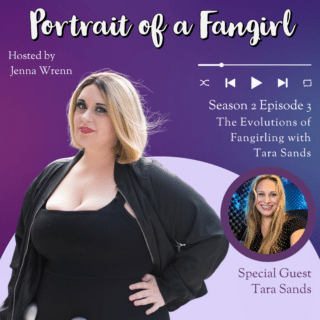
In the latest episode of Portrait of a Fangirl podcast, host Jenna Wrenn spoke with voice actor, Tara Sands.
The post The Evolutions of Fangirling with Tara Sands – Portrait of a Fangirl appeared first on TEMPLE OF GEEK.
[00:00:00] PORTUNOVA FANGREL
[00:00:10] PORTUNOVA FANGREL is a web series and podcast created by Temple of Geek.
[00:00:13] At the core of the project is telling the important stories of women who have found inspiration,
[00:00:18] growth and power through fandom.
[00:00:20] My name is Jenna Ren and I'm the host of PORTUNOVA FANGREL Podcast and today I'm
[00:00:24] here with Tara Sand.
[00:00:25] Hi Tara, how are you?
[00:00:27] Hi, thank you so much for having me.
[00:00:29] Well, thank you for coming on.
[00:00:30] I'm super excited to hear your stories and what you have to share with us today.
[00:00:35] We'll see.
[00:00:36] Well, let's get into it and then you can decide if you're happy with it or not.
[00:00:41] I'm sure I will be.
[00:00:43] Can you please just start off by introducing yourself to our audience
[00:00:46] and just telling us a little bit about who you are?
[00:00:48] Sure.
[00:00:49] My name is Tara Sands.
[00:00:50] I am a voice actor.
[00:00:52] I consider myself an actor.
[00:00:54] Sometimes I put the voice in front of it.
[00:00:56] I don't know if I always need to do that, but that's something we could talk about.
[00:01:00] Yeah, and I work on shows like Pokemon and Jujutsu Kaisan and Digimon and Yu-Gi-Oh
[00:01:06] and Rainbow High and all different stuff.
[00:01:11] I'm very tons of audiobooks, commercials, video games.
[00:01:15] I basically am a talker.
[00:01:17] I will do anything you tell me to say I will say.
[00:01:22] With some limits, but yes.
[00:01:25] That can get you into trouble sometimes, I would think.
[00:01:28] Yes. Well, I always say like I talk too much as a kid.
[00:01:31] I used to get detention and get in trouble.
[00:01:33] And I was like, I'll make this a job.
[00:01:35] So do what you love and try to get paid for it.
[00:01:39] Right. Maybe I should have been a voice actor.
[00:01:40] My nickname, my grandfather nicknamed me Jenna Jabberjaw when I was little
[00:01:45] because I used to love to talk.
[00:01:47] Jabberjaw is so cute.
[00:01:49] That's a good one, right?
[00:01:50] That is adorable.
[00:01:52] So maybe I made the wrong career choice.
[00:01:55] No, you're doing it right. You're talking right now.
[00:01:57] This counts.
[00:01:58] It totally counts.
[00:02:00] Try to get paid.
[00:02:00] So something we always really like to ask our guests is how they knew the term
[00:02:05] fangirl.
[00:02:06] So to you, what does being a fangirl mean?
[00:02:08] And has that changed over the years?
[00:02:11] Oh, for sure.
[00:02:12] So I think when not growing up because I'm a bit older than you,
[00:02:16] that was definitely a negative thing.
[00:02:18] Even though I was a fangirl of certain things, like if
[00:02:21] but I think if you had said that to me, I would have been like, no,
[00:02:24] I just really like it.
[00:02:25] There's a negative connotation with all things geek or I mean,
[00:02:30] especially anime, you know, we're talking about and that
[00:02:34] it's a different world now.
[00:02:36] I think, you know, people embrace their inner geek, but it's this
[00:02:40] a lot of this stuff is mainstream.
[00:02:42] So it's not even which is a tricky thing too, because you're like,
[00:02:48] well, just because it's mainstream.
[00:02:50] Now that we don't have to say it's a secret interest.
[00:02:56] Is that I don't know if that negates the I want to say this the right way.
[00:03:03] Now that it's mainstream, I think people should still be embracing
[00:03:06] their inner weirdness, geekiness, nerdyness, whatever you want to call it,
[00:03:10] otherness and it's cool that anime is mainstream, but I hope we don't
[00:03:13] lose the fun niches of it all.
[00:03:16] Right. Yeah.
[00:03:17] It was more of like, I know growing up while Pokemon was one of the big
[00:03:22] things that really took the world by storm when I was growing up.
[00:03:25] And it was very niche, like you said, very different.
[00:03:30] It's funny too, because like Pokemon is sort of became
[00:03:33] like a launchpad for people who then wanted to find more anime.
[00:03:36] Like kids who watched it didn't necessarily know that they were watching anime.
[00:03:40] And it's the kids who and I'm sure you were one of them were like,
[00:03:44] what is this? I want to learn more.
[00:03:46] And then went down that rabbit hole of of this other stuff
[00:03:49] that was maybe harder to find than Pokemon.
[00:03:53] But yeah, I think being a fangirl maybe was a dirty word or it sounded like
[00:04:00] you try to think of what the right thing would be.
[00:04:04] Because if it was a sports thing, I think maybe that would be looked
[00:04:07] at differently than if it was a fangirl of something like sci-fi.
[00:04:10] You know, I think there were different camps of fandom.
[00:04:14] That makes sense.
[00:04:15] Right. Like the, for instance, like when you say sci-fi,
[00:04:20] I think right away of Star Trek and like we're considered very different
[00:04:25] than somebody who is in a sports fandom or even music or something that's more
[00:04:31] I always want to say acceptable, but, you know,
[00:04:35] that's mainstream within. Yeah.
[00:04:36] Yeah. I mean, I was a fangirl of certain musical bands,
[00:04:40] like musical groups or never really got into sports.
[00:04:44] But like musical theater, I mean, I was a hardcore fangirl of musical theater.
[00:04:48] I still I still am and no shame in that.
[00:04:51] You know what I mean?
[00:04:52] It maybe wasn't what the whoever was considered the cool kids in school were into.
[00:04:56] But I didn't give a shit.
[00:04:57] I was like, well, what I like. Yeah.
[00:05:00] Right. And like fangirling, I think like when I think of it,
[00:05:03] it's very very tuned into like boy bands, like boy bands were huge.
[00:05:08] So music is a part of that.
[00:05:10] It's not just like comics or TV.
[00:05:12] It could be music. It could be sports, but I always think of boy bands.
[00:05:16] Totally. Yeah.
[00:05:17] I mean, there've always been what, you know, I think like we didn't
[00:05:20] call them that, but when you look at like the history,
[00:05:22] the Beatles were a boy band.
[00:05:24] We didn't say that, but if you were this has always been a thing.
[00:05:28] I actually do the there's a channel on serious XM called Boy Bands.
[00:05:32] And I do the voice work and it's really fun because I'm like
[00:05:36] saying all the names of all these great bands,
[00:05:39] but sometimes they'll throw in like a Jackson five or like,
[00:05:42] like this was a boy band, technically Manuto or whatever.
[00:05:48] They were boy bands.
[00:05:49] Totally. And I think it's finding the healthy relationship with it.
[00:05:53] Like I'm very obsessed with not that's that's backwards.
[00:05:57] I shouldn't say I'm obsessed with because then it sounds negative.
[00:06:00] But I'm really interested in learning about healthy fandom
[00:06:04] right where we draw the lines of obsession
[00:06:08] and when it's a healthy love of something.
[00:06:12] Yeah, that's a very interesting fact.
[00:06:14] That's a very interesting point to bring up.
[00:06:16] I want to interview someone who's an expert on that,
[00:06:18] but I don't know who that person is.
[00:06:20] Yeah, it would have to be, I guess somebody I almost want to say
[00:06:22] like a psychological aspect, right?
[00:06:26] Yeah, very interesting.
[00:06:27] Dan, I mean, it's it's what Stan became, you know,
[00:06:30] like it's what it's based on is this unhealthy obsession.
[00:06:34] Right. Now we know the word Stan around like it's like, I stand this, I stand that.
[00:06:38] And it's like, actually, that's bad.
[00:06:42] That means you are stalking them maybe at that point.
[00:06:45] I was going to say, kind of reminds me of like when you get
[00:06:48] until like stalkers or something along those lines,
[00:06:50] that kind of is when it's taken to the extreme.
[00:06:53] Great. And we use the word Otaku, you know, we throw that around.
[00:06:56] And again, I think that it's especially if someone's calling themselves an Otaku,
[00:07:01] it's fine. But then you're like, OK, where's the limit?
[00:07:04] Where's the right?
[00:07:06] I don't know. I may not have the answer.
[00:07:08] No. And it's it's I guess maybe it's an individual thing.
[00:07:12] Maybe it comes down to the person themselves
[00:07:14] and how they present themselves within the fandom.
[00:07:16] I don't know. It's a very interesting conversation to have.
[00:07:18] Or how much it overcomes your life. Right.
[00:07:22] You know, if you can't go to work because you need to watch,
[00:07:26] you know, you or you need to play all through a video game
[00:07:29] before you can go back to work.
[00:07:30] Maybe that's an unhealthy balance. Right. Yeah.
[00:07:34] And very interesting.
[00:07:35] I would love to hear that conversation if you ever do find someone to talk to,
[00:07:39] send it my way.
[00:07:40] Someone there is one person I need to keep following up on it
[00:07:43] because from my podcast, I work will talk about that later.
[00:07:47] But I am really interested in fandom
[00:07:50] and I someone did recommend one woman, but she never wrote back to me.
[00:07:53] So I'm still diving deeper to see who's an expert.
[00:07:57] Yeah. If anyone, hey, if anyone's listening to me,
[00:07:59] no one else an expert. Reach out.
[00:08:03] When was the first moment you really found yourself
[00:08:06] in grilling over something?
[00:08:08] I remember being in New York and someone like was like,
[00:08:14] there's Bernadette Peters.
[00:08:16] Oh, she was walking down the street.
[00:08:17] And I remember my knees buckling.
[00:08:19] Like I never understood that expression.
[00:08:23] Like my knees went weak or my knees.
[00:08:25] And I was like, I just could.
[00:08:26] It was like seeing royalty.
[00:08:28] I mean, this was like I met God.
[00:08:30] Like we're not. I mean, I didn't even meet her.
[00:08:32] I saw her walking down the street.
[00:08:34] I just I could not believe this is a human who shared the same street.
[00:08:40] Wow. Pavement as I did.
[00:08:42] So because that's where my fandom lies.
[00:08:43] It's it was musicals at that time.
[00:08:46] And yeah, I fully think I understood it at that point.
[00:08:50] Yeah. I don't think it gets much bigger for a musical theater fan girl
[00:08:53] than Bernadette Peters. That's like, oh my God.
[00:08:57] Wow, that's fantastic.
[00:08:58] I couldn't even imagine. Yeah.
[00:09:00] I mean, like and again, I didn't say anything.
[00:09:02] I would never have been brave enough to say anything.
[00:09:06] Just being near her was so cool.
[00:09:10] Just seeing seeing her experiencing her presence.
[00:09:14] Yeah. I mean, and that's what's what's interesting too.
[00:09:16] Like I'm throughout because of my jobs
[00:09:19] and I used to interview celebrities and stuff.
[00:09:21] I've met so many people and I don't get nervous when I know
[00:09:25] I'm going to meet them.
[00:09:26] It's when I see them in the wild that I'm excited like whole foods.
[00:09:31] Like if I see them in the supermarket, that's so much more interesting
[00:09:35] and makes me nervous as opposed to if you put a microphone in my hand
[00:09:39] and you're like interview Angelina Jolie like I was fine.
[00:09:43] You know, it's just the supermarket is weird.
[00:09:47] There's structure to that.
[00:09:48] There is no. Yeah.
[00:09:51] Oh, if I crossed the month path in the supermarket like that,
[00:09:54] I would I don't think I could handle it.
[00:09:56] You know, well, it's in the try not to stare
[00:09:59] and then you become a crazy person.
[00:10:01] Yeah, I'm very friendly.
[00:10:03] So I know this actually did happen to me one time.
[00:10:05] I know.
[00:10:07] Bearing of thought, but I ran into one of the MCU Netflix
[00:10:12] show stars, he's been Jones who does Iron Fist at the time.
[00:10:16] Ran into him on the train and we were sitting next to each other.
[00:10:20] And I know you like I just right.
[00:10:23] But when you're and also like, you're already sitting next to each other,
[00:10:26] like you kind of got to say something at that point. Right.
[00:10:29] Yeah.
[00:10:29] It's just as long as you're respectful and, you know, yeah,
[00:10:34] I guess a healthy person, you're not like coming on like you said,
[00:10:39] like a stalker stand kind of thing.
[00:10:41] Yeah, there's a way to do it. Right.
[00:10:44] Can you tell us a little bit about your job as a voice actor
[00:10:47] and what it's like to do that?
[00:10:49] Yeah, sure. So I talk, I wake up, I talk and then I keep talking.
[00:10:54] Yeah. So like, like today is a good example.
[00:10:57] So like I had to do some auditions when I woke up
[00:11:00] and then in the middle of an audio book
[00:11:02] and I'm directing myself basically.
[00:11:05] So you just try to be disciplined.
[00:11:07] I did not get a lot done because I get distracted by the world
[00:11:12] and the internet and Twitter and Instagram and yeah.
[00:11:16] So those days are tough because I'm in charge of myself.
[00:11:22] Then there's days when I have a director that I'm like going to a studio
[00:11:25] like first show like Jiu-Jitsu Kaesan, a lot of that's done at a studio
[00:11:29] with a director and an engineer.
[00:11:32] And then then I can get a lot.
[00:11:36] But every day is different, which is what I like about my job.
[00:11:40] You know, sometimes I have book a video game
[00:11:44] and they don't tell me in advance anything about it.
[00:11:46] So like I'm just cold reading everything, which is super fun
[00:11:50] and nerve wracking, but I find I enjoy that.
[00:11:53] Right. Yeah. And I enjoy just working on different projects
[00:11:55] and that every day is completely bananas and different.
[00:11:59] So with the audiobooks, are you basically kind of given a deadline?
[00:12:03] How does that work?
[00:12:04] Right. They say, you know, finish it by this day.
[00:12:07] Yeah. I mean, some do have a director, but for the most don't.
[00:12:10] And they say that here's your book, here's your due date.
[00:12:13] Get questions in by this date.
[00:12:14] So that because I don't usually have communication with the author.
[00:12:18] So I'm, you know, waiting for responses from publishers to ask the
[00:12:22] you know, because there's like like in this book right now,
[00:12:24] then there's a name that's L-E-A-H, which I always pronounce Leah.
[00:12:29] Right. But there are some people that might pronounce that Lee.
[00:12:32] So or Lee. I mean, who knows?
[00:12:34] You know, the author might have something else in her brain.
[00:12:37] So I send in a question like that.
[00:12:39] And sometimes that like screws up your deadline or, you know,
[00:12:42] you wait for a response. Luckily, I got it pretty quickly.
[00:12:46] So yeah, I'm kind of left to my own devices.
[00:12:49] Right. Just weird.
[00:12:51] I guess it's a good and a bad thing because like you said,
[00:12:53] you do have the time and the freedom to kind of get distracted.
[00:12:57] Right. Yeah.
[00:12:58] But I also have the time like I went to Trader Joe's today
[00:13:00] in the middle of the day because I can now just work on it tonight.
[00:13:04] You know, I don't have this.
[00:13:05] I don't have not locked into like a strict schedule.
[00:13:08] Right. That's nice. A little sense of freedom.
[00:13:11] Yeah. And I want to be a Trader Joe's all the time.
[00:13:14] So the more time I have to go to Trader Joe's,
[00:13:18] record your audio book at Trader Joe's.
[00:13:20] I would love to record an audio book about Trader Joe's.
[00:13:23] Oh my God, they have a podcast.
[00:13:25] You know, Trader Joe's insider, I think it's called
[00:13:29] their company makes a podcast about new items.
[00:13:33] Sorry, this is not what your audience wants to know about.
[00:13:36] I think that's super interesting.
[00:13:38] I do. I like it. I'm into it.
[00:13:41] So how did you wind up in the career you're in now?
[00:13:45] So I from a young age knew I wanted to be an actor.
[00:13:49] It's just it was I don't know how else to explain it,
[00:13:52] except I knew that's what I wanted to do.
[00:13:54] And if there was nothing else I wanted to do.
[00:13:57] And I always sell people and it's cliche, but like
[00:13:59] don't go into this if there's anything else you want to do.
[00:14:02] It's completely unstable.
[00:14:05] And I begged my parents.
[00:14:08] I lived in New Jersey really close to the city.
[00:14:11] I begged my dad to get me that newspaper backstage
[00:14:14] where there were auditions.
[00:14:16] So finally, when I when I was in high school, they
[00:14:19] they let me get that and I begged them to take me to auditions and they did.
[00:14:23] They were very patient and kind.
[00:14:25] And then I was in a local singing competition.
[00:14:28] I was a sophomore, I think at the local Y.
[00:14:31] And I entered this contest and there was a talent manager there
[00:14:37] and she called me into her office and she's like, hey, I think we want to,
[00:14:40] you know, we're going to send you on auditions.
[00:14:43] And we think you could also do voiceovers.
[00:14:45] And I'm like, I don't know what that is.
[00:14:47] And the first job they sent me on was a voiceover commercial
[00:14:50] for compound W. Wart cream.
[00:14:53] Oh, and I had to say something like, you know, croce award.
[00:14:57] And I booked the job and it was my first audition.
[00:14:59] Like so something in the universe was like, this is what you're supposed to do.
[00:15:04] And I did the job at put on the headphones in the studio.
[00:15:06] I felt so cool, but I did not at that point know that this was going to be my focus.
[00:15:11] I continue doing a lot of theater, television work, hosting work on a TV show,
[00:15:17] all different things.
[00:15:17] And the thing I kept coming back to his voiceover.
[00:15:20] And I love, you know, I got this job on Pokemon, which
[00:15:24] in, I guess, 99, 98.
[00:15:27] This is my first anime job.
[00:15:28] I didn't know anything about anime.
[00:15:32] But yet still, I was like, I'm a serious actor.
[00:15:34] And I kept going back to that.
[00:15:37] And then I was like, wait, there's other ways to do voiceover where it is more
[00:15:41] fulfilling because like anime as much as I love it, we're working alone.
[00:15:45] We're only seeing our part of the script a lot of the time.
[00:15:50] And there's other things in voice.
[00:15:51] I mean, gosh, some of my favorite work has been on video games and intense
[00:15:56] stuff where you're calling on whatever training you have
[00:15:58] and whatever life experience you have.
[00:16:01] So I feel lucky to really only be doing voiceover work right now.
[00:16:06] That's such a great story.
[00:16:07] It's, you know, something you always meant to be in.
[00:16:09] I think so.
[00:16:10] I think that, you know, listen, I'm not very like spiritual or university,
[00:16:13] but I think the world just guides you to where you're supposed to be
[00:16:19] somehow like I was going to end up here.
[00:16:21] I used to quote commercials as a kid.
[00:16:22] Like this was this was going to happen.
[00:16:25] And I always tell kids that like you're going to be surprised at what you end up doing.
[00:16:30] It's probably not what you think, but it's you're going to get there.
[00:16:34] Just be patient and yeah.
[00:16:37] Exactly.
[00:16:39] Do you ever find yourself fangirling over one of your roles
[00:16:43] or some of the characters that you've played?
[00:16:45] I'd like to be some of the characters I play.
[00:16:48] Like if I could trade places and be bisquey from Hunter Hunter for a day.
[00:16:54] That'd be cool.
[00:16:55] That'd be awesome.
[00:16:56] Yeah, I'd like to be her.
[00:16:57] She travels with the masseuse and then can kick butt.
[00:17:01] So I, you know, anyone that like the characters I fangirl over that I love
[00:17:05] are the ones that have really cliche girly sides.
[00:17:09] You know, I don't know.
[00:17:10] I know that that terminology is probably changing, but.
[00:17:14] But the cliche of that, but then also can kick ass.
[00:17:17] And are tough and strong.
[00:17:20] And, you know, all those things, it's that great balance of human.
[00:17:25] So yeah, I mean, I I would love to be some of my characters.
[00:17:28] I'm trying to think, I mean, Bulbasaur, I don't know that I'd want to fangirl over Bulbasaur.
[00:17:34] Maybe in the universe, in like the Kokémon universe.
[00:17:37] Yeah, like if I was going to have to be a Pokemon, like, yeah,
[00:17:40] Ash treats him pretty well.
[00:17:41] I mean, it's, you know, I guess I'm not a bad gig.
[00:17:46] Yeah, why not?
[00:17:48] I think they get fed well.
[00:17:49] It treated better than some of the other the other Pokemon out there.
[00:17:52] So.
[00:17:52] Well, yes, that's very that's that's a good point.
[00:17:55] Yeah, I mean, so cute.
[00:17:57] I think it's so cute.
[00:17:58] They're all adorable.
[00:17:59] Like, yeah.
[00:18:00] But and you said it was like 1999 that you started Pokemon.
[00:18:04] Yeah, I was part of the original dub cast in New York.
[00:18:07] So huge. That was a minute.
[00:18:09] That was a long time ago.
[00:18:11] I was part of the first eight seasons until the cast got replaced.
[00:18:14] So I feel very lucky to have been part of the beginning of that.
[00:18:18] Right. That was, you know, I would think when it really first hit the US
[00:18:24] when it first exploded.
[00:18:26] Yeah, it was crazy.
[00:18:27] We didn't. I mean, listen, my first day of work there, I was like,
[00:18:29] what is this weird show? Good luck.
[00:18:32] Never see you guys again.
[00:18:33] It was I don't I mean, I mean, this is a lot of what the podcast
[00:18:37] I made is about is them taking a chance on this show
[00:18:41] that yes, was successful overseas in Japan.
[00:18:44] But I don't most of us looked at it as adults and we're like, what is exactly?
[00:18:49] Yeah. But there's so much heart and I've realized over the years
[00:18:53] and speaking up like fan girling over
[00:18:56] I fangirl over the artwork because that these characters,
[00:18:59] especially the original hundred fifty, like
[00:19:02] they speak to children in a way that is just remarkable.
[00:19:06] Kids see this stuff and are just on into it.
[00:19:10] And now I understand that.
[00:19:12] Now I understand that it has to do any when you know, speaking of fandom
[00:19:15] and that the Pokemon Company understood
[00:19:19] how to approach this from all angles, from a TV show to a card game
[00:19:23] to the video games.
[00:19:24] So it was all encompassing and it was hard not to
[00:19:30] not to capture a kid's attention, even if they only watch the show
[00:19:33] or they only collected the cards.
[00:19:35] I mean, there are kids who collect those cards
[00:19:36] and have never played a game or watched the show.
[00:19:38] They're just obsessed with the collection.
[00:19:41] So, you know, if you talk about fandom,
[00:19:43] the Pokemon Company is an expert at knowing how to capture fans.
[00:19:49] But they really are.
[00:19:50] I it's so funny because it was so popular when I was in,
[00:19:54] I guess like middle school, but I never really watched the show
[00:19:58] until I had really little siblings.
[00:20:00] My sister and I are 17 years apart and she had me watch it with her.
[00:20:04] And I was probably in my 20s.
[00:20:05] It was like, I can't believe I missed out on this.
[00:20:07] This show is amazing.
[00:20:08] It's so good.
[00:20:10] That's so cute. Yeah, I mean, it's my cousin's kid was
[00:20:13] I was dropping something off to my cousin's kid one day
[00:20:16] and he was about five, I think at the time.
[00:20:18] And he and his friends were holding the Pokemon cards.
[00:20:21] And I was like, hey, guys, I tried to I thought maybe I'll give him some
[00:20:24] streetcrant and I was like, you know, I I play some voices on the show.
[00:20:30] Do you watch the show?
[00:20:30] And they go, no, it's for babies.
[00:20:34] I was like, never mind.
[00:20:36] Here is your whatever I was dropping off.
[00:20:38] Yeah. And I was like, oh my God, I just got put in my place.
[00:20:41] But five year olds. Oh, man.
[00:20:43] And you're going to be the cool. I thought I could be cool.
[00:20:47] Yeah. No, not a no.
[00:20:50] It's so funny.
[00:20:51] But that was but that was a good learning moment for me too.
[00:20:53] I was like, they are into this, but it doesn't mean they watch the show.
[00:20:57] Right. You know, there's so many different facets
[00:20:59] of that particular fandom for someone to be involved in.
[00:21:04] Totally.
[00:21:06] What was it like to experience fandom
[00:21:09] in such an immersive way when you started attending conventions?
[00:21:14] It's confusing because we worked in such a bubble.
[00:21:17] Like I knew the show was big, but I didn't know anyone cared about us,
[00:21:22] which is probably for the better.
[00:21:23] I think it kept all our egos in check for sure.
[00:21:26] And there weren't.
[00:21:28] There was no social media.
[00:21:30] There were some message boards, but honestly, those were mostly used
[00:21:33] to complain and to yell at the companies for things they didn't like.
[00:21:39] So I, you know, it was I was sort of late to the convention game,
[00:21:43] like some of Ronick Taylor and Lee Sorties, they had been in our steward.
[00:21:47] They had been doing it longer than I had.
[00:21:49] And I was like, wait, you're saying that people want to meet us?
[00:21:53] They're like, not only meet you, they want like your autograph.
[00:21:56] They want to like your no, there's no way.
[00:21:59] And now I have traveled the world meeting these people.
[00:22:02] And what I realized to you, it's like it's not about being a fan of me necessarily
[00:22:10] because I can take I have to take myself out of the equation.
[00:22:12] It's about what these shows meant to them and where they were in their life
[00:22:16] when they first saw it because that is so powerful.
[00:22:20] Nostalgia is so powerful.
[00:22:23] I've heard so many times that someone was going through a tough point
[00:22:27] in their life when they started watching the show and it got them through it.
[00:22:31] It was their distraction.
[00:22:32] It was their happy place.
[00:22:34] You know, I've told this before, like someone's house burned down
[00:22:37] and they only had their Yu-Gi-Oh VHS tape or whatever, a DVD or so.
[00:22:42] It's what this represents.
[00:22:43] And if I'm there representing the face of this thing that is so much bigger than I am
[00:22:49] and I'm a cog in this wheel, I'm happy to be there for them to share their story.
[00:22:54] But I in no way feel responsible for the success of these shows.
[00:22:59] I think it would be unhealthy to think that I am responsible for it.
[00:23:04] It must be very touching to hear these stories, though, from from people of all
[00:23:08] different walks of life.
[00:23:09] Oh, that's the big that's what it is.
[00:23:11] I mean, I and the fact that they're trusting me with this information, it's huge.
[00:23:16] It's it's what I make sure that at every convention, I at least have like a
[00:23:21] connection like that.
[00:23:22] And I hear I let someone just go on and on for as long as they need to to tell me this.
[00:23:27] And I and then I try to compare it to what I'm a fan of and what I would have
[00:23:31] said to Bernadette Peters that day if she had just if I was allowed to talk to her.
[00:23:37] So that's, you know, it's it's such it's an honor.
[00:23:40] It's a privilege.
[00:23:41] It's it's crazy that anyone wants to talk to me.
[00:23:44] Find it strange.
[00:23:47] But you now run a podcast and it's called Four Kids Flashback.
[00:23:52] Yes, I do talk to you a little bit about that.
[00:23:54] And here just kind of how you got started with this.
[00:23:58] So can you just tell me a little bit about what the podcast is?
[00:24:01] Yeah, so for people who don't know, Four Kids is the company that brought
[00:24:05] shows like Pokemon and Yu-Gi-Oh and Shaman King.
[00:24:07] And they did a version of Teenage Mutant Ninja Turtles.
[00:24:10] And they were responsible for a lot of the stuff in your childhoods
[00:24:14] that you watch. And they took a real risk with Pokemon.
[00:24:17] Nobody wanted it.
[00:24:19] They are also a company that has been yelled at many times for changing anime
[00:24:23] for maybe Americanizing it or making cuts in it that to make it more
[00:24:28] appropriate for children because it was on Saturday mornings.
[00:24:31] And I get asked about it at conventions all the time.
[00:24:34] And it encouraged me that there were people who should be at these
[00:24:39] conventions and and answering these questions.
[00:24:41] It's the writers, it's the producers, the people who wrote the music,
[00:24:45] the just all aspects of this, the voice directors that I wanted
[00:24:50] to shine a light on also get answers from but give some credit to
[00:24:54] and give attention to because they should have that attention.
[00:24:59] So I've started interviewing everyone I can who works there, you know,
[00:25:02] the actors included, but the actors tend to know a lot less than the writers
[00:25:06] and the people who are on staff there.
[00:25:09] Right, the people who went into more of the creating
[00:25:12] yep behind the scenes process for sure.
[00:25:14] Yeah, so it's basically a behind the scenes look at this company
[00:25:18] and the shows that happened during that time.
[00:25:20] Right, it's I did hear how they would kind of sensor the shows to make
[00:25:25] it more appropriate like instead of a cigarette, they have a lollipop or
[00:25:28] something like that. Right?
[00:25:30] I've heard those stories before.
[00:25:32] And like they would and listen, One Piece was an example of a show
[00:25:36] when we interviewed the president of the companies like we shouldn't have
[00:25:38] done One Piece. We were a children's company, but it was a big hit in Japan.
[00:25:42] Toei wanted to make toys.
[00:25:43] So we acquired it and tried our best, you know, with what
[00:25:48] they had also created a ton more work for them.
[00:25:50] So people that yell at them for changing this stuff, it's like,
[00:25:53] they don't want to do all this extra work.
[00:25:55] This is the standards and practices insisting that they do this.
[00:26:00] Wow, a lot goes into that.
[00:26:01] It's very interesting.
[00:26:03] Yes, job to do.
[00:26:04] You see, it's not a job I would be good at.
[00:26:07] So I admire anyone who could handle that.
[00:26:10] What sort of challenges have you run into while doing this podcast?
[00:26:15] Well, scheduling is not fun.
[00:26:17] What I found and actually this is kind of appropriate for this podcast
[00:26:20] is that the men I approach to do interviews are often very eager.
[00:26:27] And a lot of the women are not interested in being interviewed.
[00:26:31] And I don't think it's because they are upset about any.
[00:26:33] I think it's a difference between maybe the way we're wired
[00:26:38] and they're wanting to share maybe details about themselves.
[00:26:44] Or feeling someone was insecure about maybe not remembering enough.
[00:26:49] And I'm like, it's OK.
[00:26:50] We kind of digress and it's been fascinating how many
[00:26:56] knows I've gotten from women as opposed to men.
[00:26:58] I think there was one man who wasn't interested.
[00:27:01] I mean, there are a few women who are like busy taking care of family members.
[00:27:07] And listen, I don't know what the answer is to that.
[00:27:11] And maybe that women are shy or by nature.
[00:27:13] I don't I don't know.
[00:27:14] Like I and I again, don't want to make stereotypes out of this.
[00:27:20] And I don't want to.
[00:27:21] I know we're at a point where we're figuring out gender norms
[00:27:26] and all this stuff and wanting to get away from that.
[00:27:29] But I think there's something to it that I've had many more
[00:27:33] knows from women than men.
[00:27:34] And I don't I don't know.
[00:27:37] I think inherently that I mean, I don't know.
[00:27:40] This is the trend that I've kind of seen in a lot of the women
[00:27:42] I've spoken to where they feel like they have to justify their place in fandom.
[00:27:48] You know, maybe I don't think maybe men maybe don't feel like they have
[00:27:53] to they're a fan of something and that's it.
[00:27:55] Like I feel like that's a great point spot at the table almost.
[00:27:59] That's a great point.
[00:28:00] Like there's still even conventions.
[00:28:02] And listen, I think what's great is early days of conventions.
[00:28:05] There was no line for the women's bathroom and now there is.
[00:28:08] And I think that's very telling.
[00:28:10] But but again, when you see like a group of cosplayers,
[00:28:13] sometimes it's all dudes in one or two.
[00:28:15] It I think they're still earning and fighting for their place.
[00:28:19] And I think that's a great point.
[00:28:20] Yeah, I don't know.
[00:28:22] I don't know.
[00:28:24] Yeah.
[00:28:25] I wonder if in general, too, I mean, I don't know,
[00:28:27] you would obviously know more.
[00:28:29] But when you're reaching out to people who work on these shows,
[00:28:32] is the demographic generally more predominantly male than this female?
[00:28:36] It is, which is why I made a concerted effort to reach out to more females.
[00:28:40] And then I was surprised by the response I was getting.
[00:28:45] Yeah, interesting trend.
[00:28:47] I mean, also, I mean, it could just be that more of them are more hands on
[00:28:51] with their elderly family members and are helping out like it's
[00:28:55] it is interesting though.
[00:28:56] Like there's something societal about this.
[00:28:58] Like I don't again, I'm not a psychiatrist.
[00:29:01] I'm probably not going to figure it out.
[00:29:02] But there is.
[00:29:04] There's something in our race that is making
[00:29:07] women not as eager to talk about their lives publicly than men.
[00:29:11] Right.
[00:29:12] And I think this it's interesting because this podcast,
[00:29:15] I feel like a lot of women were excited because it is tailored to fan girls
[00:29:19] like women. So I think it's more, I guess,
[00:29:23] more of a safe space kind of for women to tell their stories.
[00:29:27] Yeah, no, it's a great idea.
[00:29:29] Yeah.
[00:29:30] What have been some of your favorite experiences working on your podcast?
[00:29:35] Oh, gosh. Well, so I'm a fan of like true crime podcasts and stuff.
[00:29:39] So I treat myself like I fancy myself a detective.
[00:29:43] So there is like stuff that when I solve
[00:29:48] a mystery about four kids, like there was some lost media
[00:29:52] that we were able to uncover.
[00:29:54] Somebody happened to have some that we were interviewing.
[00:29:56] So we found these like this lost episode of Ultraman Tiga.
[00:30:00] And I mean, it was as if I had just solved
[00:30:04] I'm trying to think of a I'm like Sherlock Holmes,
[00:30:06] like I am so proud of myself.
[00:30:09] So it's the moments of discovery that are really fun for me.
[00:30:14] Or like when I find up, you know, there is
[00:30:16] there were a lot of questions about some of these uncut DVDs that got made.
[00:30:19] And I found someone who worked in the home video department
[00:30:23] and I wrote to him. I said, do you know anything about this?
[00:30:25] And he wrote back and said, oh, those were my idea.
[00:30:28] I mean, I did it.
[00:30:31] It was like a happy dance like you've never seen.
[00:30:33] Like I again felt like a detective.
[00:30:36] Like I found the guy.
[00:30:38] So yeah, it's those moment, right?
[00:30:41] Yeah, pathologists put together.
[00:30:42] That's what I feel like.
[00:30:43] Yes. On bones or whatever shows they uncover things on.
[00:30:48] Yeah. So it's the discovery process of it for me because.
[00:30:52] I mean, in all honesty, anime is not where my fangirl lies.
[00:30:57] It's just not because I work in it.
[00:30:59] So it's it's demystified for me from a very early time.
[00:31:03] It was demystified for me.
[00:31:05] So I think it would have been strange if that was my fandom.
[00:31:09] Right.
[00:31:10] So the podcast itself, like I feel like I'm discovering this for other people.
[00:31:14] Like we have a discord channel where we share stuff and like if I can,
[00:31:17] you know, they'll send me sound clips and they're like,
[00:31:20] we want to know who voiced this.
[00:31:21] And it for kids was notorious.
[00:31:23] They just made a list of credits.
[00:31:25] They never said who played what.
[00:31:28] So literally I'm sending sound files to like director.
[00:31:32] I'm annoying my friends constantly sending them sound files.
[00:31:35] And then when we do figure it out and I present it to our discord channel
[00:31:39] and I know how happy they are to have it solved,
[00:31:41] I am living vicariously through them.
[00:31:44] And even though I kind of don't care who voiced it,
[00:31:47] I'm still as excited as they are.
[00:31:49] Right. You're facilitating someone else's inner fangirl.
[00:31:54] You really are.
[00:31:55] Well, that's it.
[00:31:56] You're so that's exactly what it is.
[00:31:58] And if I can help that in any way without it being like,
[00:32:01] listen, I'm sure some of those people have an unhealthy obsession
[00:32:04] and I hope I'm not feeding that.
[00:32:05] But if I smile on their face by finding it and all it took was an email,
[00:32:10] then I'm the real to help.
[00:32:12] Oh, that's that's great.
[00:32:14] Do you find yourself remembering things from dubbing with four kids
[00:32:17] that you may have forgotten when you're talking to guests?
[00:32:21] Sadly, my memory is there's things I remember,
[00:32:25] but I they mention things and I keep wishing that it'll like unlock
[00:32:30] a treasure trove of memories that has not happened yet.
[00:32:34] Unfortunately, yet yet.
[00:32:37] But it is fun to watch their memories get unlocked.
[00:32:40] Like once in a while, I'll ask a question that suddenly
[00:32:44] then they like I get so many apologies before the podcast
[00:32:49] where they're like, listen, I don't know how much I'm going to remember.
[00:32:51] And suddenly we sit down for the interview and something
[00:32:55] sparks something in them and they talk for an hour about a project
[00:32:59] they thought they knew nothing about.
[00:33:01] So that it's not me remembering, but it's fun watching their memories
[00:33:06] get unlocked.
[00:33:07] Right? You're placing them back in that time, in that place
[00:33:09] that kind of brings back all these.
[00:33:11] Yeah, these moments for them.
[00:33:13] Yeah, it's really cool to see.
[00:33:15] That is really cool.
[00:33:17] Yeah, especially because I think a lot of us have mixed feelings
[00:33:20] about our time there because, you know, it's like any job.
[00:33:24] No one no job is perfect.
[00:33:27] And it was an imperfect company because everywhere is.
[00:33:29] And, you know, maybe people didn't get paid right,
[00:33:32] maybe they didn't get treated right or the the intensity of the schedule.
[00:33:36] But what I'm watching them, I'm watching their mostly happy memories
[00:33:40] come back to them, which is kind of fun.
[00:33:43] And again, if I can facilitate that, it's cool.
[00:33:47] It's very cool.
[00:33:48] Now, I would like to ask you my final question and I want to know what
[00:33:52] advice you would give to women who are trying to succeed in the entertainment field?
[00:33:58] It's a tricky place right now because I think we're figuring out,
[00:34:03] first of all, what's going to happen with a lot of I think.
[00:34:08] Listen, I encourage everyone to pursue their dreams,
[00:34:10] but I also encourage you to look for jobs that are not replaceable.
[00:34:15] You know, we've watched shows, especially in animation,
[00:34:17] get cut from streaming networks.
[00:34:19] I think there is probably an oversaturation of work and of product
[00:34:23] in general happening and now a lot of places are pairing back.
[00:34:26] So I think find your passion, be savvy about it.
[00:34:29] But also if you I've watched so many people who consider themselves
[00:34:35] performers, find happiness, enjoy in other aspects of this industry.
[00:34:39] And I think just be I wish I had been more open to that,
[00:34:43] to producing and doing other other things that not
[00:34:47] necessarily offered more stability, but would have made me a more
[00:34:50] well rounded human.
[00:34:52] So I think just being open to all areas of I always say, like,
[00:34:56] if you want to live a creative life, be open to all sorts of creativity.
[00:34:59] And that might come in surprising places because that was my goal.
[00:35:03] It was to be a creative person.
[00:35:05] And I didn't again, I think I would have been upset if you told me
[00:35:09] I was only doing voiceover work and I'm not upset about it.
[00:35:12] But I think 18 year old me would have been like, but no, I'm a theater actor.
[00:35:17] I'm a TV actor, you know, but there's this is so fulfilling.
[00:35:21] So I just say be open to every every aspect of this industry
[00:35:25] because it's changing constantly.
[00:35:27] Technology is changing it constantly.
[00:35:29] Learn everything you can about it.
[00:35:32] I think that's wonderful advice.
[00:35:34] I hope so.
[00:35:36] Well, thank you very much for taking the time to talk to me today
[00:35:40] and telling me sharing your story with me.
[00:35:42] I really appreciate it.
[00:35:43] Thank you for having me.
[00:35:45] Thank you. And where can we listen to your podcast?
[00:35:47] Oh, anywhere you get podcasts, it's for kids flashback the number four
[00:35:52] for kids flashback dot com.
[00:35:53] You can find our Patreon page or you can find places to listen for free.
[00:35:57] And I met Tara Sands Vio and I post links to all that nonsense on my pages.
[00:36:02] So thank you again.
[00:36:03] I appreciate it.
[00:36:06] Thank you.