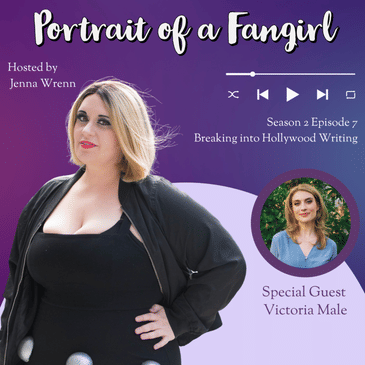
In the latest episode of Portrait of a Fangirl podcast, host Jenna Wrenn spoke with Hollywood screenwriter, Victoria Male.
The post Breaking into Hollywood Writing with Victoria Male appeared first on TEMPLE OF GEEK.
[00:00:00] .
[00:00:10] Portrait of a Fangirl is a web series and podcast created by Temple of Geek. At the core of the
[00:00:14] project is the importance of telling the stories of women who have found inspiration, growth,
[00:00:19] and power through fandom. My name is Jenna Wrenn and I am the host of Portrait of a Fangirl Podcast.
[00:00:25] Today, I have the pleasure of talking to Victoria Malé. Hi, Victoria.
[00:00:30] Hi, thank you so much for having me, Jenna. I'm thrilled to be here. Be back here at Portrait
[00:00:35] of a Fangirl in a new exciting context. I know you were part of the web series, right?
[00:00:41] I was. I was so honored to be part of the web series and to get to play dress up and be shot
[00:00:46] and interviewed by Monica was truly a dream come true. It's so exciting to see the way ideas
[00:00:54] evolve and how this was a web series and now it's a podcast but at the core it's the same
[00:00:59] the same project and the same love we're sharing with for fandom.
[00:01:04] Yes, yes. I love the mission so I'm here to contribute to it however I can.
[00:01:08] Yes. So can you please just tell our audience about yourself and what you do?
[00:01:14] Sure. Yeah, I am a writer. I write for a bunch of different mediums. I've written
[00:01:19] screenplays. I've written short stories. I'm currently writing on an audio drama
[00:01:23] but before I got there, I started working in the film industry about 10 years ago,
[00:01:31] literally from the bottom up. I was very lucky that I got to intern for my childhood hero,
[00:01:36] Tobey Maguire because a huge fandom of mine is Spider-Man. I'm obsessed with Spider-Man
[00:01:41] and the Spider-Verse and then I just kind of bounced around for the past 10 years in the
[00:01:46] entertainment industry. I was a researcher. I worked in casting. I was a personal assistant
[00:01:53] and then in 2017, I got a job with Ivan Reitman who was kind of the godfather of
[00:02:01] the Ghostbusters franchise. He directed the first movies in the 80s and he produced all
[00:02:04] subsequent Ghostbusters movies so I worked with the Ghostbusters franchise and that team for
[00:02:10] about five years in creative development where I was part of the team that kind of took an
[00:02:15] idea from script to screen and was like the midwife of any project that we were working on
[00:02:22] which was incredibly illuminating and very much like a Hollywood boot camp.
[00:02:28] And then Ivan passed away in 2022. I moved on to work for Graphic India which is this really cool
[00:02:36] media startup trying to kind of create the marvel of the East using South Asian and East
[00:02:42] Asian mythologies. I helped them get their American office set up and then now I've
[00:02:48] transitioned to writing full-time. I've had my five short stories published in 14 literary
[00:02:52] magazines worldwide. I had a couple screenplays do well this past year. One made the love list of
[00:02:58] the best unproduced romance scripts in Hollywood. Another one made it to the finals
[00:03:03] of the Nickel Fellowship that's run by the Academy and then yeah now I'm here
[00:03:08] writing on this really fun splashy audio drama called Murder Overboard for Pocket FM.
[00:03:17] Wow you have had your hands in everything the past decade huh?
[00:03:21] It's like not it was never the like it was just out of necessity. It's like okay this these people
[00:03:26] give me money sure like what if no one's you know especially last year with all those short
[00:03:30] stories that I wrote they were all a lot of them are based on my scripts and it was because
[00:03:34] we were in a strike and no one I couldn't do anything with them so I'm like let me try to
[00:03:39] do this I'll create some IP for myself and then get myself published and see what happens
[00:03:43] there and it's just one of those things where you have to all like especially in Hollywood I feel
[00:03:48] like you always have to be resourceful and always kind of look at things slightly from the side
[00:03:53] and get creative and think out of the box. Right I would think though that being a part
[00:03:58] of all these different aspects of Hollywood helped you grow as a creator yourself. Oh my
[00:04:05] and like definitely you hit the nail right on the head I think. I was thinking about this
[00:04:09] actually yesterday because I'm really lucky with the manager I work with like it's very much
[00:04:14] a partnership. I'm pitching as many companies and places we should go out to with my material
[00:04:19] as he is and that I think has really helped me become a more savvy creator and writer and
[00:04:25] producer. The fact that I did have almost a decade of doing almost everything else so I kind
[00:04:32] of know how the sausage is made and how to work certain things and I'm really also blessed
[00:04:36] that I have a great Rolodex of people that I can call and that I'm finally now starting
[00:04:42] to call on favors with. Right they're now your peers. Yes it's very exciting. Yes I
[00:04:50] want to get into your career in Hollywood I knew I'll get distracted if I start now
[00:04:55] but I want to start off by asking you something we ask all of our guests is how
[00:05:00] they view the term fan girl and if that's changed over the years. Oh man that's such a
[00:05:06] loaded question for me and such a loaded term because I think it's gone through like peaks
[00:05:11] and valleys. I think when I was younger I loved being a fan girl. I was so unapologetically
[00:05:16] a fan girl especially when I discovered like the OG Spider-Man that Tobey Maguire was in
[00:05:23] and Kirsten Dunston directed by Sam Raimi. That was the movie that really made me fall
[00:05:27] in love with movies and really opened my eyes to engaging with fandom.
[00:05:32] And then you know so I don't want to age myself too much but you know it was so interesting
[00:05:36] because back when I was younger those liking superheroes were so gendered and I think that
[00:05:42] was the first time I ever ran into shame or a negative reaction to being super passionate
[00:05:49] about something that I loved where they're like that's for like why do you like Spider-Man
[00:05:53] that's for boys. I was like no it's not or I was like I don't care like I just like it and
[00:05:59] and then I think throughout my adolescence and my early 20s I was so ashamed of being a fan
[00:06:05] girl and it felt like something I had to hide and you know I used to host this podcast
[00:06:10] called Your Biggest Fangirl and me and my co-host Kirsten who also who's a contributor
[00:06:17] at TempliGeek and one of my dearest friends we made these 10 rules of fangirling and I
[00:06:24] I'm pretty sure the first rule was hide your crazy which I do stand by it's always good to kind
[00:06:28] of play try to play things cool if you can but I think I had so much shame and I felt so judged
[00:06:35] for how much I liked things and how passionate I was and I think it's really
[00:06:39] only in the past couple years that I've learned it's a it's a superpower and it's
[00:06:43] actually something I can use and all those years I've spent fangirling have actually are
[00:06:48] now coming back to serve me in ways I didn't expect so now I love being a fangirl and I love
[00:06:54] I feel like I've done such a good job or I'm proud of myself for really owning the term
[00:07:00] and owning who I am and owning what I'm passionate about rather than trying to
[00:07:05] hide it and and play things cool so yeah I know that's a that's a wide that was a
[00:07:11] winding road I took everyone on but that's kind of my relationship with the term in a nutshell
[00:07:17] it's loaded it's loaded it is nice fully I also I can't speak a nut gal my god but yeah so well
[00:07:25] it is a fangirl podcast so nut gal I kind of I don't know it works it's me I think that is how
[00:07:30] you would describe it she's nutty and she's a gal so not gal it's the new it's a fangirl now
[00:07:35] we're creating more in the in the lexicon as we speak you can catch us on portrait of a nut
[00:07:41] girl next yeah exactly that's my spin-off podcast to them yeah it's it's definitely something you see
[00:07:47] nowadays where I feel like women are into these things that I think the media sometimes can
[00:07:53] portray it as oh it's trendy they're into this because it's trendy but I think women are
[00:08:00] it's just that women are more apt now to show that they like these things that maybe we
[00:08:05] were kind of gate kept from in the past yeah and I think also I think women were so
[00:08:09] dismissed by we were so dismissed too because I remember when I was doing my degree in communication
[00:08:15] studies in college we did this little mini student documentary about vampires and vampires
[00:08:21] in pop culture and I remember we interviewed this a brilliant grad student who was saying
[00:08:26] you know how important twilight was even though people poo poo it it really showed that
[00:08:31] women have purchasing power and financial power and that's honestly what speaks to the Hollywood
[00:08:37] executives and that's how we get more of the things we love on screen and so I think you know
[00:08:42] honestly there wouldn't be a bridgerton if we didn't if the fan girls hadn't shown out for
[00:08:48] like hunger games and twilight in in the in the aughts it's weird too it's like wait no
[00:08:54] this is something we could own and something that actually gives us power and I was reflecting
[00:09:00] on this earlier this week how when I was working in development that people used my colleagues kind
[00:09:09] of used to look at me sideways for wanting to bring in people I was super passionate about
[00:09:14] and I think there was a very gendered kind of misogynist slant with that where they're like
[00:09:18] oh you just you just have a crush on this actor you just want to bring in this person
[00:09:21] because you want to be friends with them or you're you're trying to social climb which
[00:09:25] like wasn't totally untrue but also it's like why why wouldn't we if we're I was so privileged
[00:09:31] to be in this position why wouldn't I bring in people I'm genuinely excited to work with and
[00:09:37] collaborate with right so yeah it's it's I feel like it's very it's a good time to be a fan
[00:09:42] girl because I really feel like we're changing kind of how we're viewed right and it's
[00:09:47] interesting that you bring up the fact that you worked on ghostbusters because I feel like
[00:09:51] if we're gonna hit on fangirl culture and women in the media that was one of the biggest things
[00:09:57] we've seen in recent Hollywood history you know it caused such a almost like an uproar
[00:10:04] yeah and as someone who worked really you know who got I came on right after that movie
[00:10:09] came out took Ghostbusters franchise and I will always maintain because I think it's it's
[00:10:13] a decent movie I just think everyone felt crestfallen by it and disappointed by it
[00:10:18] because it didn't have any connective tissue to the original lore and I think when we now that
[00:10:23] we're living in this media landscape of multiverses and the mcu and and everything all being
[00:10:28] connected and they're being even if it's not outwardly connected there's like a wink at
[00:10:32] something that all the fans can recognize I think that was something that that um that
[00:10:38] that movie was missing for me personally I mean I feel like Chris Hemsworth being hilarious
[00:10:42] really made up for a lot but yeah it was it was really shocking to to experience as a woman
[00:10:51] creating and who consumes media um and then it also made me really happy when Ghostbusters
[00:10:56] Afterlife which I got to be on that movie from literally like inception to release
[00:11:02] how that how well received that was um with two female protagonists you know Phoebe and Callie
[00:11:08] so it's very interesting how how women I think we're we're always in the like we're always in
[00:11:15] process of negotiating how we want to be seen and perceived in the media both as like an object
[00:11:20] on the screen and also as a consumer of it right yeah it's a very complicated beast
[00:11:25] it's all very complicated yes when was the moment that you personally first found yourself
[00:11:32] fangirling you know I've thought about this and it's so funny um because I think my first
[00:11:40] I really do feel like I came out of the womb this way and the evidence for that is I remember
[00:11:44] when I was five years old I saw the Disney animated Hercules and I was like this is art
[00:11:50] and X amount of years later I still maintain that I that movie's brilliant bloody brilliant and
[00:11:57] but I remember I was so like enamored with that movie and that movie ignited a lifelong
[00:12:02] passion and love of Greek mythology and I will never forget my poor grandmother she was
[00:12:08] babysitting me I think my parents were like doing a couple's trip to Hawaii or something
[00:12:13] and I remember I literally dictated a story to her about Hercules and Meg from the Disney movie
[00:12:21] going to Olympus and I made her not only write it out but like draw all the photos like draw
[00:12:28] all the pictures for me and I it was hilarious they were going to heaven and they took a plane
[00:12:33] naturally so I think again it's been like this has been something that um has kind of been
[00:12:39] inherent within me so that was I think my first real instance of fangirling and then I
[00:12:44] think when I when I stumbled upon uh Spider-Man I that kind of just ratcheted everything up to
[00:12:51] the next level. Yeah it's so great that you mentioned Hercules like I think for our
[00:12:56] generation it's the Disney the presence of those Disney movies was defining of our
[00:13:03] childhood so you can easily see how that would play a part in those formative years.
[00:13:09] Yes and I think they are brilliant movies I think that's the best I think we our generation
[00:13:14] was so spoiled that we had them as children because it's been such a joy to rediscover them
[00:13:19] and re-watch them as an adult and pick up on all the smart little jokes they put in that
[00:13:24] naturally kids would have missed and I just still I tell everyone I do I like am
[00:13:31] unabashed at Hercules Stan because I think also now knowing what I know now about
[00:13:36] Greek mythology and music and musicals and writing and all that good stuff I'm like
[00:13:41] the fact Alan Menken went Greek chorus gospel choir I'm good like my mind won't be blown
[00:13:47] by that for the rest of my life like it's so freaking genius. Yeah I don't know who would
[00:13:53] have married those ideas besides Alan Menken. Yeah yeah and I like I will always be grateful
[00:13:58] for it. Now it's you're not it's funny because you're not the first the first guest
[00:14:03] I've spoken to that have pointed to Hercules particularly. Really? Oh that's awesome!
[00:14:09] Usually I'm like the lone weirdo who loves Hercules. Oh no it's actually probably I always
[00:14:14] have it tied with The Little Mermaid because The Little Mermaid is very special to me
[00:14:18] it came out when I was like one yeah but I love Hercules too and I spoke with with Rachel
[00:14:25] Smythe she does you know Laura Olympus and that oh my god which I'm a huge fan of I
[00:14:29] can't believe I'm on a podcast that also had Rachel Smythe on as a guest because I love
[00:14:34] this. And we wouldn't have Laura Olympus if somebody didn't fangirl over Hercules.
[00:14:38] What are you currently fangirling over? So it's so funny I feel like I'm in like in a
[00:14:43] nostalgia fangirl era where I'm I'm revisiting some old some old loves I think right now
[00:14:51] even though the movie came out about a year ago I'm still loving Across the Spider-Verse
[00:14:55] and and the animated Spider-Verse because I think it's just so brilliant and I'm sorry
[00:15:01] but like what you made Oscar Isaac tall and a Spider-Man like what am I supposed to do?
[00:15:05] I'm only a human woman. And but no but also the storytelling and the art and like it's just so
[00:15:11] exciting because I also think that series opened up this amazing way that everyone could
[00:15:16] be part of that fandom and everyone could have a spider-sona because there was infinite
[00:15:21] amounts of different dimensions and earths that we you could be a superhero on so I love that.
[00:15:27] I think because we're it's the 20th anniversary of Spider-Man 2 I'm very much in my old
[00:15:33] like my old school Spider-Man era especially with Kirsten Dunst doing all this press for
[00:15:38] Civil War. It just reminds me how much I love her because I think she's one of the most
[00:15:43] brilliant and underrated actresses in Hollywood. And then my other little nostalgia fangirl moment
[00:15:48] is I really had been getting back into Smallville because that was my intro to the DC
[00:15:54] superheroes in Canon. I got very obsessed with Smallville as a preteen and they used to
[00:15:59] throw tantrums if I couldn't watch the episodes which is a very fun normal thing to share about
[00:16:04] yourself but yeah so I'm like weirdly like in a Superman Spider-Man moment at the moment.
[00:16:11] That's so so fun. I'm still kind of stuck on that you just said it was a 20th
[00:16:16] anniversary of Spider-Man 2. I don't get me started. I think it was five minutes ago. What
[00:16:21] are you talking about? I don't think I can get past that. I'm still stuck there.
[00:16:26] We just spend the rest of the podcast like in a ball rocking back and forth.
[00:16:29] I cannot. contemplating the passage of time.
[00:16:34] Wow that's that's a it's amazing to show what has really been defining cultural
[00:16:42] movies and entertainment in our lives. We have a good time. It's a good time to have grown up.
[00:16:48] Yeah and I think also it's so interesting to you because I think Spider-Man and Smallville both
[00:16:53] so informed all the media of that genre that we see now. So it's odd. It's bizarre.
[00:16:58] Yeah Spider-Man was my first introduction to superhero culture too. I didn't read comics
[00:17:03] or anything in the movie. It was like I don't think I expected at the time. I'm going to
[00:17:09] date myself now. I think I was 13 when the first one came out and I don't think I ever
[00:17:15] expected especially as like a girl in eighth grade to like a superhero and it just
[00:17:23] immediately caught me and you spiral. Yeah and then next thing you know it's 20 years later
[00:17:28] you're still talking about it. No and it's still then you have you know who is your
[00:17:32] favorite Spider-Man? It's a huge debate. All the generations can talk about it. It's Toby.
[00:17:36] I'm sorry like again like Toby. I'm sorry we wouldn't have Andrew. We wouldn't have Tom if
[00:17:41] it wasn't for Toby. I do agree. I agree with that but I love Andrew Garfield so much. I know
[00:17:48] I love him too. I think they can all and that's why he loves about No Way Home is that they can
[00:17:52] all like be their own thing and we can all love them and we don't have to choose but I
[00:17:57] always joke. I always tell everyone when I interned for Toby my first in his production
[00:18:01] company Material Pictures my first time in LA. I remember I like once had a conversation
[00:18:05] with him and it was going too well for too long and I had to run away. I'm like
[00:18:09] it's like any any second now I'm gonna like blur it out that like every birthday wish
[00:18:14] until like from age 11 to now or you know for about 10 years has been like to meet you. So
[00:18:22] I'm just gonna I'm just gonna Homer Simpson out of here. Yeah but while we're ahead of the game
[00:18:27] yes yeah so getting now really into the crux of your Hollywood work working as a writer
[00:18:35] in Hollywood comes with a lot of struggles for a woman. Many times these struggles are
[00:18:41] intensified just due to gender dynamics. So what was the experience like for you when
[00:18:47] you first started trying to break into the field? You know I think it took me a long time
[00:18:53] to even show anyone my writing because I think there was this very like subliminal misogynistic
[00:19:01] message of like you could never write anything as good as what you know all the male writers
[00:19:06] that we we work with and I don't think it was ever explicit. It was one of those implicit things
[00:19:12] but it was funny because I had this idea. I'd written really I'd taken screenwriting courses
[00:19:19] in college. I knew I always wanted to work in film working actually for Toby's company
[00:19:23] Material really opened my eyes to how awesome that process was and how exciting it was
[00:19:28] to be on both sides of it. To be the writer as well as to be the producer and the development
[00:19:31] executive shaping it but I think I was you know I was afraid to leave my comfort zone for a
[00:19:38] really long time because of it because it's also it is it's so hard and it's not I don't
[00:19:44] think it's ever been harder right now just as we're in at we're still in the aftermath of
[00:19:48] the strikes last year and but I had this idea for a screenplay. I took a UCLA course back in 2019
[00:19:59] to write it out like to get the guidance and the accountability I knew I needed because I was
[00:20:04] still working full-time for Ivan to at least have a draft and then it wasn't until I sent
[00:20:10] it to a manager acquaintance of mine being like would you there's like low key a conflict
[00:20:15] of interest but I was like would you be open to reading me like maybe wrapping me would you
[00:20:22] would you just read me I've met with a ton of your clients and he was like yeah of course
[00:20:26] and then three weeks later he was like yeah your pilot's really good and your feature
[00:20:31] film script I want to go out with this weekend and then all of a sudden I was a
[00:20:34] writer and then all of a sudden huge A-list movie stars some who are Avengers were reading
[00:20:43] my script and I was like wait oh my god I could have been doing this all along it's one of those
[00:20:47] things where I think like especially women were told to like minimize ourselves and be humble and
[00:20:52] it wasn't until I got the courage to take a shot that I found myself on this new path of
[00:20:57] a career that I had secretly always wanted to pursue. Wow it sounds like it kind of went
[00:21:02] from zero to 60 for you must have been a whirlwind. It was whirlwind and then it went
[00:21:06] like back to zero because no one bought the script but then but it was it was huge too
[00:21:11] because I was like okay no this is I can do this this is this is something I can do I am good at
[00:21:17] this and then ever since then I've like you know I've written more and more scripts I've
[00:21:21] started collaborating with people I've started acquiring IP I'm now staffed on a on a podcast
[00:21:27] so it's it's amazing but it wasn't until I took that chance and I took that shot in the dark
[00:21:34] that I you know I could realize that dream and then start and realize that I had the goods
[00:21:42] even like to start to end like just to enter the struggle because I feel like
[00:21:46] the struggle never goes away I'll never forget it me and my ex-boyfriend had this crazy
[00:21:50] night out with Liev Schreiber and uh I remember hearing him talk like even though he was the
[00:21:56] he's like this amazing actor and he was you know it was during Ray Donovan and like he
[00:22:00] was this huge star and he he was like I remember overhearing conversations where he and they
[00:22:05] sounded very similar to mine as like this little baby trying to make her way in the industry and
[00:22:09] it's so I think like the struggle is always going to be there I think you just learn how to
[00:22:13] take it in stride better and I think for the longest time I was afraid to even like jump in
[00:22:18] the pool I was afraid to even like get in get into the struggle I was I was I feel like
[00:22:23] I was content for too long sitting on the sidelines um and as hard as the struggle is I'm
[00:22:28] I am rather proud and happy that I'm at least in it.
[00:22:33] It's lovely you know sometimes I wonder is it a writer thing or is it a female thing where
[00:22:39] you're kind of a little bit afraid to say hey I'm really good at this and I struggle with it
[00:22:45] because I don't I'm like I don't want someone to think that maybe I'm cocky but is that
[00:22:50] is it's a I think it's a gendered thing I really do.
[00:22:53] Oh I would totally agree I think it's it's and again there's exceptions to every rule
[00:22:58] generalizations are just that but I think you know I think I just remember I was so much better
[00:23:04] at pitching my friend's stuff than pitching mine and it's something I've really had to work on in
[00:23:10] the past couple years and I've and I've gotten to a better place to be like I have something
[00:23:15] to offer and also it's when I'm pitching myself and pitching a collaboration rather than
[00:23:19] like it's me like and so yeah but oh it's so in my opinion it's totally gendered because
[00:23:25] I think we're taught to self-efface and even if we are getting praise like we
[00:23:32] we have to thank and like again like take the spotlight off of us.
[00:23:36] Right yeah it's definitely a little bit of psychology thrown in with the fangirling.
[00:23:41] Oh this is yeah.
[00:23:43] What sort of obstacles did you face when you first got into this business?
[00:23:48] I think the biggest one is that you're just you are one of so many people who want to do
[00:23:54] this and the competition is fierce and I think also because the competition is so
[00:24:01] fierce rather the people who are in the places to hire and provide the opportunities
[00:24:09] are always looking for what they can get away with like the least they can get away with
[00:24:14] because they know even if you leave there'll be 10 other people who would be happy to
[00:24:19] work for like minimum wage for this job so I think that that's a really big one.
[00:24:25] I think again the misogyny and again and even after me too I think everyone knows now not to
[00:24:29] like slap their secretary's butt and like tell a woman she has to sleep with someone for a job.
[00:24:36] That being said we still have such a long way to go championing your voices and I think as
[00:24:41] someone who's written quite a few screenplays and a couple of my screenplays have male
[00:24:45] protagonists it's something I've actually encountered with female led production companies
[00:24:50] we're like oh no no wait female leads only and I hate to be like I hear you like on the surface
[00:24:55] that's a beautiful mission but at the same time I would argue that my scripts written by
[00:25:02] by a woman last I checked are still feminist scripts and they're so written from the female
[00:25:06] gaze so I think what I'm noticing now it's combating like this old school misogyny
[00:25:13] as well as this like kind of narrow idea that they've that you know the powers that be who
[00:25:17] are mostly cis white male have allowed of like what a strong woman looks like and what a
[00:25:24] feminist project looks like it's trying to it's like getting rid of the last of this very like
[00:25:29] limiting belief and then also expanding what is considered to be a feminist and a female led
[00:25:35] project because I think now we have a very that they're allowed to exist but we have a very
[00:25:41] limited view of what's acceptable and what fits into that box right I mean I would think it's
[00:25:47] kind of like you don't want a female lead for the sake of having a female lead you have to
[00:25:52] have a a story that goes along or something that's interconnected not just for the sake of
[00:25:58] feminism exactly and then also like God forbid the woman isn't totally likable
[00:26:06] God forbid she's complicated no oh yeah I'm forbid yeah no because we know that's that's
[00:26:13] not what women are like in real life so I guess that's on me
[00:26:18] did you ever second guess your career choice I mean it's like daily like especially right now
[00:26:26] and that's why I think it's so important one of the one of the best pieces of advice I got
[00:26:30] before I moved out to California was you have to build your tribe you have to
[00:26:34] find your community and I'm really fortunate that I have a great support system of friends
[00:26:44] and family and collaborators and because I mean there's so much rejection so much rejection
[00:26:52] and I feel like you develop a thick skin and you get better and better and better at
[00:26:57] at letting it kind of roll off like water off a duck's back but at the end of the day it's
[00:27:04] you know I think of my scripts as my little brain babies and at the end of the day it's someone
[00:27:08] saying no to something you've put so many hours of blood sweat and tears and love into and
[00:27:14] it can get to you every now and then so that's why I think it's so important to have people
[00:27:19] who kind of will like pick you back up put you back on the put you back on your feet
[00:27:25] you know kind of be like keep going this is just part of it and I think that's why it's great that
[00:27:28] we're having conversations like this and and that we I think it's actually kind of great
[00:27:32] that we have all these podcasts because it allows us to hear more from these creators
[00:27:37] and I think it helps people like me and other emerging artists to feel less alone because
[00:27:42] when you're hearing that you know these these people you look up to also have the same doubts
[00:27:48] and and second guess just like you it's an encouragement to keep going I mean it was so
[00:27:52] interesting I went to the Santa Barbara Film Festival back in February and Bradley Cooper
[00:27:56] had a was one of the artists honored in this really amazing career retrospective
[00:28:02] and it was just so interesting to me because the moderator would bring up like what like the
[00:28:11] hangover or like all these amazing films that he did and usually Bradley's first response
[00:28:16] would be like I was so scared I had no idea that this was going to work and so I think
[00:28:21] it's good to know it's a weird like even though even when I'm second guessing myself and I just
[00:28:26] want to like run away to a dog farm and pet all the dogs and stop trying it's good to know that
[00:28:32] like this is actually part of the process. Right everybody no matter how successful goes
[00:28:38] through the same fears the same struggles. Exactly. So you had mentioned a little bit
[00:28:45] earlier about some of the scripts you've written and I really want to talk to you
[00:28:49] about these works that you've done. You talked about your script Showstopper and that was the
[00:28:55] one that was that had made it into the final for the Nickel Fellowship Fellowship. Yes.
[00:29:00] So first off can you just tell me a little bit about Showstopper? Yes I'd be more than happy to.
[00:29:06] Basically it is in a nutshell not a nut gal but a nutshell um it's it's about uh the making
[00:29:13] of Singing in the Rain and I think a lot of people don't realize that not only did Gene
[00:29:18] Kelly star in that movie he co-directed it. So it's him trying to make this magnum opus you know
[00:29:24] what's considered his greatest piece of work while his marriage is falling apart and part of
[00:29:29] there's two reasons his marriage is falling apart one is that his wife is blacklisted
[00:29:34] as communist because this is during the early 1950s in Hollywood when the Red Scare was
[00:29:38] raging um and then also she's not exactly faithful to him so it's him trying to make
[00:29:44] this this you know what will become this amazing piece of cinema history while his personal life is
[00:29:51] in shambles and I and I related to that deeply. So uh yeah so that's Singing so that's uh the
[00:29:57] Singing in the Rain script at Showstopper and um for those who don't know what the Nickel Fellowship
[00:30:02] is it is the basically the Oscar Screenwriting competition it's put on every year by the academy
[00:30:08] and I honestly could not believe that I made it to the finals. I actually had submitted
[00:30:12] Showstopper the year before and didn't make the quarterfinals so to be in the top 13 scripts out
[00:30:18] of the nearly 5,600 that were submitted like just saying that out loud still blows my mind
[00:30:24] and I'm really grateful. Right that's a huge accomplishment the pool alone is overwhelming.
[00:30:31] Nuts. Wow. Nuts. Like I remember when I got the quarterfinalist email I was like oh cool
[00:30:35] and then like and I got the semi-finalist email and then I'm on a zoom where they're
[00:30:39] telling me I'm a finalist and it was just madness. Wow that that also just sounds like
[00:30:43] such a great script I would watch that movie in a second. Oh my god it's a lot of it would
[00:30:48] be a lot of me like on the phone with my mom so I don't know how exciting that would be
[00:30:53] but thank you. That's quite an accomplishment what was your reaction when you found out
[00:30:58] that you made it to the finals? Shock um I think well it's funny because we I got this
[00:31:05] email saying like I had like from the academy and it's always it's like very intimidating still
[00:31:10] when you get an email from oscars.org and they're like we need you on this this zoom
[00:31:16] at a certain time to talk about your script and I was like oh this is it I'm getting sued
[00:31:21] like they they know like honestly I could show you the text messages with my with my manager
[00:31:26] being like I think I need to talk to a lawyer like I don't think this is good I think
[00:31:31] you know because I'm writing about real people and real life events and so I'm like they're
[00:31:35] they're they're mad at me and then I was so ready to like fight for my life and then
[00:31:43] and then I remember on the zoom they're like because it was me and the other finalists
[00:31:45] and they say like we had a question about your script and I was like oh no or because
[00:31:50] they said oh no they said we noticed some similarities with your script like how I wrote
[00:31:55] about Gene Kelly four years ago like what and they're like yeah how does it feel to be a
[00:31:59] finalist and I think all of it and I think that was the vibe of almost everyone on the call were
[00:32:03] like there was something seriously wrong and then when we found out like it was shock and relief
[00:32:11] and just like total elation and happiness because yeah it was no small feat and they
[00:32:16] really like they really made us work for it. They knew they were dangling dangling that
[00:32:22] over your heads. So scary. Wow and another script of yours you mentioned a little bit earlier
[00:32:29] is the love list and you said that was featured on the list for the best unproduced romance
[00:32:34] scripts in Hollywood. Yes so the script I wrote was called Sculpted and it made the first ever
[00:32:39] love list which I'm super honored to be a part of which are the best unproduced romance
[00:32:44] scripts both for film and television in Hollywood. I think because it's actually
[00:32:48] really exciting that the romantic comedy is going through and just the genre of romance
[00:32:54] to begin with is kind of going through this really exciting renaissance I think because
[00:32:57] we're centering these films more on the female gaze and so I wrote Sculpted. Sculpted obviously
[00:33:04] you can draw the line from Sculpted which is a gender-flipped anachronistic version of The
[00:33:10] Myth of Pygmalion like you can take that and then you can like draw back to me watching
[00:33:15] Hercules when I was five because I've always loved Greek mythology and I always wanted to
[00:33:20] write like my Greek mythology piece and I love and The Myth of Pygmalion is one of
[00:33:25] my favorites because and for those who don't know it's basically man, sculpts, ideal woman,
[00:33:30] ideal woman is brought to life by Aphrodite, ideal woman and man fall in love and live happily
[00:33:36] ever after. It's literally I think one of the only happy myths out there because usually it's
[00:33:40] like incest death someone gets turned into a tree it's you know Greek mythology is wild.
[00:33:46] Don't let Hercules is like the sanitized version of what was going on and so I but I
[00:33:53] and it's so interesting because that myth has been portrayed in modern pop culture in so many
[00:33:59] different ways like My Fair Lady is the myth of Pygmalion, Ruby Sparks, Mannequin, Weird Science
[00:34:05] and I mean I love all those movies but I was like why haven't we ever flipped it like why
[00:34:11] haven't why is it always the man creating the woman? Why is the woman always the object?
[00:34:15] So I wanted to create a I wanted it to be the woman who creates a man because
[00:34:20] my lead character Pygmalion can't seem to find a man who wants to be in a relationship with her
[00:34:26] if she doesn't want to give up her craft of sculpting after they get married. So it's you
[00:34:31] know it's a very I like to think it I took a very modern issue of like women trying to
[00:34:36] quote unquote have it all and then dressed it up and like fun and like chitons which are
[00:34:42] ancient Greek togas and like set it in Cyprus because I feel like that's honestly the way I
[00:34:46] feel like that's honestly the way I think audiences know when you're being preached to
[00:34:50] but I think they're a little they're a little less allergic if they're having a lot of fun
[00:34:54] while you're doing it so I try to make it as fun and kind of sexy yet wholesome as possible.
[00:34:59] I think like in addition to Hercules one of my big a couple of my big inspirations
[00:35:04] and references for sculpted were well A. Madeleine Miller's books if you haven't read
[00:35:08] Circe or Song of the Achilles and you like and you like Greek mythology like honestly
[00:35:14] after this podcast is over just get those books immediately and then also I really I kind of wanted
[00:35:21] sculpted to feel like our flag means death and and I dream of Jeannie like I just wanted
[00:35:28] to be kind of fun and silly and sexy but not in a way that felt like creepy at the same time.
[00:35:35] It's funny you mentioned Madeleine Miller I was as you were answering that I was going to say
[00:35:38] have you read Circe? Have you read the Song of Achilles?
[00:35:41] Song of Achilles it was like one of those books I didn't want to finish because I loved I mean I
[00:35:45] loved both those books so much and it's like you're like voraciously reading but then when
[00:35:48] you realize you only have like 20 pages left you're like no. It's probably my favorite book
[00:35:55] I've ever read it's so good and heartbreaking. I know I can't wait I know her next one is
[00:36:00] going to be Persephone and I'm like frothing out the mouth for it. Is it really? I didn't know that.
[00:36:05] It's gonna be such a slay. Oh my gosh wow uh see now you have two Greek mythology
[00:36:11] fangirls just going off the road. We've completely derailed the podcast. Fabulous.
[00:36:16] Yeah can we get Madeleine Miller on the line? Yeah oh my god that's amazing I love the idea of
[00:36:24] gender flipping it. I think that's I really can't believe it hasn't been done before.
[00:36:29] I mean like I'm sure maybe it has in like some other capacity but I couldn't find any
[00:36:35] examples in mainstream media so I said all right I'm gonna do it and no one's gonna
[00:36:39] make it as weird as I do so like let's let's go embrace the weird. Exactly. So you again mentioned
[00:36:48] earlier about a podcast that you're currently working on at this very moment and that's called
[00:36:53] Murder Overboard right? Yes Murder Overboard on Pocket FM. Yes I am super excited when you tell
[00:36:59] me about this because I love fictionalized podcasts and this is going to be that sort of
[00:37:06] vibe right? Like a serialized fiction podcast. Yes so it's basically it's like a real audio
[00:37:11] drama where it's a story but you know it's like a radio play like you hear it's all
[00:37:17] audio and it's based on a series of books by Steve Higgs about a woman who after she
[00:37:25] discovers her husband cheating on her with her best friend empties their bank account and
[00:37:29] goes on a three month around the world cruise and gets in gets uh and finds herself kind
[00:37:35] of being becoming an amateur detective and and investigating all the all the wild things that
[00:37:40] go on on board and it's been super fun to work on it I have a great team um at Pocket on our
[00:37:48] show and it's it's again I think it's it should come out in June 2024-ish and I think it's
[00:37:53] like the perfect fun summer listen while you're I don't know driving at the beach walking
[00:38:00] cleaning whatever it's going to it's like I think it's really fun because it feels like we're
[00:38:05] creating like a really really um delicious piece of ear candy for everyone. It kind of sounds
[00:38:12] almost like a little bit of a modernized Agatha Christie sort of thing right? Yes kind of yes
[00:38:18] except like I don't think Patty or Patricia our our lead is quite as she's learning to become
[00:38:26] as like shrewd as Ms. Marple um this is her like Ms. Marple origin story but yeah it's super fun
[00:38:33] it's also just fun to like pretend I'm on a cruise all day and like because you know obviously
[00:38:38] it's an around the world cruise so they stop in all these different places and I like oh no
[00:38:42] I have to research Bermuda okay the must oh pull my arm right with my arm pretend I'm in
[00:38:49] the Caribbean well if you say so and I'm sure that helps if you're stuck in your office
[00:38:54] you know at least you can kind of get a little bit of a vacation when you're researching these
[00:38:57] exotic locations. It's so true one of the scripts I wrote during the pandemic was set on a
[00:39:03] mountain in Wales and even though it was a horror movie it was such a joy to write because
[00:39:10] I was in my apartment in Los Angeles where I could only like really go to the grocery store
[00:39:14] and maybe like go out for a run in the morning but when I was writing I got to
[00:39:18] pretend I was I was on a mountain in Wales. Right it's escapism. Even though there were
[00:39:22] like yeah even though there were like tons of like mythological monsters on it
[00:39:27] it was still I mean I was in control of them so it was still a lot of fun. So you were safe.
[00:39:32] Yes. How does writing a podcast script differ from some of the other projects that you've
[00:39:38] created in the past? It's a great challenge honestly because usually when you're writing
[00:39:43] for screen it's all about images and I remember one of my my wonderful screenwriting
[00:39:51] teachers Matt Harrison he goes you know you have pretend that someone is watching your movie
[00:39:59] over someone's shoulder on a plane. It's like even without the sound they should know kind
[00:40:04] of what's happening so in traditional screenwriting it's all about the images
[00:40:10] and like and making sure the visuals work and visual storytelling whereas for an audio
[00:40:16] drama or radio play you're doing it it all has to be sound and the dialogue is so important
[00:40:22] for the screen but it becomes even more important when you're writing and trying to
[00:40:27] communicate everything you need to to the audience with dialogue or sound effects in a
[00:40:33] way that doesn't feel like all right now I'm telling you exactly what you need to know.
[00:40:37] So it's been a really fun really fun challenge and like has taught me a lot about using
[00:40:44] sound effects and just kind of I don't know it's like getting it's an interesting way
[00:40:51] to kind of sharpen my skills as a writer. Right it's that cliche advice of the show don't tell
[00:40:57] right? Yeah but then how do you do that when like you're showing through sound and you
[00:41:03] don't have images it's a really I mean it's a lot of fun. It's like the one puzzle I
[00:41:09] like solving you know it's like the one challenge that I get excited by
[00:41:14] like don't give me Sudoku give me an audio drama. Were you a fan of audio dramas and fiction
[00:41:20] podcasts before you started working on this? Oddly enough not too much like I know what was
[00:41:25] the one we were talking about earlier Jenna? Oh you know I should have written it down
[00:41:29] it was one with Julianne Moore and Oscar Isaac is that yes no I've listened to so
[00:41:33] many of them. I know it's so annoying that was one that I listened to. I usually tend to like
[00:41:41] non-fiction podcasts but I was I'm also a really big fan of I guess it must have been 10ish
[00:41:48] years ago Kenneth Branagh did a radio version of one of my favorite plays of all time which
[00:41:54] is Cyrano de Bergerac and he's Cyrano I forget who's Roxanne and this young up
[00:42:00] and coming actor I don't think anyone's ever heard of him Tom Hiddleston is Christian
[00:42:04] and yeah it's like so much fun and I think that was such an education on leveraging
[00:42:11] drama in an audio space so I was not the biggest fan so again it's just added to kind
[00:42:18] of the excitement and the challenge of tackling this project. Right it is called case 63 by the
[00:42:23] way. I kept wanting you know it's I'm in my smallville moment like era and so I kept wanting
[00:42:29] to call it section 33 which is like this weird thing on smallville and I was like that's not
[00:42:34] right I'm confusing I'm confusing properties here so thank you. I was taking order 66 like
[00:42:39] Star Wars we're like all over the board yes but that's a that's a really fun one that's
[00:42:46] one of the ones I listened to recently you know on Spotify it's Oscar Isaac and Julian
[00:42:51] Moore and it's so cool that Nicole had listened to it because you know I would think that you
[00:42:56] this is kind of like the the genre that you're working on this is murder overboard.
[00:43:03] Yes it is I will say murder overboard is a little more splashy and soapy than case 63
[00:43:09] which is all about like time travel and pandemics and stuff and it was I remember when I was
[00:43:14] I was listening to it on the tube in London and we weren't like you know it was like
[00:43:18] back in 2022 so we weren't kind of where we are in the pandemic and I was like oh no
[00:43:23] oh no I'm like I'm catching I'm getting sick as we speak I could feel it no but no I mean they're
[00:43:30] both great and again I think it's just it's kind of lovely that I think even in this era
[00:43:36] of like CGI everything we're all kind of returning to audio dramas and something you
[00:43:44] can merely listen to and I think it really speaks to how our imaginations are still
[00:43:50] our most important the most important thing you need when you're viewing a piece or experiencing
[00:43:54] a piece of art. Right that's what it comes down to and that's coming out you said next month
[00:44:00] already right? I believe so pocket works quick we haven't gotten enough I've been told summer
[00:44:06] 2024 is when we'll be on the airwaves on their own their app pocket FM has their own
[00:44:11] app where you can find murder overboard. I'm so excited to listen to this I cannot wait.
[00:44:16] Thanks if you can afford a cruise this will be the perfect like thing to scratch that edge.
[00:44:23] My summer vacation is your podcast what is some advice that you would give to women who are
[00:44:29] trying to break into a career as a writer in Hollywood? I think one of the biggest things
[00:44:37] that has helped me in my decade now of working in this industry is recognizing that your social
[00:44:45] life is a job I think that's something that I think people who don't work in this industry
[00:44:49] don't fully understand because relationships are so pivotal. I remember I had a friend who was a
[00:44:55] who's one you know who's wanted Emmy he was on a huge TV show and he was on the TV he started
[00:45:02] on that TV show in 2010 we were having this discussion in like 2021 and he goes that show
[00:45:08] that everyone knows before that was the last thing that was the last audition I booked
[00:45:12] everything since then has been through relationships and friendships and
[00:45:17] like collaborators wanting to work with me again so I think you know everyone in in Hollywood
[00:45:23] but there's a it's a fine line to walk because everyone's like networking networking how can you
[00:45:26] help me how can you help me but I think the way you really stand out in this industry is if
[00:45:30] you are out there creating relationships but you make them authentic and genuine
[00:45:35] and your your lovely authentic self because then people are like oh I want to work with
[00:45:39] you you're awesome you're not like these people who just want something from me
[00:45:44] because I think you know Hollywood can get so transactional so quickly so I think it's
[00:45:50] it's realizing it's it's this thing of like knowing how to market yourself but also not
[00:45:54] selling your soul while you're at it and and really prioritizing authentic connection
[00:46:01] and then I also think just believe like having confidence in yourself and part of the reason
[00:46:08] I think I found that confidence was working in development you read a lot of bad scripts
[00:46:13] it's like okay well if this is what's getting submitted to Ivan Reitman then like I don't know
[00:46:18] maybe I should try it like like I wish it was I wish I could give like a more like empowering
[00:46:23] inspirational like story or piece of advice but sometimes it's like I don't know everyone
[00:46:28] else is doing it why not you right and and just kind of taking away because I think
[00:46:33] especially as women we tend to put or at least I don't I mean I don't speak for any
[00:46:36] other woman but like me I I'm really good at creating my own obstacles and my own boundaries
[00:46:41] and my own limits and I think as a woman especially in this industry where people
[00:46:47] are tearing you down until you're until you're like until something hits and then they're
[00:46:52] building you up only to tear you down again I think it's really important to know what who
[00:46:58] you are what you have to offer and something I love that my mother always says is let them
[00:47:04] say no don't say no to yourself let them say no that is amazing advice and I think a great
[00:47:12] note to end this wonderful conversation on oh no it's over I'm having too much fun I know
[00:47:18] listen we could talk I think that we could go on for a really long time but it might go
[00:47:23] off the rails yeah we're just like talking about we're just crying about Song of Achilles
[00:47:28] or Circe by the end of this yeah it's just conversation is the rest of the podcast talking
[00:47:34] about what we love but maybe we should do like like an Instagram live or something that's that's
[00:47:40] oh my god I would love that I'd have so much fun doing that but thank you Victoria thank
[00:47:44] you so much for taking the time to talk to me today and talk about your amazing projects
[00:47:49] and giving me your story oh thank you so much for having me thank you so much