
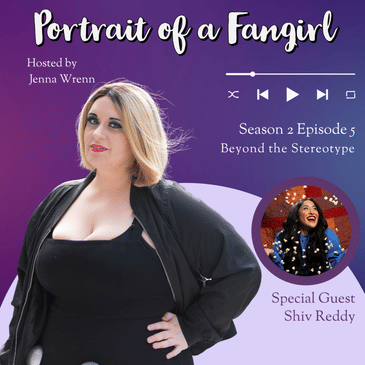
In the latest episode of Portrait of a Fangirl podcast, host Jenna Wrenn spoke with TikTok star and advocate for South Asian voices, Shiv Reddy.
The post Beyond the Stereotypes: How TikTok Star Shiv Reddy is Changing the Narrative appeared first on TEMPLE OF GEEK.
[00:00:00] Fortune of a Fangirl is a web series and podcast created by Temple of Geek.
[00:00:15] At the core of the project is the importance of telling the stories of women who have
[00:00:18] found inspiration, growth, and power through fandom.
[00:00:21] My name is Jenna Wren and I'm the host of Fortune of a Fangirl Podcast.
[00:00:25] And today I'm here with Shiv Reddy.
[00:00:26] Hi Shiv, how are you?
[00:00:28] I'm good.
[00:00:29] Thanks for having me.
[00:00:31] I am so excited to talk to you.
[00:00:33] This has been, we've had this in the works for a while.
[00:00:36] Yeah, it feels like that.
[00:00:38] I'm very excited.
[00:00:39] I'm glad you're here today to take time and tell us about your story a little bit.
[00:00:42] Yeah, excited to just hop into this.
[00:00:44] So can you please just start off and let our audience know a little bit about who
[00:00:48] you are?
[00:00:49] Yeah, so formally I am a photographer and with that comes a lot of time editing.
[00:00:55] So I got into watching a lot of TVs and TV shows and movies while editing a bunch
[00:01:01] of photos.
[00:01:03] That kind of turned into me providing recommendations on social media just to see,
[00:01:08] you know, putting a net out there to be like, are there any other people that are
[00:01:11] watching this show?
[00:01:12] Because I would love to know their thoughts.
[00:01:14] And then that kind of snowballed into me creating content on TikTok specifically
[00:01:19] covering a lot of projects that I was excited about that involves South Asian actors
[00:01:24] and stories, things that I hadn't really seen a lot of other people in the space
[00:01:28] cover because there are obviously so many other things to talk about in Hollywood.
[00:01:33] And then I also decided to focus a lot of my content on Indian cinema because I
[00:01:38] definitely saw that there was a need to talk about it.
[00:01:42] So that's kind of a little bit about me.
[00:01:45] Can you remember the first sort of content that you reviewed and put out there
[00:01:49] on the Internet?
[00:01:50] Yeah, on Instagram, I would do text reviews and it was a lot of like Netflix
[00:01:56] reality TV stuff originally.
[00:01:58] And then that kind of turned into the original series that they would put out like
[00:02:02] Squid Games, for example.
[00:02:04] Or there's a series on Amazon Prime called Made in Heaven that was one of India's
[00:02:08] first streaming series that really put it on the map, I would say that kind
[00:02:12] of was in a league of its own.
[00:02:15] And those are the ones that I feel like I got the most traction from.
[00:02:19] And I can remember thinking like, maybe I can make something out of this.
[00:02:23] Was there a specific time that this started?
[00:02:25] Because I noticed a lot of content creators I've spoken to over the course of
[00:02:29] this podcast all kind of say the same sort of thing in that COVID was kind of
[00:02:33] where they got their start because they were looking for something new.
[00:02:36] Yeah, it wasn't COVID for me initially.
[00:02:39] I started in 2017 with text reviews on my Instagram stories and it was
[00:02:43] super informal.
[00:02:44] So it wasn't really like it was going anywhere.
[00:02:47] And then COVID happened.
[00:02:49] And because I'm a wedding photographer, our industry got hit pretty bad.
[00:02:53] So I like many other people were at home watching a bunch of content.
[00:02:58] And I guess that's kind of when I started seeing that a lot of these types
[00:03:02] of creators were coming up, which is exactly what you're saying, right?
[00:03:04] Which is when that origination happened for a lot of them.
[00:03:07] And although I love binging their content, there was a part of me that
[00:03:11] felt like, man, why is no one talking about these projects that I feel so
[00:03:14] passionate about or that I personally am really excited to see?
[00:03:18] So I only started content on TikTok in 2022, but the inspiration behind it was
[00:03:24] because there was a surge of South Asian led projects and I knew that if they
[00:03:30] weren't going to talk about it, I would.
[00:03:31] So I just did.
[00:03:32] Well, that's such a great thing.
[00:03:34] It's one of those experiences you hear where people say, if you don't see
[00:03:37] what you want, create it.
[00:03:39] So if you're not seeing people who are talking about these projects, you
[00:03:43] create the space for it.
[00:03:44] Yeah.
[00:03:45] Definitely a Gandhi moment of be the change you want to see, for sure.
[00:03:48] Love that.
[00:03:49] What was the first moment that you really found yourself fan girling over something?
[00:03:55] Man, probably anything Disney Pixar related.
[00:03:58] I grew up watching a ton of Emma Millennial, so it's my one personality trait.
[00:04:02] But I also live in SoCal, so close to Disneyland.
[00:04:05] I've had a Disney pass pretty much my entire young adulthood.
[00:04:09] And ironically and also coincidentally, my first brand collaboration was with Pixar.
[00:04:15] So it felt very full circle for like me to have been a fan of something for so
[00:04:19] long and for it to align in a way where that was the first brand that reached out
[00:04:23] and recognized my talent and value.
[00:04:25] And I couldn't have asked for anything more than that.
[00:04:28] Oh, that must have been so exciting.
[00:04:29] I can imagine like the little child in you is probably.
[00:04:32] Yeah, so excited.
[00:04:34] Very happy about it.
[00:04:34] Yeah.
[00:04:35] Oh, that's awesome.
[00:04:36] What do you currently fangirl over?
[00:04:39] Oh, man.
[00:04:40] I fangirl over brown women winning.
[00:04:44] As simple as that sounds, I think because of the platform I have now, what I've gained
[00:04:50] insight into is the fact that, yeah, I was so alone in thinking that I was the one
[00:04:54] that needed all of this.
[00:04:56] And there are so many other people that want this type of content and want to
[00:04:59] discuss this and talk about representation in a more critical way so that we can get
[00:05:04] better representation over time.
[00:05:06] And I think that now it's just about supporting these projects, making sure
[00:05:10] that they're getting amplified in a way that studios clearly aren't putting
[00:05:14] money into sometimes.
[00:05:15] And being that voice for my generation, for generations to come of
[00:05:21] amplifying our stories and our voices.
[00:05:23] When you first started out, it sounds like it was kind of you were very
[00:05:27] much into these movies, these projects.
[00:05:29] Did you expect that so many people would want the same thing you do and
[00:05:35] would resonate with your work?
[00:05:36] No, not at all.
[00:05:37] I think when you're a creator online, you just expect hate, unfortunately,
[00:05:41] all the time.
[00:05:42] It's like the starter pack of putting your face online.
[00:05:46] So I kind of didn't really know at all what to expect.
[00:05:49] My first couple of videos, there was this trifecta of representation
[00:05:54] going on at the time.
[00:05:55] It was Bridgerton season two starring Simone Ashley and Turning Red starring
[00:06:01] Maitri Ramakrishnan as Priya, the first South Asian animated character.
[00:06:05] And then Miss Marvel, which was a huge deal for so many Pakistani girls
[00:06:10] that had never even seen that type of representation.
[00:06:13] So for me, it was more so about, OK, let me just put this out there
[00:06:18] and see if anyone else is interested.
[00:06:19] Like, there's got to be someone that's as stoked about this stuff as I am.
[00:06:24] And lo and behold, we have a huge, just speaking about Indians
[00:06:27] specifically, there's over a billion Indians on this planet.
[00:06:30] So I didn't think that my content would fall on deaf ears.
[00:06:34] I knew that it was going to hit somewhere.
[00:06:35] It was just a matter of, you know, trying to break into my specific niche
[00:06:40] of South Asian Americans specifically, right?
[00:06:43] That felt like there was this dearth of and this lack of talking
[00:06:47] about this type of representation and seeing someone that does look
[00:06:50] like them talk about it, right?
[00:06:51] Not some outsider that doesn't really understand the culture
[00:06:54] and the perspective that it brings.
[00:06:55] Right, right.
[00:06:56] So there were a lot of people who were looking for someone
[00:06:59] to fill that void in the Internet and in a critical way.
[00:07:02] When it comes to fangirl culture, have you noticed any trends
[00:07:05] or anything fascinating about the community?
[00:07:08] I have been really blessed, I feel like, to have a very supportive
[00:07:13] group of creators that are also fangirls.
[00:07:16] And that's kind of how we all found each other's content.
[00:07:18] It was around that same time that I was describing.
[00:07:20] Everyone was really excited for Bridgerton season two naturally.
[00:07:23] I mean, we all saw the season.
[00:07:24] I feel like it is that unification of finally getting to be seen
[00:07:29] in a very positive light about a series that so many people had been
[00:07:34] fanning over and finding now this niche group of people that see themselves
[00:07:39] in this character, that can understand the culture that's trying
[00:07:42] to be represented on screen and then getting to discuss that
[00:07:45] in a very critical way.
[00:07:47] But also just being like, look at us in this huge series right now
[00:07:50] that's being consumed globally.
[00:07:52] Isn't that amazing?
[00:07:53] This is just the start.
[00:07:54] There's so much more beyond that.
[00:07:56] And it really does feel like we're writing a very new wave
[00:08:00] of these types of stories and very diverse storytelling in general.
[00:08:04] So that's kind of what I've enjoyed the most about, you know,
[00:08:06] making friends on the Internet that have very similar interests to me
[00:08:09] or are part of the same, you know, like passionate
[00:08:12] projects that I want to amplify.
[00:08:14] Right. That's such a beautiful thing.
[00:08:16] We here are really impressed with how you've made a following
[00:08:20] by being both very informative and knowledgeable about film and television.
[00:08:24] But we were even more impressed by the way you champion representation,
[00:08:29] as you talked about in the film and television industry.
[00:08:32] Can you tell us about a specific moment or an experience
[00:08:36] that really ignited your passion for advocating for representation
[00:08:40] in film and television?
[00:08:41] Yeah, I think in order to talk about that, I need to talk about my career
[00:08:45] outside of film and TV because being a wedding photographer
[00:08:49] in a space that, number one, is very male dominant.
[00:08:52] And on top of that, doesn't have a lot of people that look like me
[00:08:55] as someone that is South Asian. I'm specifically Indian.
[00:08:59] We are raised to think that, you know, careers in the arts
[00:09:02] are not very valuable, like many cultures, unfortunately.
[00:09:05] So it's been a lot of like self advocating of,
[00:09:09] you know, trying to put myself in a space that is uncomfortable
[00:09:12] because there isn't really a lot of people that I can look up to
[00:09:15] as like a mentor or someone that's already paved the way
[00:09:18] as a photographer for me in the wedding space specifically.
[00:09:21] And that kind of just parallels
[00:09:25] what happened when I jumped to this industry.
[00:09:28] Like I said, I do follow tons of creators, you know,
[00:09:31] during the pandemic, when they first started really diving
[00:09:33] into this specific niche of talking about film and TV
[00:09:36] in a critical format.
[00:09:37] And it felt like they can do it.
[00:09:41] So why can't I?
[00:09:42] And again, because I think that in in the talk of global cinema,
[00:09:46] Indian film gets really left out of that conversation.
[00:09:50] But it's crazy because they produce probably the most amount of movies ever,
[00:09:55] like every year.
[00:09:57] So yeah, and there's also like a huge lack of miseducation
[00:10:01] in terms of like the fact that there are so many different
[00:10:04] regional industries in India and everyone kind of groups them all
[00:10:07] into one, which is Bollywood, which is the most recognized.
[00:10:10] But I actually come from the south of India, where there are three
[00:10:13] major film industries that put out just incredible content
[00:10:18] that's not as glitzy and glamoury as the stuff from Bollywood,
[00:10:21] but has a lot of heart and soul.
[00:10:23] And they just like never get the advertising money
[00:10:26] to really push to a lot of foreign audiences.
[00:10:29] And only now because of streaming, a lot of people are getting access to them.
[00:10:33] So for me, it was it was this twofold thing of
[00:10:37] I have to kind of grapple with this fact that I am an Indian American
[00:10:41] and I have these two identities, right?
[00:10:43] There's one side of me that wants people to understand
[00:10:46] that South Asian representation in Western media is sometimes
[00:10:49] misconstrued because of certain people that we have
[00:10:53] behind the lens that are writing these stories or maybe some of the content
[00:10:57] that they have to put out has to be approved for majority white audiences.
[00:11:01] So it's kind of being diluted.
[00:11:03] And there was this part of me that wanted to really dive deeper into it
[00:11:06] and explain to people like, this is what our culture is
[00:11:09] and this is kind of what it's being portrayed as.
[00:11:11] So that's led to some really amazing conversations on the representation front.
[00:11:15] But then it also led me to that understanding of people don't have
[00:11:19] this understanding of Indian cinema the way that I grew up loving and knowing.
[00:11:23] And I've taken it upon myself to really
[00:11:27] even broaden my own horizons and try to watch a bunch of films
[00:11:30] in different languages in order to educate people on the fact that
[00:11:33] there's so much out there that you could learn about
[00:11:37] various Indian cultures through our cinema,
[00:11:39] because it's such a huge facet of our culture.
[00:11:42] Music, cinema, dancing, all of it is like all encompassing
[00:11:46] as part of one component of our really rich culture.
[00:11:50] So it's it's kind of both things I have been trying, you know, to
[00:11:55] balance both of those worlds.
[00:11:57] And the craziest part is that TikTok is banned in India.
[00:12:01] So it's not like any of my content is really going to India,
[00:12:06] which is kind of I feel like my following base has been so
[00:12:09] varied across the board.
[00:12:11] And I have like a really diverse group of people, which I love.
[00:12:14] So can you tell me a little bit about what makes South Asian film
[00:12:18] different than the more recognizable and high profile Bollywood?
[00:12:23] Yeah. So South Asia represents seven different countries.
[00:12:28] And the most predominant film industry is Bollywood
[00:12:31] because they have the most marketing budget, which is great.
[00:12:34] Good for them.
[00:12:34] Unfortunately, that means that a lot of other countries get sidelined.
[00:12:38] I think there are over 20 different regional film industries in just India.
[00:12:42] That's not considering the other South Asian countries like Sri Lanka,
[00:12:45] Pakistan, Nepal, et cetera.
[00:12:47] And I largely grew up watching the three most prominent,
[00:12:52] which is Hindi, Telugu and Tamil.
[00:12:54] And they're all distinguished as Hollywood.
[00:12:57] Sorry, Bollywood.
[00:12:58] That is Hindi, Taliwood, which is Telugu and Hollywood, which is Tamil.
[00:13:03] I really don't like calling them by their American denotations,
[00:13:07] only because not a lot of people refer to them that way.
[00:13:10] It's more so just the language and then film industry.
[00:13:13] So those are the most predominant languages in India to produce films.
[00:13:17] They they produce a mass amount every single year.
[00:13:21] And, you know, just after, I think, 2022 when RR,
[00:13:26] which was the Telugu film that won the Oscar, really made waves in America.
[00:13:31] I think a lot of people are now way more curious to check out Indian cinema.
[00:13:35] So I definitely wanted to be a part of that wave as well.
[00:13:39] And I and I'm really glad that I just started on TikTok during that time.
[00:13:44] Perfect timing. Yeah, you were right there on the cusp of everything.
[00:13:48] Before social media, how did you express your frustration
[00:13:51] with the lack of diversity you saw on the screens?
[00:13:54] It was just having conversations with friends, you know, naturally.
[00:13:57] I would like to say that because fighting for people
[00:14:01] that look like me in spaces that aren't made for us
[00:14:04] has always been a part of my motto in life.
[00:14:06] I've had these types of conversations in different regards,
[00:14:10] whether it be the movies that we're watching
[00:14:12] and the culture that we're seeing on screen being misrepresented
[00:14:14] or even in the wedding space.
[00:14:17] You know, something that a lot of people don't consider is
[00:14:20] when you have a darker skin tone and a lot of the photo trends
[00:14:24] right now are meant to like whitewash people's skins
[00:14:27] using filters that are kind of filmic or
[00:14:30] desaturated, that doesn't really translate to a lot of
[00:14:34] melanated skin tones.
[00:14:35] And I almost see, you know, critically analyzing film
[00:14:40] from this aesthetic standpoint of considering that, as well as the,
[00:14:45] you know, contextual cultural standpoint of seeing what they're representing.
[00:14:49] So these conversations have always existed in my mind.
[00:14:53] And I'm very vocal about bringing it up with my friends
[00:14:56] just because I want people to be thinking about it.
[00:14:59] I think it's something that should be at the forefront of our minds,
[00:15:02] especially if we are in this generation
[00:15:05] that's bringing kids into this world.
[00:15:06] And we have nieces and nephews that are getting to see this content
[00:15:10] that we'd ever grew up with, right?
[00:15:12] That they have cartoon characters now that look like them
[00:15:15] that are representing cultural holidays that never existed for me as a kid.
[00:15:20] So even having conversations with, you know, my younger nieces and nephews
[00:15:24] about that has just been super enlightening for me.
[00:15:26] They don't have that lack of confidence that I had when I was growing up.
[00:15:30] They're just so proud in their skin.
[00:15:31] And that's amazing to see.
[00:15:34] It's such a beautiful thing.
[00:15:35] And it's great to see that younger generation not not
[00:15:39] when I think of the word, not struggling to see themselves on the screen,
[00:15:43] you know, like you did when you were younger.
[00:15:46] You didn't have these type of representations.
[00:15:48] But now the younger kids, they don't they don't know what that's like.
[00:15:50] Yeah. And it was it's also this like the economy of like
[00:15:54] the type of representation we had was stereotypical.
[00:15:57] So it's not like we definitely didn't have anything.
[00:15:59] We just had characters that made us feel ashamed of who we were
[00:16:03] or were being ragged and joked on or the butt of the joke.
[00:16:07] They were sidekicks.
[00:16:08] They were never the main character.
[00:16:10] And now it's just like a 180 for all of us.
[00:16:13] So it's really nice to see. I love that progress.
[00:16:17] I want to backtrack a little.
[00:16:18] I'm very interested in your career in wedding photography.
[00:16:22] How did you get into that field?
[00:16:24] Yeah, my grandfather super into cameras.
[00:16:27] So when I was in high school, he would always, you know,
[00:16:30] let me tinker around with some stuff.
[00:16:31] But I've always been in the arts.
[00:16:33] I'm a dancer.
[00:16:34] I started dancing at the age of five doing Indian classical dance.
[00:16:37] And then I became a contemporary dancer for my high school.
[00:16:41] And they needed a photographer for their shows.
[00:16:44] So while I wasn't on stage, I was shooting, just kind of getting practice in.
[00:16:49] And that kind of just transformed when I got to college and social media
[00:16:53] became a thing and everyone wanted cute profile pictures.
[00:16:56] And I always look back at this and laugh because this is literally how I got my start
[00:17:00] and also got to meet so many people
[00:17:02] because they literally just wanted new profile pictures.
[00:17:04] And I was like, yeah, I can take a picture for you.
[00:17:07] So I would just the rise, the rise of Facebook and social media.
[00:17:13] You kind of had to be there.
[00:17:14] It's it's so hard to describe it now to people,
[00:17:16] because I feel like Facebook is such an ick to so many.
[00:17:18] Oh, well, it's not.
[00:17:19] And after that, I was really grateful enough to build a community
[00:17:24] and of a lot of clients that live in SoCal here.
[00:17:28] And it just kind of my career in photography
[00:17:30] has just kind of blossomed in a really natural way as I've grown up.
[00:17:34] I started off doing a lot of like engagement sessions
[00:17:36] and smaller events for families.
[00:17:39] And then that turned into, you know, me doing weddings.
[00:17:43] I worked for a company for about seven years.
[00:17:46] That's just like a huge, huge wedding photography company here in SoCal.
[00:17:51] They shoot about 400 events a year.
[00:17:53] So it was it was pretty brutal.
[00:17:55] I lost a lot of not lost, but I invested a lot of my time
[00:17:59] into shooting a bunch of weddings and getting so much experience.
[00:18:03] And in some way, you know, kind of bring it back to representation.
[00:18:07] There was a part of me that in college
[00:18:10] felt really ashamed is not the right word.
[00:18:12] I definitely didn't wear my my identity with a lot of pride, my cultural identity.
[00:18:17] And when I started shooting weddings and specifically South Asian weddings,
[00:18:22] you just get so immersed in everyone's culture
[00:18:25] because our weddings have, you know, so much tradition
[00:18:30] a part of them there around four or five days.
[00:18:32] And you're around so much family.
[00:18:34] And I was exposed to so many diverse cultures within the South Asian diaspora
[00:18:39] that it was enlightening, to say the least.
[00:18:42] But also, I was like, why am I hiding my identity?
[00:18:46] Like everyone here is just wearing it with so much pride.
[00:18:49] And I not only learned more about my culture, but I was just
[00:18:53] so happy to be able to spend time with people
[00:18:56] and how willing they were to share information about their own
[00:18:59] background and their traditions and how it differs from my family's.
[00:19:03] So it was such an educational time for me.
[00:19:06] And that, again, just naturally just
[00:19:10] finds its way in a lot of the content that I create.
[00:19:13] You know, it is why I think I'm so curious,
[00:19:16] even when watching foreign film now that has nothing to do with my culture.
[00:19:20] It feels like I'm able to absorb and understand
[00:19:24] characters through the cultural contracts that they're providing.
[00:19:27] So you were basically kind of always looking for a creative outlet
[00:19:31] that really inspired you when it went from dancing, photography,
[00:19:35] all these this way through the arts.
[00:19:37] Yeah, I'm heavily leaning towards the right side of it.
[00:19:39] Is it right side? Right? Right side. Right.
[00:19:41] Yeah, very heavily right sided.
[00:19:43] I joke with my husband because he's heavily left sided.
[00:19:46] So we balance each other out a lot.
[00:19:47] But there is an analysis of me that doesn't want to create every single day.
[00:19:51] Like, I don't think I would I could be fulfilled if I wasn't able to.
[00:19:56] Totally. And I think of, you know, I always joke.
[00:19:58] I made the joke earlier today, actually, and I was like,
[00:20:01] I was a liberal arts student. I can't add.
[00:20:02] I can't do math. I'm not a lefty.
[00:20:05] I would make the joke that I'm Indian and I literally can't do math.
[00:20:08] So my biggest downfall for sure.
[00:20:10] I was never meant to be a corporate girlie.
[00:20:12] It could never be me. I just.
[00:20:14] Oh, never.
[00:20:15] Like I it's it's enough if you're asking me to like figure out
[00:20:18] someone's age based on like their birth year.
[00:20:19] And like that's that's about the extent of where I'm going to go.
[00:20:22] I was a history major. I wasn't I wasn't.
[00:20:24] I was really touching math when you started using social media
[00:20:28] to champion representation and talk about these films
[00:20:31] that you discussed that you loved so much.
[00:20:33] Did you anticipate the kind of following you would build that you have today?
[00:20:39] Not at all. No, I've been on Instagram doing wedding
[00:20:44] or just photo related content for years now, right?
[00:20:46] Since its origination.
[00:20:48] And I had only garnered like I know this is a lot for a lot of people,
[00:20:52] but for me in that space as a creator, it's not a lot.
[00:20:55] I only got like 8K followers,
[00:20:57] and that was over years of time of me investing into that app, you know,
[00:21:02] using hashtag strategy and really trying to gain a good following.
[00:21:07] And, you know, two months into TikTok, I got to 20K.
[00:21:12] And that was just mind boggling to me.
[00:21:15] It was so overwhelming to see that type of growth,
[00:21:17] to comprehend what that means, like to even see that
[00:21:21] I got like 10,000 views on something.
[00:21:23] I was like, I don't even know 10,000 people in real life.
[00:21:26] Like that's kind of crazy.
[00:21:28] So it never stops being overwhelming to me, even when I see videos blow up now,
[00:21:32] especially because I cover pretty niche content.
[00:21:35] You know, it's it's not every day you scroll on TikTok
[00:21:38] and you see a girl talking about Indian movies and want to stop and listen.
[00:21:42] And I'm always grateful that people choose to.
[00:21:44] So I think that there's a part of me that takes a lot of pride in that.
[00:21:47] But also it is really important because there's a lot of folks
[00:21:51] on social media that don't attach their face to this content.
[00:21:55] And it was really important for me when I was deciding between should I or shouldn't I
[00:21:59] that I should, because there aren't a lot of female reviewers out there,
[00:22:03] female movie critics.
[00:22:04] And when there are, they get crucified a lot of the time
[00:22:07] for having an opinion or especially in India.
[00:22:10] And I have to say this because I have so many people
[00:22:14] to look up to in this space now.
[00:22:15] But, you know, when I first started, it wasn't like that.
[00:22:18] And it's it's overwhelmingly joyous to be in company with those people
[00:22:24] and to have people associate me to, oh, like she must have watched this movie.
[00:22:30] Let me go to her page and see what she thinks.
[00:22:32] I wear that with a lot of honor and I never want to take that for granted.
[00:22:36] How has your online community impacted your advocacy
[00:22:40] and the way that you specifically fangirl?
[00:22:43] There's good and bad.
[00:22:44] I'll start with the bad.
[00:22:45] Everything on the Internet.
[00:22:46] With with being a fangirl comes really toxic fan boys.
[00:22:50] Not to make this a gender issue, but you know,
[00:22:53] you see a lot of this in the Marvel DC comic book world.
[00:22:57] But I want to talk about this specifically from the Indian movie standpoint,
[00:23:00] because in India there are a ton of I'll say specifically in South India.
[00:23:05] There are a ton of heroes, action heroes,
[00:23:09] just like you would have your superheroes here.
[00:23:12] But they're supposed to be ordinary men.
[00:23:13] They just have incredible powers.
[00:23:15] So they have a huge fan base.
[00:23:17] Rightfully so. I'm a part of those fan bases.
[00:23:19] I really do like these men.
[00:23:21] However, I am not above holding anyone accountable.
[00:23:24] And if they are starring alongside a girl that's,
[00:23:27] you know, 20 years younger than them, I will call them out.
[00:23:30] I have absolutely no problem with that.
[00:23:33] And, you know, I faced a lot of backlash,
[00:23:36] but the block button is my best friend.
[00:23:38] So absolutely no problem with that.
[00:23:41] But I will say that with the bad comes
[00:23:44] the people that do agree with my standpoint,
[00:23:48] that even if there are people that disagree, they say it in a respectful way.
[00:23:52] And I always appreciate that.
[00:23:53] I love a good constructive criticism moment.
[00:23:56] And ideally, I want to learn.
[00:23:58] That's the whole point.
[00:23:59] You know, I believe as a human, if we don't, if we stop learning,
[00:24:04] we stop evolving and I never want to stop evolving.
[00:24:06] Like, I think the wheel should constantly be turning.
[00:24:09] Cinema does that for me.
[00:24:10] Like, I feel like absorbing other people's cultures and getting insight
[00:24:13] into different cultures allows me to learn from the medium of filmmaking
[00:24:19] in a way that I don't think I just am not a book reader.
[00:24:23] So films really do it for me in that capacity,
[00:24:26] that the same way that a lot of people read books and they gain insight.
[00:24:29] And the fan the fandoms, regardless of who they are,
[00:24:33] have really helped me, you know, gain insight on things or like pick a part,
[00:24:37] you know, different analyses that I just didn't see on my first watch.
[00:24:41] A lot of the times I'm watching these things super fast and trying to get through them.
[00:24:44] So there's obviously these like minute details that I love when others pick up on.
[00:24:48] And the fact that they're just ordinary people, right?
[00:24:50] They're not creators.
[00:24:51] They're just people like you and me who are just watching this content,
[00:24:55] consuming it for the enjoyment of it.
[00:24:58] And that to me is always going to be the most rewarding type of banter
[00:25:03] back and forth is just people that are just here to have fun.
[00:25:07] Right. Do you often get people in your comments and your responses,
[00:25:12] stitches, what have you on various platforms of social media?
[00:25:16] Do you often get people who want to learn like you're saying,
[00:25:20] who reach out to you and are like asking you to explain
[00:25:25] something about the culture that they didn't know about?
[00:25:27] Yeah, I try my best to respond to every comment.
[00:25:30] I know that's like probably not a lot of people's best practices,
[00:25:34] but I think it's a great way to engage with people.
[00:25:36] And like I said, I'd like to learn from others.
[00:25:38] I do not have my stitches on specifically to protect my piece.
[00:25:41] I don't like my face being spread without my without my consent.
[00:25:45] And I do love talking to people, though.
[00:25:49] Like that's kind of how it all started for me, right?
[00:25:51] It all started in my DMS because I would post stories.
[00:25:54] There was no other way for people to interact.
[00:25:56] It was it was before the emojis would pop up
[00:25:58] and you could just pick one of the six emojis to respond to my story.
[00:26:00] It was like you had to text me something back. Right.
[00:26:03] And that's that was how it all started for me.
[00:26:06] There was people from across the world that I had never met in my life
[00:26:09] that would slide into my DMS in a positive way and talk to me about,
[00:26:15] oh, my gosh, this is what you thought about that character.
[00:26:17] So did I. I thought I was the only one.
[00:26:19] And it's it's stuff like that.
[00:26:20] It makes you feel so seen as someone that is just consuming content.
[00:26:25] And it all it all stems from the fact that I have a very similar
[00:26:29] background and experience to them.
[00:26:31] So they never really saw anyone that looked and was raised like me
[00:26:35] talking about media that was on screen. Right.
[00:26:37] It makes you a relatable person in social media.
[00:26:41] You're not distanced from, you know, the millennial generation or even Gen X.
[00:26:46] You're very much accessible. Yeah.
[00:26:48] Ideally, I do.
[00:26:50] I do think that's a huge component about being a creator.
[00:26:53] Have you seen any tangible changes in the industry in the past few years?
[00:26:57] Definitely. I always think of representation as baby steps,
[00:27:01] even though people want to see it as like leaps and bounds,
[00:27:03] which is what we need.
[00:27:04] Of course, we need massive overhauls pretty much all across the board.
[00:27:08] But it's it's frustrating when it comes to cultural representation,
[00:27:12] because it all kind of dwindles down to being on one single person's
[00:27:16] shoulders a lot of the time.
[00:27:17] You know, Mindy Kaling gets a lot of flack for this.
[00:27:20] She's just one brown woman.
[00:27:22] And there's no way that she can represent the experience
[00:27:25] of seven different countries on her back.
[00:27:27] And that's why we need more people behind the lens.
[00:27:29] It's it's something I bring up quite frequently when I talk about media
[00:27:33] is that we focus a lot about what we see on screen,
[00:27:36] but it's actually what's behind the camera.
[00:27:38] The writers, producers, directors behind a lot of this production
[00:27:42] that we need to change.
[00:27:45] And that unfortunately comes from the hard part about this
[00:27:49] is that it comes from us encouraging a new generation of people
[00:27:53] to enter these spaces. Right.
[00:27:55] As I mentioned, like as a creative,
[00:27:57] I was never really encouraged to be a photographer or get a career in the arts.
[00:28:01] And it's amazing and incredible to see that change happening right now
[00:28:06] in this new generation.
[00:28:08] And it's it's something I really want to support.
[00:28:10] I'm trying my best to like find ways to do that.
[00:28:13] And, you know, whether it be, you know,
[00:28:15] people that are making small films right now or just putting out scripts
[00:28:18] and trying to get their name out there.
[00:28:20] I hope they continue because there are hope for better representation. Right.
[00:28:25] And I think I think, you know, you're a millennial as well.
[00:28:27] And I think it's a product of our generation where we were raised
[00:28:31] to think, oh, what are you going to do with that sort of degree?
[00:28:34] What are you going to do with an arts and arts and liberal arts degree?
[00:28:38] You know, we were raised to think you go into a field
[00:28:40] that's almost like a capitalistic sort of point of view.
[00:28:44] And it's nice to see that, to see people embracing now
[00:28:48] our generation, the younger generations, embracing creativity
[00:28:51] and expanding their horizons.
[00:28:53] Yeah. And as as much flack as social media gets,
[00:28:56] I do think that it's been such a great outlet for so many to pursue careers
[00:28:59] in the arts.
[00:29:00] You're getting reach that you've never even dreamt of before,
[00:29:04] whether it be singers that are putting out their songs or,
[00:29:07] you know, actors.
[00:29:08] How is advocating for representation changed you as a person?
[00:29:13] I think it's made me more aware of what I consume and how I consume it,
[00:29:19] especially about other cultures.
[00:29:20] Like, it makes me want to ask more questions and and get to know
[00:29:23] other creators that are from these different cultures,
[00:29:26] just because I know what it feels like to be misrepresented.
[00:29:29] And I wouldn't wish that upon anyone else
[00:29:32] because I know the ramifications in real life.
[00:29:34] What I love noticing is how these brands and studios
[00:29:38] are making the effort to work with creators
[00:29:42] in order to properly represent the media that they're putting out.
[00:29:46] You know, most recently, this happened for me in Monkey Man.
[00:29:48] I got the opportunity to interview Dave Patel,
[00:29:51] and it was all because they recognized the value that I provide
[00:29:55] as someone that is a part of the culture that's being represented in the film.
[00:29:58] It meant the world to me.
[00:29:59] And I know that it also was so inspirational for so many to see
[00:30:03] that something like that is even possible
[00:30:05] and that it's worth talking about the things that you're passionate about.
[00:30:09] Definitely. There's always a space for that.
[00:30:12] I find that you can tell when someone is really passionate about someone,
[00:30:17] and it draws you to that.
[00:30:19] You want to learn more about them, more about what they're also passionate about.
[00:30:22] What was your life like before you started transitioning
[00:30:25] into podcasting and TikTok influencing?
[00:30:28] It was a lot less chronically online.
[00:30:30] That was for sure.
[00:30:31] I would love to say that it was less hectic and chaotic,
[00:30:34] but it was it was the same.
[00:30:36] It was just balanced out more with photography than it was now.
[00:30:39] I because weddings take up so much of my time.
[00:30:42] I was just constantly shooting.
[00:30:44] And again, just being able to experience my culture
[00:30:47] and other cultures in a way that I just never thought I would be able to.
[00:30:52] So in a way, it was kind of the same, but a little bit different
[00:30:55] and less involving TikTok.
[00:30:57] Right. It's just the added the added experience
[00:31:00] of having these online platforms to maintain.
[00:31:03] So speaking of these online platforms and social media,
[00:31:06] you touched on this a little earlier about how a lot of times
[00:31:10] having a presence online comes with negative comments.
[00:31:14] Trolls, these sort of ugly things.
[00:31:18] How do you stay positive and motivated when you are faced
[00:31:22] with these sort of comments who disagree or sometimes
[00:31:25] are even just blatantly rude?
[00:31:27] I think that I know my intentions, right?
[00:31:30] That's so important when you're doing something like this.
[00:31:32] Everything I do is with intentionality.
[00:31:34] I want to make sure that the brand partnerships that I take on are
[00:31:38] are very implied of who I stand with and what I stand for.
[00:31:42] And I think that that's always going to come with some type of vitriol,
[00:31:47] no matter who you are and what you try to do, even if it's in your best intentions.
[00:31:52] And I think that I just try to focus on the fact that I'm trying to do good here.
[00:31:57] The overall goal of my content is to spread awareness.
[00:32:00] It's to spread a lot of love for my culture and my people.
[00:32:04] And it's to educate myself.
[00:32:07] I want to grow.
[00:32:07] I'm not I'm never going to come on here and be like,
[00:32:10] I know everything and I'm the master of this domain.
[00:32:12] I think that's foolish.
[00:32:14] So I feel like, you know, if you're not here to grow, then,
[00:32:17] like I said before, I'm all about evolving.
[00:32:19] And I think that social media is as scary of a place as it can be.
[00:32:23] It's such a great place to learn to us in a way that we've never had
[00:32:27] access to people from around the world.
[00:32:30] Perspectives that you could never be able to,
[00:32:35] you know, read about or or just again, get access to.
[00:32:38] Right. And I like how earlier you said you're not afraid to use that block button.
[00:32:42] I think a lot of people are.
[00:32:44] I've noticed that some people are a little more hesitant
[00:32:47] because they don't want to, you know, come up a certain way.
[00:32:50] I personally I have I don't have a following even remotely close to yours,
[00:32:53] but I am not afraid to hit the block.
[00:32:55] I don't know who said this.
[00:32:56] There was a creator that I was watching really early on into my career.
[00:33:00] And they mentioned that, you know, if someone is knocking at your door at 7 a.m.
[00:33:05] and they're screaming some crazy things at you about your character
[00:33:08] and all of this, would you let them in your house?
[00:33:11] And I'm one of those people that wakes up and checks
[00:33:13] Tick Tock immediately because it is a part of my job.
[00:33:15] And I thought about that one morning when I was looking at my comments
[00:33:18] and I'm like, they're so right, like I would never let that person in.
[00:33:22] So why am I letting them into my mental space?
[00:33:24] And it was just kind of that moment of, OK, well,
[00:33:27] that means I'm just going to delete the common block.
[00:33:29] And then that it's like it never existed, you know.
[00:33:31] So it's great. It's a great philosophy to adapt.
[00:33:35] Oh, such a great way of looking at things.
[00:33:37] I never heard that one before and I love it.
[00:33:39] I wish I knew who I could credit it to.
[00:33:41] So as you mentioned, being online sometimes can be really mentally taxing.
[00:33:45] How do you prevent yourself from being burned out?
[00:33:49] I take breaks.
[00:33:50] I think when you initially start out, you want to post every single day.
[00:33:53] And I don't blame people for that.
[00:33:55] I just don't think I've ever been that kind of person.
[00:33:57] I think also because media requires time to like let it sit
[00:34:00] and sink in and analyze.
[00:34:02] And I've always wanted to not be a slave to the system of like,
[00:34:08] oh, this movie just came out.
[00:34:09] I have to put content out about it.
[00:34:11] There are definitely really popular projects that I know that I'm going
[00:34:14] to get the best traction and views if I do put it out in the first couple
[00:34:17] of days. So I try my best.
[00:34:19] But I also want to enjoy the stuff that I'm watching.
[00:34:22] Just like I mean, that is the best part about being a fan girl, right?
[00:34:24] Is that you you have been looking forward to this
[00:34:27] like the new Bridgerton season, like I'm so looking forward to it.
[00:34:30] But I also know that there is a little bit of pressure
[00:34:32] to put out a review pretty quickly and thoughts on the season.
[00:34:35] So there's just, you know, finding that balance.
[00:34:37] And I take breaks for sure.
[00:34:40] I like to travel a lot and I think that that helps me.
[00:34:42] And the best part about travel is that I can download a lot of content
[00:34:45] while I'm traveling and I can watch that.
[00:34:47] So I'm still kind of working and taking a step away from creating.
[00:34:51] It makes me fall back in love with the art of filmmaking.
[00:34:54] And I think that that's again, intentionality wise,
[00:34:57] that's always been what I went into this space for,
[00:35:00] was to appreciate that art and just find my own way to talk about it.
[00:35:04] Right. It's not being so attached to the algorithm of things.
[00:35:09] Otherwise, like you said, do you where do you
[00:35:13] find that enjoyment when you're producing like that?
[00:35:17] I mean, more power to the people that do.
[00:35:19] I just can't be that person. Right.
[00:35:20] It's I would imagine it's different for every everyone, every content creator.
[00:35:24] Some people probably thrive that way, where they see something and they,
[00:35:28] oh, I got to jump online and quickly write about it.
[00:35:29] That's that's I'm sure how some people work.
[00:35:33] But just for you, that's not your specific best way to do things.
[00:35:38] Looking ahead, what are some of your biggest hopes
[00:35:40] for the increase of diversity and inclusion on screen?
[00:35:44] You know, we talked a little bit about all these different South Asian countries,
[00:35:46] and that's something that I'm really hopeful and
[00:35:50] passionate about seeing more of on screen.
[00:35:52] That all starts with getting better representation behind the lens first,
[00:35:55] of course. But, you know, I recently went to South by Southwest
[00:35:59] and there was such a diverse selection of films at that festival
[00:36:03] from various South Asian countries, whether it be Sri Lanka, Pakistan, India.
[00:36:08] And I was enamored.
[00:36:12] I was like, if this is what our future looks like, I'm so grateful
[00:36:15] that more people are trying to get careers in these industries
[00:36:18] so that we get to see these types of stories and characters unfold.
[00:36:22] And I would also just love to see, you know,
[00:36:26] we focus a lot about cultural representation in today's landscape.
[00:36:29] And I actually just want to see more people that look like me doing regular things.
[00:36:34] I say this a lot on different interviews, and I feel like it
[00:36:37] maybe isn't as straightforward as people are thinking,
[00:36:40] but it is what I'm saying.
[00:36:42] Simply, I just want to see brown people doing regular things.
[00:36:46] I just don't need them to be culturally rooted all of the time.
[00:36:51] I do think that's very important that we see those types of stories as well.
[00:36:53] But there's something that's so joyous in something like a main character
[00:36:57] that looks like you and just being able to relate to them on a very basic level.
[00:37:01] Right. They can be special by simply existing.
[00:37:04] They don't have to be a superhero or something.
[00:37:06] Great. What advice would you give to someone who is passionate
[00:37:10] about using their voice for change, and especially in the world of social media?
[00:37:15] To be honest, I think that, you know, when you're in the social limelight,
[00:37:21] there's this maybe there's this, you know, innate nature in you
[00:37:24] that wants to people please or service a fan base,
[00:37:28] service an IP company to make sure that you're seen by them.
[00:37:33] I've just never thought that that would feed the artist in me.
[00:37:37] So I never have done it.
[00:37:39] I've always known that, you know, I don't have a lot of skin in this game.
[00:37:41] I'm not trying to be an actor.
[00:37:42] I'm not trying to be a producer or director.
[00:37:45] I don't really have any of those types of goals.
[00:37:47] I just want to talk about the things that I love.
[00:37:49] And that comes with a lot of integrity and honesty.
[00:37:53] And, you know, like we talked about earlier,
[00:37:55] I think that is what makes me very relatable to a lot of people
[00:37:58] because I don't, you know, for lack of better term,
[00:38:01] I don't really sugarcoat things.
[00:38:02] I like to talk about things very blunt and straightforward,
[00:38:06] call people out if I need to, because I at the end of the day
[00:38:09] just want what's best for us.
[00:38:11] And that's usually proper representation, very accurate representation.
[00:38:15] That's great.
[00:38:16] That's this has been such a wonderful and eye opening conversation for me.
[00:38:20] And really, I thank you for coming on today and talking to me
[00:38:24] and sharing your experiences with us.
[00:38:26] These are great questions.
[00:38:27] I loved I loved having this chat with you, honestly,
[00:38:30] and just like taking the time to get to know me is always nice.
[00:38:33] So thank you.
[00:38:34] Well, thank you.
[00:38:35] I really like I said, this has been great.
[00:38:37] I hope that, you know, in the future, we can possibly
[00:38:41] see each other and do something more for a portion of the family.
[00:38:43] That would be great.
[00:38:44] Well, Jim, can you please let us know where our listeners can find you?
[00:38:48] I mean, you can find me on Instagram and TikTok at chivalry underscore ink.
[00:38:53] That's chivalry spelled S.H.I.
[00:38:56] V.A. L.R.Y. underscore INC.
[00:38:59] Excellent. And make sure you give ship a follow.
[00:39:01] Thank you so much again.
[00:39:03] I really appreciate it today.